
Gold vs Equity: Which is Better for Long-Term Wealth?
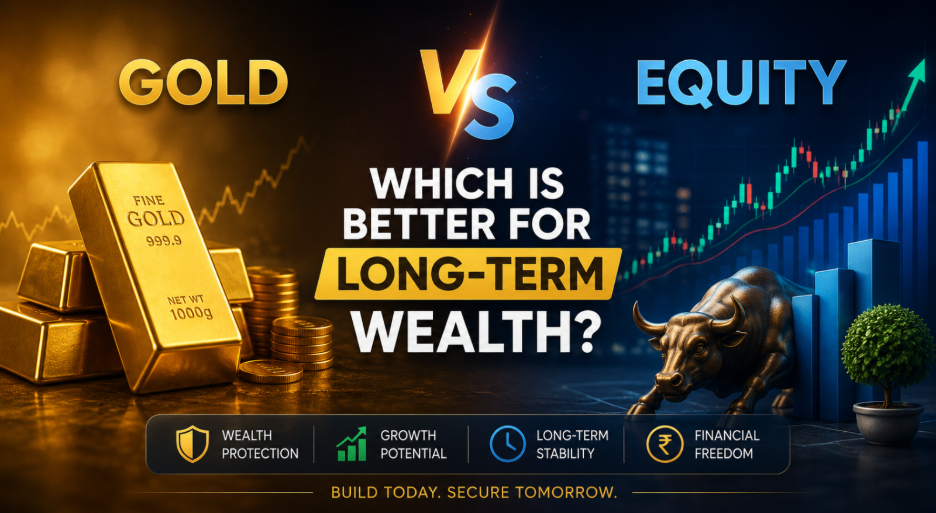
Every Indian investor runs into this question sooner or later. Should you buy gold or should you put your money into equity? Your grandfather probably swore by gold. Your finance influencer on Instagram probably swears by index funds. Both have a point, and both are missing half the picture.
This is not a question with one right answer for everyone. It depends on your goal, your timeline, and how much market volatility you can stomach without losing sleep. Let us break down the numbers and see what actually works for long-term wealth creation.
Most investors do not make this decision based on data at all. They make it based on habit. Families that have always bought gold during festivals keep buying gold. Young professionals who grew up watching the Nifty on business news channels default to equity. Neither group is wrong, but neither is thinking it through properly either. Before you put your next lakh of savings into one asset or the other, it helps to actually understand what each one has delivered, what it costs you, and what role it should play in your financial plan.
Gold: The Old Reliable
Gold has held its place in Indian households for generations, not just as jewellery but as a financial cushion. It is the asset people turn to when everything else feels uncertain.
How gold has actually performed
Over the last 25 years, gold has delivered a CAGR of around 11.5 percent. That is not a small number. During the 2008 financial crisis and again in 2020, gold held its ground and even surged while equity markets fell sharply. This is exactly why gold earns the label of a safe haven asset.
Say you had invested 1 lakh rupees in gold two decades ago. That amount would have grown to roughly 15.5 lakh rupees today. Respectable growth, and it came with far less drama along the way.
Look closer at the crisis years and the pattern becomes even clearer. In 2008, when the Sensex fell by nearly half in a matter of months, gold prices in India rose steadily through the same period. Investors who held gold that year did not just avoid losses, they actually came out ahead while equity portfolios were bleeding. The same thing played out in 2020 during the early months of the pandemic. Equity markets crashed hard in March, then recovered over the following year, but gold had already climbed to record highs by August that year, giving nervous investors a place to park their money without watching it shrink.
The different ways to hold gold
Gold today is not just the jewellery sitting in your locker. You have several options, and each comes with its own cost structure.
Physical gold in the form of jewellery or coins is the most familiar but also the least efficient. Making charges alone can run 8 to 25 percent depending on the design, and you still pay GST on top of that. Selling it back rarely gets you the full market rate either.
Gold ETFs track the market price of gold and trade on the stock exchange like a share. They skip the making charges and storage worries, though you do need a demat account to hold them.
Sovereign Gold Bonds, issued by the Reserve Bank of India, are usually the smartest route for long-term investors. You get the price appreciation of gold plus a fixed 2.5 percent annual interest, and there is no making charge or GST involved. Hold them to maturity and the capital gains are tax free as well.
Why people still buy gold
It hedges against inflation. When the rupee loses purchasing power, gold prices tend to move up, protecting the real value of your savings.
It diversifies your portfolio. Gold does not move in step with the stock market. When equities fall, gold often holds steady or rises, which balances out your overall risk.
It performs well in a crisis. Wars, recessions, currency devaluation, gold tends to hold its value when confidence in other assets takes a hit.
Where gold falls short
Returns lag behind equity over the long run. History shows gold usually cannot keep pace with stock market growth over a 15 or 20 year horizon.
No income along the way. Gold just sits there. It does not pay you a dividend or generate any cash flow while you hold it.
Physical gold comes with hidden costs. Making charges, GST, and locker or security expenses quietly eat into your actual returns.
Equity: The Wealth Building Engine
Buying equity means buying a piece of a business. And businesses, unlike a bar of gold, can grow, innovate, expand, and compound your money over time.
How equity has actually performed
Over the past 20 years, Indian equities have delivered annualised returns of about 14.6 percent. That same 1 lakh rupees invested two decades ago would be worth close to 15.2 lakh rupees today, and that is before accounting for dividends reinvested along the way.
Zoom out further. Over a 40 year window, equities have beaten gold in 64 percent of all rolling 10 year periods. That is the power of compounding paired with genuine economic growth, not just price appreciation.
The real advantage of equity shows up most clearly when you invest regularly instead of putting in a lump sum. Take a monthly SIP of 10,000 rupees into a diversified equity mutual fund. Kept up consistently for 20 years at an assumed 13 percent annual return, that habit alone would grow into roughly 1 crore rupees, and the total amount you actually put in over those 20 years would only be 24 lakh rupees. The rest comes purely from compounding. This is why so many financial advisors keep repeating the same advice: start early, stay consistent, and let time do the heavy lifting rather than trying to pick the perfect stock or the perfect entry point.
Why equity wins over decades
Higher returns over time. Across almost every long stretch you study, equity outpaces gold.
Dividend income. Many companies pay out a share of profits regularly, which gold simply cannot offer.
A natural inflation hedge of its own. Businesses can raise prices when costs go up, which protects their margins and, in turn, your investment.
The catch with equity
Volatility is real. Markets can drop 20 or 30 percent in a matter of weeks, and that is hard to sit through if you check your portfolio every day.
It demands patience. The 14.6 percent figure is an average across decades, not a guarantee for any single year. You need to stay invested through the rough patches.
It is tied to the broader economy. Corporate earnings, interest rates, and GDP growth all move the needle on your returns.
Risk and Volatility, Side by Side
Gold moves slowly. It rarely gives you dramatic returns in a single year, but it also rarely gives you dramatic losses. Equity is the opposite. It can hand you 20 percent gains one year and a double digit loss the next, but the long-term trend has consistently pointed upward for those who stayed invested.
| Asset Class | 10-Year CAGR | 20-Year CAGR | Volatility |
|---|---|---|---|
| Gold | 8 to 10% | ~11.5% | Low |
| Equity | 12 to 14% | ~14.6% | High |
Tax Treatment: An Often Ignored Factor
Returns on paper rarely match returns in your bank account, and taxes are usually the reason why. This is a step people skip when they compare gold and equity, and it can quietly change which asset actually serves you better.
For equity, if you sell your mutual fund units or stocks after holding them for more than a year, any gains above 1.25 lakh rupees in a financial year are taxed at 12.5 percent as long-term capital gains. Sell before a year is up and short-term gains are taxed at 20 percent, which is one more reason patience pays off with equity.
Gold works differently depending on which form you hold. Physical gold and gold ETFs held for more than two years qualify for long-term capital gains at 12.5 percent, similar to equity. Sovereign Gold Bonds are the most tax friendly of all, since the capital gains are entirely tax free if you hold them until maturity, which is eight years from the date of issue.
This is one more reason Sovereign Gold Bonds tend to make more sense than physical gold for anyone using gold as a long-term holding rather than for personal use.
The Psychology Behind the Choice
Numbers only tell half the story. The other half is about temperament, and this is where a lot of investors get tripped up.
Gold feels safe because you can see it, weigh it, and lock it away. That comfort is real, but it is also emotional rather than financial. Equity, on the other hand, feels risky precisely because the value moves every single day and you can watch it happen on your phone. This constant visibility is what causes people to panic sell during a downturn, lock in their losses, and then miss the recovery that usually follows.
The investors who do well with equity over the long run are rarely the smartest stock pickers. They are usually just the ones who stopped checking their portfolio every day and let their SIPs run quietly in the background for years. If you know that a market crash will make you lose sleep and sell in a panic, that is useful information about yourself, and it might mean a slightly higher gold allocation is the right call for you personally, even if the pure math favours equity.
So Which One Actually Builds Long-Term Wealth?
If wealth creation is your goal and you have a decade or more on your side, equity comes out ahead. The numbers back it up and so does history. Gold plays a different role. It is not there to grow your money aggressively, it is there to protect what you already have when markets get shaky.
A sensible approach that many financial planners recommend is a split of around 75 percent equity and 25 percent gold. This keeps your portfolio growth-oriented while giving you a cushion against volatility.
What Should You Actually Do
If you are investing for the long haul, put equity at the center of your portfolio. Systematic investment plans in index funds or diversified mutual funds let you build this exposure gradually without trying to time the market.
If market swings genuinely worry you, keep a smaller allocation, somewhere around 5 to 10 percent, in gold. Sovereign Gold Bonds are usually a smarter route than physical gold since they skip the making charges and also pay you interest.
If you want the best of both, blend the two. Equity drives the growth, gold smooths out the ride.
Frequently Asked Questions
Is gold a better investment than equity in India? Not over the long term. Gold has delivered close to 11.5 percent CAGR over 25 years, while Indian equities have delivered around 14.6 percent over 20 years. Gold works better as a hedge and stabiliser, not as your main growth asset.
How much gold should I hold in my investment portfolio? Most financial planners suggest keeping gold between 5 and 15 percent of your total portfolio, mainly for diversification and protection against inflation or economic shocks.
Does equity always beat gold over 10 years? Not in every single 10 year window, but historically equity has outperformed gold in the majority of rolling 10 year periods, roughly 64 percent of the time over the last four decades.
What is a good gold to equity ratio for long-term wealth creation? A commonly recommended mix is 75 percent equity to 25 percent gold, though this should shift based on your age, risk appetite, and how many years you have until you need the money.
Is Sovereign Gold Bond better than physical gold? Yes, for most investors. Sovereign Gold Bonds avoid making charges and storage costs, and they pay an additional interest, something physical gold cannot offer.
How is gold taxed compared to equity in India? Long-term equity gains above 1.25 lakh rupees a year are taxed at 12.5 percent. Physical gold and gold ETFs held over two years are also taxed at 12.5 percent, while Sovereign Gold Bonds held till maturity are completely tax free on capital gains.
Should I invest in gold or equity during a market crash? A crash is usually not the time to change your strategy from scratch. If you already hold a mix of both, let your gold allocation absorb some of the shock while continuing your equity SIPs, since falling markets are often when equity units get bought at a lower cost.
The Bottom Line
Gold protects, equity grows. That is the simplest way to remember this. If your priority is building serious long-term wealth, equity deserves the bigger share of your portfolio. Gold still has a place, just not the leading one. Keep a modest allocation for balance, stay invested through the noisy years, and let compounding do the rest of the work.