
Loan Against Property vs Personal Loan: Which Should You Choose?
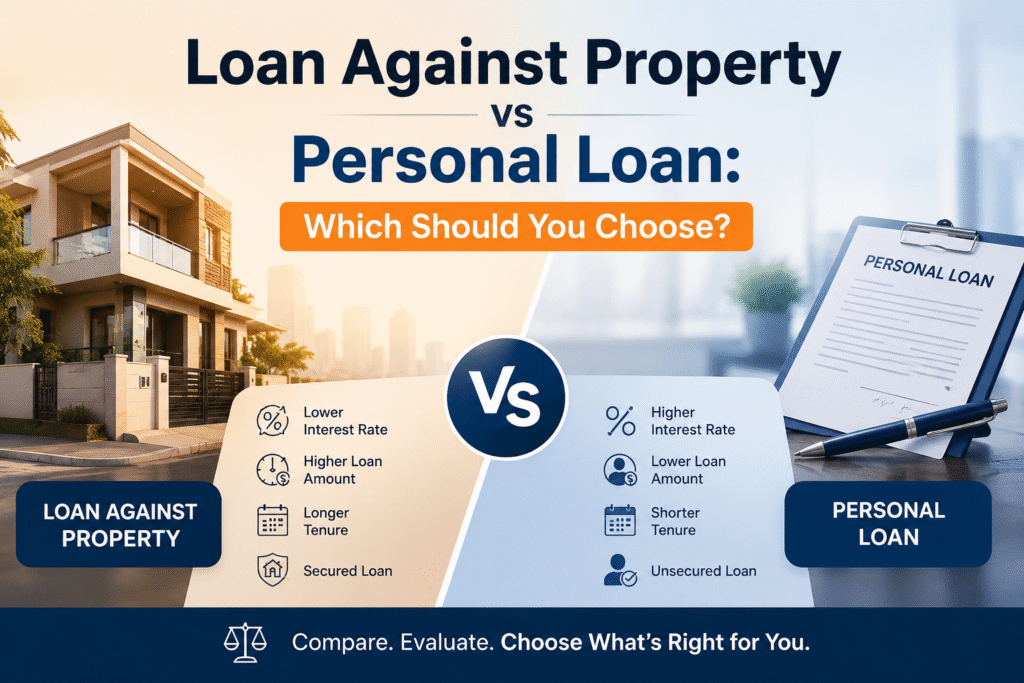
Money troubles rarely announce themselves in advance. A medical bill, a child’s admission fee, a business opportunity that will not wait, or simply the wish to consolidate three credit card dues into one manageable payment. These situations push many Indians toward borrowed money. And once that decision is made, a second question follows close behind: should the loan be secured against property, or should it be an unsecured personal loan?
Both routes put cash in your hand within days. Both come with EMIs, processing fees, and fine print worth reading twice. But they are built on different logic, and choosing the wrong one can cost lakhs over the years, or worse, put a roof over your head at risk. This article walks through the real differences between a loan against property (LAP) and a personal loan, using current interest rate data, tenure comparisons, tax rules, and the kind of practical judgment that a bank brochure will never spell out for you.
What a Loan Against Property Actually Is
A loan against property, sometimes called a mortgage loan, is money you borrow by pledging a residential, commercial, or industrial property you already own. The property does not change hands and you continue to live in it or rent it out; the lender simply holds a charge on the title until the loan is repaid in full.
Because the bank has something solid to fall back on if repayment fails, a LAP is treated as a secured loan. That single fact shapes almost everything else about it: the interest rate, the loan amount, the tenure, and even how relaxed the lender is about your credit score.
Lenders in India typically finance up to 60-70% of the property’s market value, and in some cases the loan size can run into several crores, making LAP one of the largest loan amounts an ordinary salaried or self-employed individual can access without starting a company or pledging gold.
What a Personal Loan Actually Is
A personal loan is the opposite in structure. There is no collateral, no property valuation, no lawyer combing through your title documents. The bank looks at your income, your employment stability, your existing debts, and your credit score, and decides how much it is willing to lend purely on the strength of your promise to repay.
This absence of security is exactly why personal loans move faster, often disbursed within a day or two, but also why they cost more. The bank is taking on more risk with nothing but paperwork to secure its money, and that risk is priced straight into the interest rate you pay.
Interest Rate Comparison: The First Number Everyone Checks
This is usually the deciding factor for most borrowers, and rightly so, since interest determines your monthly outgo for years.
As of 2026, loan against property interest rates in India generally start anywhere from 8% to 9.5% per annum at the lower end, with most borrowers realistically falling in the 9-15% range depending on credit profile, property valuation, and loan amount. Lenders such as Bajaj Finance and Bajaj Markets currently advertise starting rates near 8-8.5%, while several banks including SBI, HDFC, PNB Housing, and Canara Bank offer rates below 9.5% to well-qualified applicants.
Personal loan interest rates sit noticeably higher. Top private banks such as HDFC, ICICI, Axis, and IndusInd have been pricing personal loans from around 9.99-10.99% for borrowers with excellent credit, but the wider market range runs from about 10% to 28% per annum. NBFCs serving the near-prime segment, meaning applicants with a CIBIL score between 650 and 700 or a thin credit file, often charge 14-18% or higher.
The gap widens quickly once your credit score is not pristine. A borrower with a CIBIL score above 780 might be quoted a personal loan at 10%, while someone at 680 could easily see 17% or more for an identical loan amount and tenure. That difference, on a five lakh rupee loan over three years, can add up to fifty thousand rupees or more in extra interest. A loan against property does not eliminate this credit-based pricing entirely, but the presence of collateral usually keeps the spread narrower and the ceiling lower.
Loan Amount and Tenure: How Much and For How Long
A loan against property wins comfortably here. Since the loan is backed by a tangible, valuable asset, banks are willing to sanction large sums, often ranging from a few lakhs up to ten crore rupees or more, depending on the property’s worth. Repayment tenure is equally generous, frequently stretching to 15, 20, or even 25 years, which keeps the EMI manageable even on a sizeable loan.
Personal loans operate on a much smaller canvas. Loan amounts typically cap out around fifty lakh rupees for the best-qualified applicants, and repayment tenure rarely goes beyond five to seven years, with a handful of lenders extending to eight years. This shorter tenure means personal loan EMIs are higher relative to the loan size, even before accounting for the steeper interest rate.
If your requirement is a large sum, say for business expansion, buying commercial space, or funding an expensive medical procedure, a loan against property is built for that scale. If you need a smaller, quick amount for a wedding expense, a gadget purchase, or bridging a short cash flow gap, a personal loan’s smaller ticket size and faster process fit better.
Processing Time: Speed Versus Patience
Here the personal loan has a clear edge. Since there is no property to value, no title search, no legal opinion, and no mortgage registration, personal loans can be approved and disbursed within 24 to 48 hours for applicants with clean paperwork and a strong credit score. Many lenders now offer instant, app-based approval for pre-qualified customers.
A loan against property involves several additional steps: property valuation by the bank’s empanelled valuer, verification of ownership documents, a legal check for any existing encumbrance, and finally the creation of a mortgage. Depending on the lender and how organised your paperwork is, this process can take anywhere from one to three weeks, sometimes longer if the property has multiple owners or unclear title history.
If your need is urgent, a medical emergency, an unexpected travel requirement, or a payment deadline that cannot wait, a personal loan’s speed often matters more than its higher cost.
Credit Score and Eligibility: Who Gets Approved More Easily
Personal loans are heavily driven by your CIBIL score. Most lenders expect a score of 700 or higher for a reasonable rate, and anything above 750 to 780 puts you in line for the lender’s best-advertised rate. Below 650, approval itself becomes uncertain, let alone a good rate.
A loan against property is more forgiving on this front. Because the lender holds the property as security, some institutions are willing to work with borrowers whose credit score is not perfect, as long as the property value and ownership documents are in order. A commonly cited minimum CIBIL score for LAP approval is around 650, somewhat lower than what many personal loan lenders expect for a decent rate. This makes LAP a realistic option for property owners whose credit history has a few blemishes but who still need substantial funds.
Tax Benefits: An Often Overlooked Difference
Personal loans generally carry no tax benefit at all under Indian income tax law, since the funds are assumed to be used for personal, non-income-generating purposes.
A loan against property, on the other hand, can offer real tax advantages depending on how the money is used.
- If the LAP funds are used for business purposes, such as working capital, purchasing equipment, or expanding operations, the interest paid can be claimed as a deductible business expense under Section 37(1) of the Income Tax Act. Processing fees and documentation charges tied to the loan may also qualify, and there is no upper monetary cap on this deduction, provided proper records like invoices and bank statements establish that the money genuinely went into the business.
- If the LAP funds are used to purchase or construct another residential property, interest paid may be eligible for deduction under Section 24(b), typically capped at two lakh rupees, and principal repayment may be eligible under Section 80C, subject to its own overall limit.
- Funds used for purely personal expenses such as a vacation, a wedding, or buying jewellery do not qualify for any tax deduction, regardless of whether the loan is a LAP or a personal loan.
For a self-employed professional or small business owner, this tax angle alone can make a loan against property meaningfully cheaper than the headline interest rate suggests, since the effective post-tax cost of borrowing drops once the interest is set off against business income.
Risk Factor: What You Stand to Lose
This is the point that deserves the most honest thought, and the one that gets glossed over in most loan advertisements.
With a personal loan, if repayment becomes difficult, the consequences are financial and reputational: your credit score takes a hit, collection calls increase, and the lender may eventually pursue legal recovery. Painful, certainly, but your home stays yours.
With a loan against property, the property itself is the security. Sustained default can lead to the lender initiating recovery proceedings against the mortgaged asset, which in the worst case means losing the property you pledged. This is not meant to discourage anyone from choosing LAP; for most disciplined borrowers who repay on schedule, this risk never becomes real. But it is the single most important reason to borrow only what you can comfortably repay, and to treat a property-backed loan with the seriousness a large, long-tenure commitment deserves.
Loan Against Property vs Personal Loan: Quick Comparison
| Factor | Loan Against Property | Personal Loan |
|---|---|---|
| Nature of loan | Secured, backed by property | Unsecured, no collateral |
| Interest rate (2026) | Roughly 8% to 15% p.a. | Roughly 10% to 28% p.a. |
| Loan amount | Up to 60-70% of property value, can run into crores | Usually capped around ₹40-50 lakh |
| Tenure | Up to 15-25 years | Usually 1-7 years, occasionally up to 8 |
| Processing time | 1-3 weeks | 24 hours to a few days |
| Credit score flexibility | More lenient, collateral reduces risk | Stricter, score above 700 preferred |
| Tax benefit | Possible under Section 37(1) or 24(b), depending on use | Generally none |
| Risk to borrower | Property can be repossessed on default | Credit score and legal recovery, no asset loss |
So, Which One Should You Choose?
There is no single correct answer here, only a better fit for your situation.
Choose a loan against property if you need a large sum of money, you own a property you are comfortable pledging, you can wait one to three weeks for disbursal, and you want a lower interest rate with a longer, more manageable repayment tenure. It also makes strong financial sense if the funds will go into a business, since the tax deduction under Section 37(1) can meaningfully lower your real cost of borrowing.
Choose a personal loan if your requirement is smaller, you need the money urgently, you do not own property or are unwilling to pledge one, and you are confident of repaying within a shorter window of a few years. The higher interest rate is the price you pay for speed, convenience, and keeping your assets entirely out of the transaction.
Whichever path you take, run the numbers before you sign anything. Calculate the EMI for both options at your actual quoted rate, not the advertised starting rate, and check what the total interest outgo looks like over the full tenure. A loan is a long conversation with your future income, and it deserves at least an hour of careful comparison before you commit to it.
Frequently Asked Questions
Is a loan against property cheaper than a personal loan? Yes, in most cases. Because a LAP is secured against your property, lenders offer noticeably lower interest rates, generally in the 8-15% range, compared to personal loans, which typically range from 10% to 28% depending on your credit score and income profile.
Can I get a loan against property with a low CIBIL score? It is possible, though not guaranteed. Since the lender holds the property as security, some banks and NBFCs accept a lower minimum score, often around 650, compared to the 700-750+ usually expected for a good personal loan rate. Approval still depends on the property’s value and clear ownership documents.
Which loan is faster to get, LAP or personal loan? A personal loan is almost always faster, often disbursed within 24 to 48 hours, since there is no property valuation or legal verification involved. A loan against property typically takes one to three weeks due to valuation and documentation checks.
Does a personal loan offer any tax benefit? Generally, no. Personal loans are assumed to be used for personal expenses and do not qualify for a tax deduction under Indian income tax law, regardless of how the money is actually spent.
What happens if I default on a loan against property? Since the property is pledged as collateral, sustained default can lead the lender to initiate recovery proceedings against the property, which in the worst case can result in losing it. This is why borrowers should only take a LAP amount they are confident of repaying comfortably.
Can I use a loan against property for business purposes and claim tax deduction? Yes. If the LAP funds are used exclusively for business purposes such as working capital, equipment purchase, or expansion, the interest paid can be claimed as a deductible business expense under Section 37(1) of the Income Tax Act, with proper documentation establishing the business use.
This article is for general informational purposes only and does not constitute financial or tax advice. Interest rates, eligibility criteria, and tax provisions mentioned are indicative and subject to change by lenders and tax authorities. Readers should verify current rates and consult a qualified financial advisor or chartered accountant before making borrowing decisions.