
Margin of Safety: Connecting Valuation Uncertainty With Investment Risk
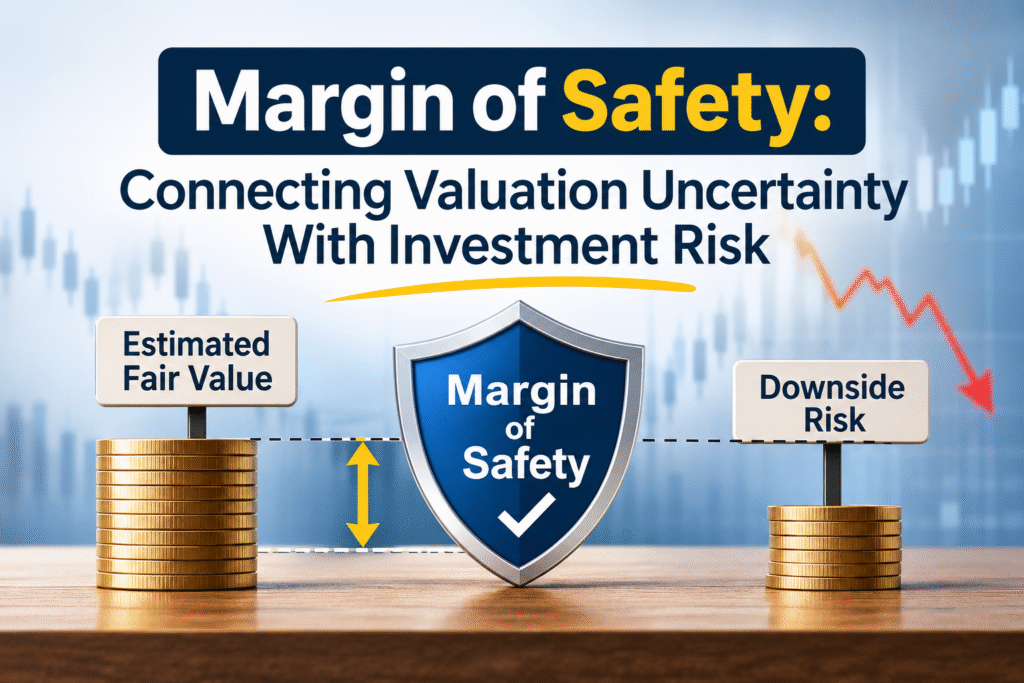
Margin of safety is the gap between what a stock is worth and what you pay for it. The wider the gap, the more room you have for mistakes, bad luck and wrong estimates before you lose money. It is the oldest idea in value investing, and it is still the best answer to a simple question: how sure can you really be about the value you calculated?
The honest answer is that you can never be fully sure. Every valuation rests on forecasts of sales, profits, interest rates and growth. Every one of those forecasts can be wrong. Valuation uncertainty is the name for this problem, and investment risk is what you pay when the problem turns against you. The margin of safety is the bridge between the two.
This guide explains what margin of safety means, how to calculate it, why valuation uncertainty should decide how large your margin is, and how Indian retail investors can use the idea with direct stocks, mutual funds and index funds.
What Is Margin of Safety in Investing?
Margin of safety is the difference between the intrinsic value of an investment and its current market price, usually shown as a percentage of intrinsic value. If a company is worth ₹1,000 per share and you buy at ₹700, your margin of safety is 30 per cent.
Intrinsic value is the amount a business is truly worth, based on the cash it can produce for its owners over its life. It is not the same as market price. Price is what the market asks today. Value is what the business is worth. The two often disagree, and margin of safety is built on that disagreement.
The concept works like a safety factor in engineering. A bridge designed to carry 10 tonnes is built to carry 15 or 20, because the real world brings loads, weather and errors that the drawings never showed. An investor who buys with a margin of safety builds in the same kind of spare strength.
Where the Idea Comes From: Benjamin Graham, Warren Buffett and Seth Klarman
Benjamin Graham, the teacher of Warren Buffett, made margin of safety the centre of his approach. In The Intelligent Investor, he described it as the central idea of sound investing. Graham did not claim he could forecast the future well. He claimed that buying well below value would protect him when his forecasts failed.
Warren Buffett has often repeated this lesson. He has said that he likes to buy with a margin of safety so large that he does not need to be exact, in the same way that you would not drive a truck over a bridge rated for 10,000 pounds if it only weighs 9,800.
Seth Klarman of Baupost Group wrote an entire book on the subject, Margin of Safety. His main point is that risk is not volatility. Risk is the chance of permanent loss of capital, and the best defence against it is price discipline.
Three different investors, one common thought: never pay full price for an estimate.
Margin of Safety Formula and How to Calculate It
The margin of safety formula is simple:
Margin of Safety (%) = (Intrinsic Value − Market Price) ÷ Intrinsic Value × 100
Suppose you value a company at ₹900 per share and it trades at ₹630. Then:
(900 − 630) ÷ 900 × 100 = 30 per cent
Another way to read the same result is that the price can fall 30 per cent from your entry before it touches your estimate of value, or that your estimate of value can be 30 per cent too high before you stop being at fair price.
A second version of the formula is used in accounting and break-even analysis: (Actual Sales − Break-Even Sales) ÷ Actual Sales. This measures how far sales can drop before a company starts making losses. Both versions ask the same question. How much can go wrong before I get hurt?
The formula is easy. The hard part is the first number, intrinsic value, because that number is never exact.
Why Valuation Uncertainty Exists
Valuation uncertainty is the range of reasonable values that two careful analysts can reach for the same company. It exists because every method needs assumptions, and assumptions are guesses about the future.
Here are the main sources.
Forecasts of growth and margins. A discounted cash flow model (DCF) depends on how fast sales will grow and what profit margin the company will keep. A small change in either one moves the answer a long way.
The discount rate. The rate you use to bring future cash flows to today’s value is itself a judgement. The cost of equity depends on interest rates, risk premium and the company’s own risk. Change it by one percentage point and the value changes sharply.
Terminal value. In most DCF models, more than half of the total value comes from the terminal value, which is the worth of the business beyond the forecast period. It rests on long-term growth and discount rate assumptions that nobody can verify.
Cyclical earnings. A steel, cement or commodity company can look cheap at peak profits and expensive at trough profits. Which year is normal?
Accounting quality. Reported profit can differ from cash profit. If earnings are not backed by cash flow, the base number of your model is already weak.
Unknown events. Policy changes, new competitors, management mistakes and global shocks are not in any spreadsheet.
The key point is this: valuation uncertainty is not a flaw you can remove with a better model. It is a fact of the business. A more detailed spreadsheet gives a more precise number, not a more accurate one.
How Small Assumptions Create Large Valuation Gaps
A simple example shows why. Take a company that will produce free cash flow of ₹100 next year. Use the basic growing perpetuity formula, where value equals next year’s cash flow divided by the discount rate minus the growth rate.
| Discount rate | Growth rate | Estimated value |
|---|---|---|
| 11% | 5% | ₹1,667 |
| 12% | 5% | ₹1,429 |
| 13% | 5% | ₹1,250 |
A change of one percentage point in the discount rate moved the value by about 12 to 17 per cent. The business did not change. Only the assumption did. Now imagine also being wrong on growth, and you can see why a single point estimate of value is a weak foundation for a large investment.
This is the link the whole article rests on. The more your value depends on distant, uncertain assumptions, the wider the range of possible values, and the larger your margin of safety must be.
Investment Risk: Volatility Versus Permanent Loss of Capital
Many textbooks treat risk as volatility, meaning how much a price moves up and down. Value investors take a different view. A falling price is not a loss until you sell, and a business that keeps growing will usually recover from a market panic.
The real risk is permanent loss of capital. This happens when you pay too much for a business, when the business gets worse than you expected, or when debt forces a sale at the bottom.
Valuation uncertainty feeds directly into this. If you overpay because your estimate was too hopeful, the market does not need to be irrational to hurt you. It only needs to return to a fair price. Margin of safety is the cushion between your estimate and that moment.
It also guards against a second danger, which is changes in the company itself. A 40 per cent discount to value can absorb a bad year, a delayed project or a slower growth rate without causing a permanent loss.
How Much Margin of Safety Do You Need?
There is no single correct percentage. The right margin depends on how uncertain the valuation is. A business with steady, predictable cash flow can be valued within a narrow range. A young, cyclical or heavily indebted business cannot.
The table below gives a rough rule of thumb. It is a starting point for thinking, not a rule from any regulator or textbook.
| Type of business | Valuation uncertainty | Margin of safety to look for |
|---|---|---|
| Stable consumer or utility business with long record | Low | 15 to 25 per cent |
| Established company with moderate growth | Medium | 25 to 35 per cent |
| Cyclical or capital-heavy company | High | 35 to 50 per cent |
| Turnaround, young or highly leveraged company | Very high | 50 per cent or more, or avoid |
The logic is easy to remember. Wider range of outcomes, wider cushion.
Two more factors should move the number. First, debt. A company with heavy borrowing has less room for error, so ask for more margin. Second, your own record. If you have often been too hopeful in the past, add a buffer to your estimates.
A Worked Example in Rupees
Let us take a fictional company, Sundaram Components Ltd., and value it three ways.
- Bear case: growth slows, margins shrink, value of ₹600 per share.
- Base case: steady growth, stable margins, value of ₹900 per share.
- Bull case: strong demand, margin gains, value of ₹1,250 per share.
The stock trades at ₹630. What is the margin of safety?
Against the base case: (900 − 630) ÷ 900 = 30 per cent.
Against the bear case: (600 − 630) ÷ 600 = about minus 5 per cent. At the bear value, the stock is slightly overpriced.
Against the bull case: (1,250 − 630) ÷ 1,250 = about 50 per cent.
What does this tell us? The price of ₹630 gives a healthy cushion in the base case, almost no downside in the bear case, and a very large reward in the bull case. The downside is small and the upside is large. That is the shape of a good investment under uncertainty.
Now change the price to ₹850. The base case margin shrinks to about 6 per cent, and the bear case shows a loss of about 29 per cent. A small error in your estimate would now cost real money. The price is not wrong, but the cushion is gone.
The lesson is to look at the whole range of values, not one number. Ask what the price is relative to your worst reasonable case, not just your best guess.
Margin of Safety Beyond the Price You Pay
Price is the most visible source of safety, but it is not the only one.
Business quality. A company with a strong competitive position, high return on capital and honest management is less likely to disappoint. Quality reduces uncertainty, which means you can accept a smaller price discount.
Balance sheet strength. Low debt, healthy cash flow and good interest cover allow a company to survive a bad cycle. Companies that must refinance during a crisis often do not.
Conservative assumptions. Use lower growth, higher discount rates and lower terminal values than the optimistic version. This builds safety into the valuation itself.
Position sizing. Even a well-researched idea can go wrong. Limiting any single stock to a modest share of your portfolio is a margin of safety against your own errors.
Diversification and asset allocation. Holding equity, debt and gold in sensible proportions keeps one wrong call from damaging your long-term goals.
Cash and time. Keeping some cash lets you buy when prices fall. A longer holding period also gives a business time to prove your estimate correct.
Margin of Safety for Indian Investors
The idea applies well to the Indian market, where retail investors face high valuations in some segments, sharp swings in mid-cap and small-cap shares, and plenty of stories that sound better than the numbers behind them.
Direct stocks. Compare the price with a range of values, check cash flow against reported profit, and be careful with companies that have high promoter pledging or rising debt. Ask what you are paying for growth that has not happened yet.
Market valuation. The Nifty 50 price-to-earnings (PE) ratio is a handy way to judge the overall market. In recent months it has stayed in a band of roughly 19 to 21, which many analysts treat as close to fair value for the index. Remember that PE alone is not enough. It is a trailing number, it can be distorted by one-time earnings, and NSE changed its method in 2021, so comparisons with older data need care. Look at price-to-book, dividend yield and earnings growth as well.
Mutual funds and index funds. Margin of safety for a fund investor comes mostly from asset allocation and from how you invest. Systematic investment plans (SIPs) spread your purchases over many price levels, so you are never betting on one date. Raising your equity allocation when markets are cheap and trimming it when they are expensive is the fund investor’s version of buying with a margin.
Small caps and new listings. These have the widest valuation uncertainty, so they deserve the largest margins and the smallest position sizes.
Common Mistakes When Using Margin of Safety
- Treating a low price as a margin of safety. A cheap stock is not a safe stock. The price can be low because the business is in trouble. A margin of safety exists only when value is well above price.
- Using one point estimate. A single value gives a false sense of precision. Build a range.
- Using optimistic inputs, then demanding a margin. If your base case is already hopeful, the margin is fake.
- Ignoring debt. Leverage turns a bad year into a permanent loss.
- Confusing a value trap with a bargain. A business in long decline can stay cheap and keep getting cheaper.
- Anchoring on the purchase price. Your cost does not change what the business is worth.
- Waiting for perfect prices forever. Staying out of the market also has a cost. Margin of safety is a discipline, not a reason never to invest.
Limits of Margin of Safety
Margin of safety reduces risk. It does not remove it. A company can be valued wrongly by a very wide margin, especially when a technology shift or a change in law destroys the business model. A large discount to a bad estimate is still a bad investment.
There is also an opportunity cost. If you demand a 40 per cent discount on every purchase, you may find few opportunities and miss good companies that never get that cheap. The answer is to match the margin to the uncertainty, as shown earlier, and not to use one blanket number for everything.
A Simple Checklist Before You Buy
- Have I valued the business with at least three scenarios, a bear, a base and a bull case?
- How much of the value depends on terminal value or growth far in the future?
- What does the price look like against my bear case?
- Is reported profit backed by cash flow?
- How much debt does the company carry, and when is it due?
- Is the margin of safety wide enough for the level of uncertainty?
- How much of my portfolio am I putting in this one idea?
- What would make me wrong, and would I notice in time?
If you cannot answer these honestly, the safest choice is to wait.
Frequently Asked Questions About Margin of Safety
What is margin of safety in simple words?
Margin of safety is the difference between what an investment is worth and the price you pay. A bigger difference means more protection if your estimate turns out to be wrong or the business does worse than expected.
What is the margin of safety formula in investing?
Margin of Safety (%) = (Intrinsic Value − Market Price) ÷ Intrinsic Value × 100. If intrinsic value is ₹900 and the price is ₹630, the margin of safety is 30 per cent.
Who created the margin of safety concept?
Benjamin Graham, often called the father of value investing, built the idea into his approach in the 1930s and later made it the central principle of The Intelligent Investor. Warren Buffett and Seth Klarman are well-known followers.
What is a good margin of safety percentage?
It depends on how uncertain the valuation is. Many value investors look for 20 to 30 per cent on stable companies and 40 to 50 per cent or more on cyclical, leveraged or fast-changing ones. There is no fixed rule.
How is margin of safety related to valuation uncertainty?
Valuation uncertainty is the range of values a company could reasonably have. The wider that range, the more likely your estimate is wrong, so the larger your margin of safety should be. In short, uncertainty sets the size of the cushion.
Is margin of safety the same as risk?
No. Risk is the chance of losing money permanently. Margin of safety is a method of reducing that risk by buying below intrinsic value.
Can mutual fund investors use margin of safety?
Yes, though in a different form. Fund investors can use sensible asset allocation, SIPs, rebalancing and a check on market valuation, such as the Nifty PE ratio, to avoid putting large amounts in at expensive levels.
Does a low PE ratio mean a high margin of safety?
Not always. A low PE can mean the market expects earnings to fall. Margin of safety needs a comparison between price and a carefully calculated intrinsic value.
What is the difference between margin of safety and margin of safety in accounting?
In investing, it compares price with intrinsic value. In accounting, it compares actual or expected sales with break-even sales. Both measure how much of a drop you can absorb before losses begin.
Conclusion
No investor can know the true value of a business. The best any of us can do is estimate a range, be honest about how wide it is, and pay a price that still works when we are wrong. That is the whole purpose of margin of safety.
When valuation uncertainty is low, a modest cushion may be enough. When it is high, because of cyclical profits, heavy debt or long-term growth stories, the cushion must be larger or the investment should be skipped. Add business quality, position sizing and diversification, and you have a framework that protects capital in good markets and bad ones.
In the end, margin of safety is less about finding cheap stocks and more about respecting what you do not know.
Disclaimer: This article is for education only and is not investment advice. Enigma Capital and the author are not SEBI-registered investment advisers through this content. Figures used in examples are illustrative. Market data such as the Nifty PE ratio changes daily, so check current figures before you decide. Please consult a SEBI-registered adviser before you invest.