
Anchoring in Valuation: How Historical Prices Distort Investment Decisions
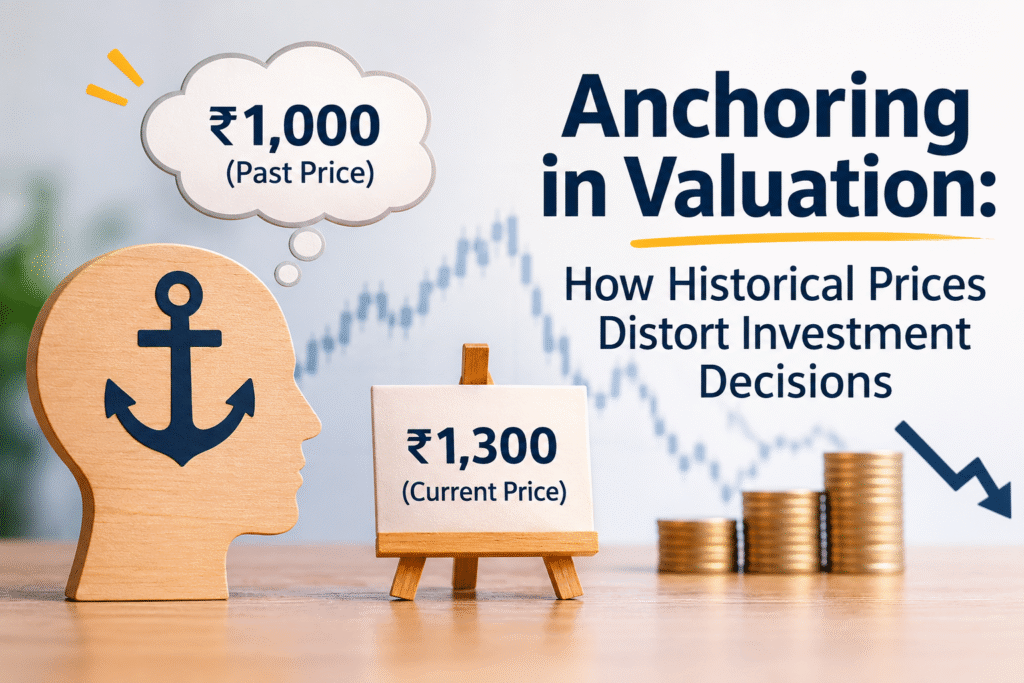
Quick answer: Anchoring bias in investing is the habit of judging a stock, mutual fund or property by a past number, such as your purchase price, the 52-week high or the IPO price, instead of by what the asset is worth today. Because that old number has nothing to do with the business’s current earnings, cash flows or risks, it leads to poor valuation, late selling and bad buying decisions. The fix is to value every investment from fresh fundamentals, using intrinsic value, a margin of safety and a written checklist.
What Is Anchoring Bias in Investing?
Anchoring bias, also called the anchoring effect, is a cognitive bias in which the first number we see becomes the reference point for every judgment that follows. It is one of the best-known ideas in behavioral finance.
In the stock market, the “first number” is usually a price. It may be the price you paid, the price the stock touched last year, or the price a broker quoted on a call. Once that figure sits in your mind, every later price is compared with it, even when the comparison makes no sense.
Anchoring in valuation is the same problem applied to the work of estimating what a share is really worth. An investor who anchors does not start from the company’s earnings, debt, growth and competitive position. He starts from an old price and adjusts a little from there. The adjustment is almost always too small.
Why Anchoring Matters in Stock Valuation
Stock valuation is meant to answer one question: what is this business worth today, based on the cash it is likely to produce in the future? Methods such as the discounted cash flow (DCF) model, the price to earnings (P/E) ratio, price to book value and EV/EBITDA all try to answer it.
A historical price answers a different question. It tells you what other people were willing to pay on some earlier day, under earlier conditions, with earlier information. That can be a useful data point. It is a poor measure of value.
When a past price quietly replaces intrinsic value, three things go wrong:
- Overpriced stocks look like bargains because they are “down” from a high.
- Fairly priced or cheap stocks look expensive because they are “up” from your cost.
- Sell and hold decisions get tied to your personal entry price, which the market does not know and does not care about.
How Historical Prices Distort Investment Decisions
Anchors show up in many forms. These are the six most common ones among Indian retail investors.
1. Your Own Purchase Price (Cost Price)
This is the strongest anchor of all. Suppose you bought a stock at ₹500 and it now trades at ₹350. Many investors say, “I will sell when it comes back to ₹500.” They wait for break-even.
The market has no idea what you paid. The only useful question is whether the stock is worth more or less than ₹350 today, and whether that money would earn more somewhere else. If your own analysis says the fair value is ₹300, then holding for ₹500 is hope, not a plan.
2. The 52-Week High
A stock that has fallen from ₹1,200 to ₹800 looks 33 percent cheaper, because (1,200 − 800) ÷ 1,200 is about 33 percent. But if profits have fallen by half in the meantime, the old high may have been too generous in the first place, and ₹800 may still be expensive.
A stock is not cheap because it fell. It is cheap only when the price is low compared with its value.
3. The IPO Price
In India, the issue price of an IPO often becomes a permanent mental reference. Investors say a share is “a good buy below its IPO price” or “too costly after listing gains.” The issue price was set by bankers and the company at a particular time, partly to attract subscribers. It is a marketing and pricing decision, not a valuation verdict.
4. Past Valuation Multiples
Suppose a company traded at a P/E ratio of 30 for five years. When it drops to 25, it feels cheap. But if its profit growth has slowed from 25 percent to 8 percent, a fair P/E may now be closer to 18. The old multiple is an anchor, and it hides the fact that the business has changed.
5. Analyst Target Prices
A broker report that says “target price ₹900” gives you a number to hold on to. Target prices rest on assumptions about growth and margins. If those assumptions are out of date, the number is out of date too, yet it keeps influencing decisions long after the report is forgotten.
6. Mutual Fund NAV
Many first-time investors believe a fund with a net asset value (NAV) of ₹12 is cheaper than one with an NAV of ₹120. This is anchoring on a low number. NAV is simply the fund’s total assets divided by the number of units. A ₹12 fund and a ₹120 fund can deliver exactly the same percentage return. What matters is the fund’s portfolio, costs and long-term performance.
What the Research Says
The anchoring effect was first described by psychologists Amos Tversky and Daniel Kahneman in their 1974 paper, “Judgment under Uncertainty: Heuristics and Biases,” published in the journal Science. In one experiment, a wheel marked from 0 to 100 was spun in front of the participants. It was rigged to stop at either 10 or 65. People were then asked what percentage of African countries are members of the United Nations. Those who saw 10 gave much lower estimates than those who saw 65. The wheel had nothing to do with the question, yet it moved the answers.
Professionals are not safe from it. In a well-known 1987 study by Gregory Northcraft and Margaret Neale, experienced real estate agents valued the same house after seeing different listing prices. Their valuations moved toward the listing price they were shown, even though most of them said the listing price had not influenced them.
In investing, the closely related disposition effect, described by Hersh Shefrin and Meir Statman in 1985 and studied by Terrance Odean in 1998, shows that investors tend to sell winning stocks too early and hold losing stocks too long. Anchoring on the purchase price is one of the reasons.
A Simple Worked Example
Take an investor, Ramesh, who bought shares of a mid-cap company at ₹500 in 2023. The shares now trade at ₹350.
Anchored thinking: “I am down 30 percent. I cannot sell at a loss. I will wait for ₹500.”
Fundamental thinking: Ramesh builds a basic DCF and checks the P/E ratio against peers. He estimates fair value at about ₹300. He also finds that a better-run company in the same sector trades at a reasonable valuation with higher growth.
The decision changes. The stock is trading above his estimate of fair value, and the loss is already in the past. Selling and moving the money to a better opportunity is a sound option. Holding on only to “get back to even” is what economists call a sunk cost mistake, and anchoring is what keeps it alive.
Anchoring Bias vs. Related Biases
| Bias | What it means | How it looks in investing |
|---|---|---|
| Anchoring bias | Relying too heavily on the first or an earlier number | Judging a stock by its 52-week high or your cost price |
| Sunk cost fallacy | Continuing because of money already spent | Holding a falling stock to avoid booking a loss |
| Disposition effect | Selling winners early, holding losers | Booking small profits, ignoring large losses |
| Confirmation bias | Looking only for views that agree with you | Reading only bullish reports on a stock you own |
| Loss aversion | Feeling losses more than equal gains | Refusing to sell at a loss |
These biases often work together. Anchoring supplies the number, loss aversion supplies the pain, and the sunk cost fallacy supplies the excuse.
How to Avoid Anchoring Bias in Investing
You cannot switch off a bias, but you can build habits that limit the damage.
- Value first, look at price later. Estimate the intrinsic value of a company using a DCF, earnings power or peer multiples before you check the current market price or any old high.
- Use a margin of safety. Buy only when the price is well below your estimate of value. Benjamin Graham made this idea famous, and it protects you when your estimate is wrong.
- Ignore your purchase price when deciding to sell. Ask a different question: “If I had this money in cash today, would I buy this stock at this price?” If the answer is no, you have a reason to sell.
- Compare with alternatives. Measure a stock against other stocks, an index fund on the Nifty 50 or Sensex, and even a fixed deposit. The right comparison is the next best use of your money, not your old cost.
- Use several valuation methods. If DCF, P/E and price to book all point in the same direction, you can trust the conclusion more than any single number.
- Write down your reasons. Keep an investment journal that records why you bought, what value you expected and what would make you sell. Review it before you act.
- Set review dates, not price targets. Check the business every quarter after results. Decide from new facts, not from a fixed price you picked earlier.
- Get a second opinion. A friend, mentor or a SEBI-registered investment adviser who does not know your purchase price is free of your anchor.
A Quick Anchoring Checklist
Before you buy or sell, ask yourself:
- Am I comparing this price with an old price or with the value of the business?
- Would my decision change if I had never owned this stock?
- What has changed in earnings, debt or growth since the price I am thinking about?
- Is the “discount” real, or is the old price simply no longer valid?
Frequently Asked Questions
What is anchoring bias in simple words?
It is the tendency to rely too much on the first piece of information you receive, such as a price, when you make a decision. In investing, it means judging a share by an old price instead of its present value.
How does anchoring affect stock prices and investor decisions?
It makes investors hold losing stocks to reach their purchase price, treat a 52-week high as the “right” price, and consider a stock cheap only because it has fallen. These habits lead to late selling, poor entry points and missed opportunities.
Is the 52-week high a good measure of value?
No. It shows where the market once priced the stock. It does not show what the business is worth now. A stock can be far below its 52-week high and still be overvalued.
Why should I not wait for my purchase price to sell a stock?
The market does not know your cost. Waiting for break-even can lock your money in a weak investment and cost you returns elsewhere. Decide using today’s value and the best alternative for your money.
Does a low NAV mean a mutual fund is cheap?
No. NAV only reflects the fund’s total assets divided by its units. A low NAV does not mean lower prices or higher returns. Compare funds on long-term returns, expense ratio, portfolio quality and risk.
How can beginners avoid anchoring bias?
Start with intrinsic value, use a margin of safety, keep a written reason for every trade, compare with alternatives such as index funds, and review the business after each quarterly result rather than fixing on a price.
Can professionals also fall for anchoring?
Yes. Studies, including the Northcraft and Neale real estate experiment, show that trained professionals are influenced by anchors too. Experience helps, but a process helps more.
Conclusion
Historical prices are easy to remember and hard to ignore. That is why they do so much damage to valuation. Your purchase price, the 52-week high, the IPO price and an old P/E ratio all describe the past. Investment returns depend on the future.
The next time you look at a stock, put the old numbers aside and ask a simple question: what is this business worth today, and is the current price lower than that? Answer it with a clear method and a written record, and you will make better decisions with the same information.
Be Part of Something Bigger!
Whether you’re exploring new ideas, learning something new, or looking for opportunities, Enigma Community brings you closer to a world of possibilities.
Join Us: https://www.enigmacommunity.com/
Disclaimer: This article is for general education only and is not investment advice. The examples are illustrative. Please consult a SEBI-registered investment adviser before making financial decisions.