
Narrative Investing vs Fundamental Analysis: Why Great Stories Can Produce Poor Investments
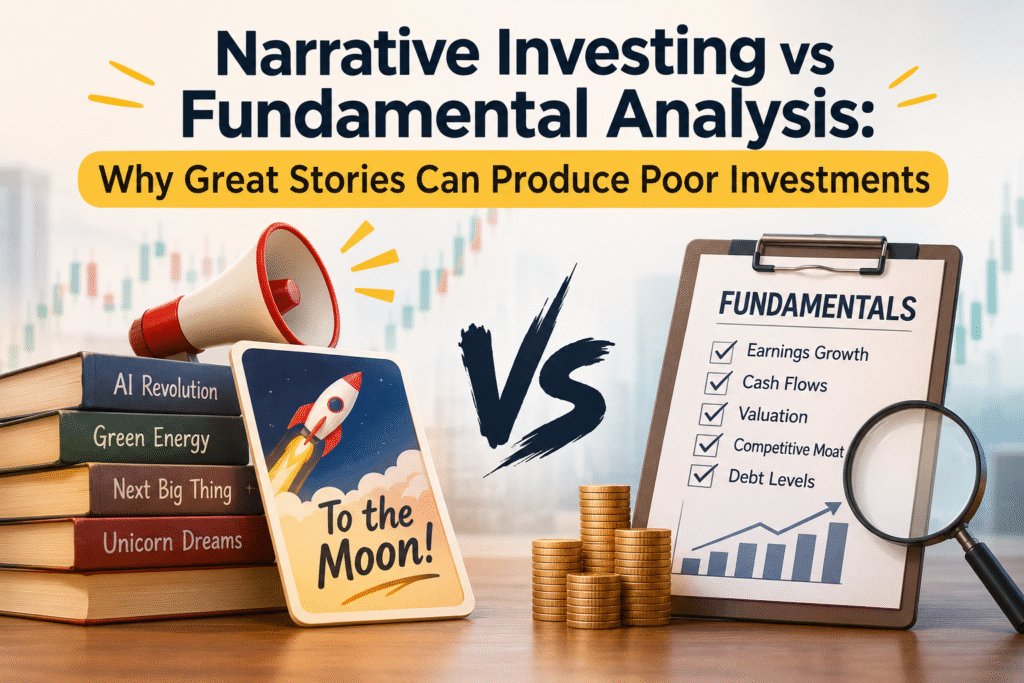
Every investor likes a good story. A company that will change how India pays, eats, travels or drives is easy to remember and easy to repeat at a family dinner. The trouble is that a share price is not a prize for the best story. It is a price, and the return you earn depends on what you pay compared with the cash the business actually produces.
This guide explains narrative investing vs fundamental analysis in plain terms. It shows why a stock with a great story can still be a poor investment, and gives you a simple checklist to test any story before you put money behind it.
Narrative Investing vs Fundamental Analysis: The Short Answer
Narrative investing means buying a stock mainly because of the story around it, such as a big theme, a famous founder, a new technology or a fast-growing market.
Fundamental analysis means valuing a company from its financial statements, business quality and growth prospects, then comparing that value with the market price.
A great story becomes a poor investment when the price already assumes the story will come true, when the numbers do not support it, or when it takes longer to play out than the investor can wait. A good story is not the problem. Paying any price for it is.
What Is Narrative Investing?
Narrative investing is the habit of making buy and sell decisions based on a popular story about a company, sector or economy. “India will become a manufacturing hub.” “Electric vehicles will replace petrol cars.” “Artificial intelligence will change every industry.” Each of these may well be true. The question is what they are worth in a share price.
Stories are useful because they make a complicated world simple. That is also their weakness. Research from wealth managers points out that reducing a complex theme to a short label can make investors overlook real risks. Memes and catchy acronyms spread fast through social media, and meme stocks sit at the far end of narrative investing, where sentiment is the whole strategy.
The economist Robert Shiller wrote a whole book on this idea, called Narrative Economics. His argument is that popular stories spread through a population much like a disease does, and that they can move spending, saving and share prices.
You will see narrative investing in many forms in India:
- IPO frenzy driven by a famous brand or a high grey market premium
- Thematic mutual funds launched after a theme has already run up
- “Next multibagger” tips on WhatsApp, Telegram and YouTube
- Small-cap and SME stocks that rise on a story with no earnings behind it
What Is Fundamental Analysis?
Fundamental analysis is the study of what a business is worth. The investor reads the annual report, studies the profit and loss account, the balance sheet and the cash flow statement, and then estimates intrinsic value, which is the price a business deserves based on the cash it can produce over time.
Most fundamental analysts look at a few things:
- Revenue and profit growth over five to ten years, not one good quarter
- Return on capital, such as ROCE and ROE, to see how well management uses money
- Free cash flow, which is the cash left after running and maintaining the business
- Debt levels, using debt to equity and interest cover
- Valuation, using P/E, price to book, EV/EBITDA and discounted cash flow
- Management quality, including promoter holding, pledging and capital allocation
- Competitive advantage, often called an economic moat
Fundamental analysis does not guarantee a good result. Forecasts can be wrong, and good companies can stay cheap for years. But it forces you to ask what you are paying and what you are getting for it.
Narrative Investing vs Fundamental Analysis: A Side-by-Side Comparison
| Point | Narrative Investing | Fundamental Analysis |
|---|---|---|
| Starting point | A story or theme | Financial statements and business quality |
| Main question | “How big can this get?” | “What is this worth today?” |
| Evidence used | News, social media, brand, founder | Earnings, cash flow, debt, returns on capital |
| Time horizon | Often short, driven by sentiment | Usually medium to long term |
| Main risk | Overpaying for a story that never delivers | Being early, or being wrong about the forecast |
| Strength | Spots big trends early | Protects against overpaying |
| Weakness | Hard to prove wrong | Slow and needs effort |
Why Great Stories Are So Hard to Resist
Stories work on the same instincts that make us human. A few biases explain why even careful investors fall for them.
Confirmation bias. Once you like a story, you read only the news that supports it. Bad news starts to look like a “temporary problem.”
Fear of missing out. When a stock is up 40 per cent in a month and everyone in your office is talking about it, waiting feels like losing.
Social proof. If many people believe a story, it feels safer. A crowd feels like evidence, but it is only a crowd.
Overconfidence. A clear and exciting story makes the future feel more predictable than it is.
Behavioural finance has studied all of these for decades, and none of them go away with more intelligence. They go away with a process.
Why a Great Story Can Produce a Poor Investment
1. The price may already include the story
When a story is popular, many buyers have already acted on it. The share price rises until it reflects the best-case outcome. If the company delivers exactly what the story promised, you earn a modest return. If it delivers anything less, you lose money. Being right about the story is not enough. You have to be right by more than everyone else.
2. A story is not the same as earnings
A fast-growing market does not guarantee profits for each company in it. Many industries that changed the world, such as airlines, railways and telecom, destroyed wealth for many shareholders because competition pushed margins down. Growth without pricing power and return on capital creates revenue, not value.
3. Stories are hard to disprove
A number can be checked. A story usually cannot. “This company will dominate its market in ten years” cannot be wrong today. That makes it comfortable to hold and dangerous to rely on, because there is no point at which the story admits it has failed.
4. Timing can ruin a correct idea
Some investors are right about a trend and still lose money, because they bought too early, too late or too expensive. A business may take twelve years to reach the scale the story needs. A shareholder who bought at a very high price may wait longer than patience, or a loan, allows.
5. Cash burn and dilution
Many story stocks lose money for years. To survive they raise fresh capital, which creates new shares and shrinks your slice of the company. A business can grow in size while your share of it falls.
6. Crowded stories end badly
When everyone owns the same story, there are few new buyers left. Any small disappointment can start a rush for the exit, and prices fall faster than they rose.
Real Examples: When the Story and the Numbers Parted Ways
The dot-com bubble
In the late 1990s, the story was that the internet would change everything. That story was correct. The internet did change everything. Yet the Nasdaq fell roughly 78 per cent from its March 2000 peak to its low in 2002, and many companies with great stories disappeared. The story was right and the investment was still poor for those who paid any price.
Paytm’s IPO in 2021
Paytm is one of the best-known Indian examples. The company had a famous brand, a huge user base and a strong story about digital payments. Its IPO, priced at ₹2,150 a share, raised ₹18,300 crore and was the biggest share sale India had seen, though it was only subscribed 1.89 times on the final day.
On listing day, the stock closed on the BSE at ₹1,564.15, about 27 per cent below the issue price. Before listing, Macquarie had downgraded the stock to Underperform with a target price of ₹1,200, which was roughly 44 per cent below the issue price. By January 2022 the shares had touched ₹1,063.75, about half the issue price.
Analysts at the time pointed to a business model that, in their view, lacked focus and direction. The story was loud. The profits were not there yet.
The other side: stories that were later backed by numbers
In the same period, Zomato’s shares rose about 80 per cent over the IPO price on listing day. Whether a buyer at that price did well depends on what they paid and how long they held. This is the point worth remembering. A story can be proved right later by real earnings, but you must still ask whether the price you pay leaves room for being wrong.
A Simple Worked Example: What a Story Must Deliver
Take an imaginary company called StoryTech Motors. It has a great story, and the numbers look like this:
- Market capitalisation: ₹50,000 crore
- Annual revenue: ₹1,000 crore
- Annual loss: ₹300 crore
The company trades at 50 times its sales. Now ask a fundamental question: what must happen for a buyer today to earn 15 per cent a year for ten years?
- At 15 per cent a year, ₹50,000 crore grows to about ₹2.02 lakh crore in ten years.
- If the market values the company at 25 times earnings by then, it needs a yearly profit of about ₹8,090 crore.
- If its net profit margin is 15 per cent, it needs revenue of roughly ₹53,900 crore.
- That means revenue growing from ₹1,000 crore to about ₹53,900 crore, which is 54 times larger, or growth of about 49 per cent a year for ten years.
Very few companies in the world have done this. The story may be wonderful, but the price demands something close to perfection. This kind of reverse calculation is the quickest way to test a story with numbers. The professor Aswath Damodaran has long argued that a good valuation links a story to numbers, and the example above is that idea in its simplest form.
When Narratives Are Actually Useful
Narrative investing is not always foolish. Stories are how most investors first find an idea. A trend can point you toward sectors worth studying, such as defence manufacturing, renewable energy, or financial services for a growing middle class.
The mistake is to treat a story as a conclusion. Use it as a starting point for research. If the story survives a look at the financials, it deserves a closer study. If it does not, you have saved yourself money.
A Checklist to Test Any Investment Story
Before you buy a stock because of a story, answer these questions in writing:
- Can I explain the story in two sentences, and the risks in two more?
- Is the company earning a profit, or does it have a clear path to one?
- What is the free cash flow, and has it been positive?
- What are the ROCE and ROE, and are they better than the cost of capital?
- How much debt does it carry, and can it pay the interest from operating profit?
- What does the current price assume about growth over the next ten years?
- What would prove the story wrong, and will I notice?
- Who is selling to me, and why? In an IPO this question is worth extra thought, especially when large parts of the issue are an offer for sale by existing investors.
- Is there a margin of safety? If the story is only half true, can I still earn a fair return?
- How much of my portfolio is this position? A single story stock should be a small part of your money.
If you cannot answer questions 2, 3 and 6, you are speculating, not investing. That is allowed, but it should be a small, deliberate part of your money.
How to Combine Both Approaches
The strongest investors do not choose between stories and numbers. They use both, in the right order.
- Start with the story to find ideas and understand where the business may go.
- Check the fundamentals to confirm that the business is sound today.
- Value the company to find out what price makes sense.
- Size the position by how sure you are, and keep it small if the story is doing most of the work.
- Review often. Compare what happens with what the story predicted. When facts and story disagree, trust the facts.
For many Indian retail investors, a core of low-cost index funds with a small satellite of individual stocks is a sensible way to put this into practice. The index holds the winners without needing you to guess them, and your stock picking is limited to money you can afford to lose.
Common Mistakes Indian Investors Make With Stories
- Buying an IPO only because the grey market premium is high
- Investing in a thematic fund after the theme has already doubled
- Acting on tips from social media without reading a single annual report
- Averaging down on a falling story stock instead of asking if the story is broken
- Ignoring promoter pledging, related-party deals and cash flow because the brand is famous
- Putting a large share of savings into one exciting idea
If you take advice from anyone, check that they are registered with SEBI, and remember that a registered adviser can still be wrong.
Frequently Asked Questions
What is the difference between narrative investing and fundamental analysis?
Narrative investing is based on the story around a stock, such as a trend, a founder or a new technology. Fundamental analysis is based on a company’s financial statements, business quality and valuation. The first asks how big the story can get. The second asks what the business is worth today.
Why can a good story be a bad investment?
A good story can be a bad investment because the price may already assume the best outcome, because the company may not earn the profits the story suggests, or because the story may take longer than the investor can wait. Paying too much for a true story still leads to a poor return.
Is narrative investing the same as speculation?
Not always, but they overlap. Narrative investing becomes speculation when the buyer has no estimate of value and relies on the price rising because others will buy. If the story is tested against the numbers, it can be part of sound investing.
Can fundamental analysis fail?
Yes. Forecasts can be wrong, accounting can be misleading, and markets can ignore a cheap stock for years. Fundamental analysis does not remove risk. It helps you avoid paying a price that needs everything to go right.
How can I tell if a stock is driven by hype?
Look for a price far above what earnings and cash flow justify, heavy social media attention, very high valuation multiples, ongoing losses, and arguments that dismiss valuation altogether. A rapid rise in the share price with no change in earnings is another warning sign.
Which is better for Indian retail investors, narrative or fundamentals?
For most retail investors, fundamentals should come first, because they give a reason to hold through falls and a way to avoid overpaying. Stories can help you find ideas, but a position should be backed by numbers before it gets real money.
Conclusion
Stories move markets in the short run, and they will keep doing so. But a share price must eventually be supported by what the business earns. A great story tells you where a company wants to go. Fundamental analysis tells you whether the price lets you profit from the trip.
Before you buy the next exciting idea, write the story in two sentences, then write what the price already assumes. If the second answer is much harder to believe than the first, you have your answer.
Be Part of Something Bigger!
Whether you’re exploring new ideas, learning something new, or looking for opportunities, Enigma Community brings you closer to a world of possibilities.
Join Us: https://www.enigmacommunity.com/
Disclaimer: This article is for education only and is not investment advice. Investments in securities are subject to market risk. Please consult a SEBI-registered investment adviser before making financial decisions. The StoryTech Motors example is imaginary and used only to show the method.