
Oil Prices, Inflation and the Indian Economy: Understanding the Transmission Mechanism
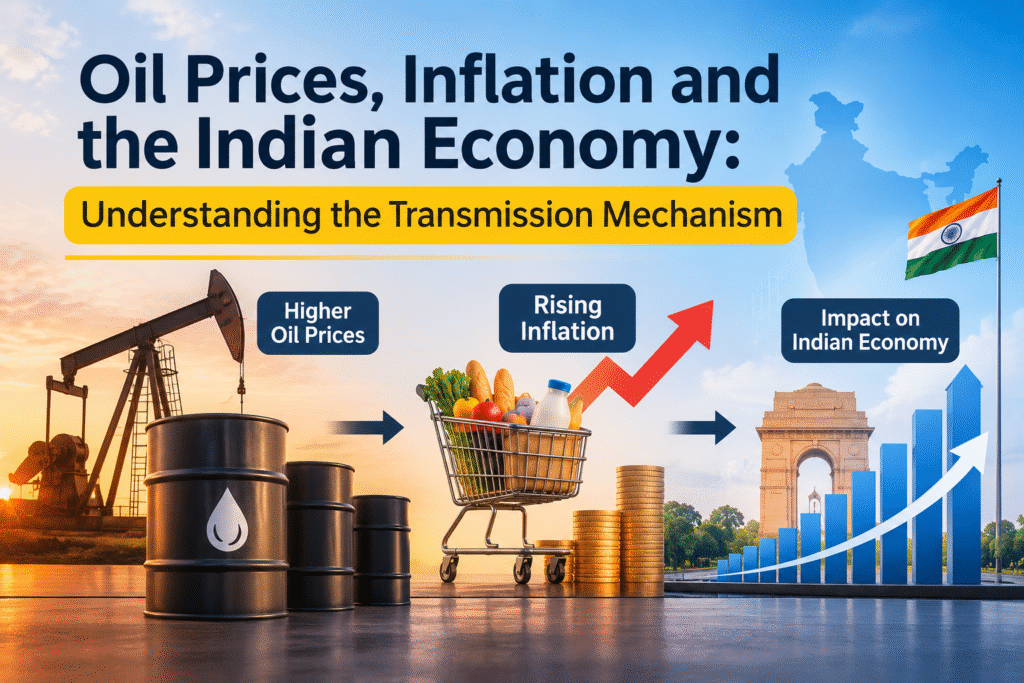
Oil prices and inflation in India are closely linked because India buys almost 90 percent of its crude oil from abroad and pays for it in dollars. When crude oil gets costlier, the effect reaches petrol pumps, freight bills, the rupee, the government’s budget and finally the RBI’s interest rate decision. This chain of events is called the oil price transmission mechanism, and it explains why a headline about Brent crude on a Tuesday can change your home loan EMI a few months later.
This guide explains each link in that chain in plain language, uses the latest numbers as of 22 November 2026, and tells you what it means for a retail investor.
What Is the Oil Price Transmission Mechanism?
The transmission mechanism is the path through which a change in global crude oil prices travels into a country’s inflation, growth, currency and interest rates. Think of it as a set of pipes. Crude oil enters at one end. At the other end you find the price of vegetables, the value of the rupee and the repo rate.
For India, economists usually split this path into five channels:
- Direct fuel prices (petrol, diesel, LPG, CNG)
- Indirect costs (freight, manufacturing, packaging, food)
- The rupee exchange rate and imported inflation
- The current account deficit and government finances
- The RBI’s monetary policy response
Each channel works at a different speed. Some show up in a week. Others take two or three quarters.
Why India Is So Exposed to Crude Oil Prices
India is the world’s third largest oil consumer and imports nearly 90 percent of the crude it refines. That single fact makes the Indian economy more sensitive to oil than countries that produce their own.
The price India pays is tracked through the Indian basket of crude, a blend of Oman, Dubai and Brent grades reported by the Petroleum Planning and Analysis Cell (PPAC). In October 2026 the basket averaged about $120 a barrel, against roughly $90 in August. For November so far, PPAC data shows it near $96, with a reading of $92.74 on 16 November.
The reason behind the spike in 2026 is the conflict involving Iran and the repeated disruption of shipping through the Strait of Hormuz, a narrow passage through which a large share of the world’s oil moves. Brent crude, the global benchmark, was above $100 in early November, then slid to the low $90s by 20 November as peace hopes grew and Gulf exports recovered towards pre-war levels. Even so, Brent is still far above where it stood a year ago.
When you search for Brent crude price today, you are looking at the number that sets the starting point for everything below.
Channel 1: Direct Impact on Petrol, Diesel, LPG and CNG
This is the channel most people see first. Higher crude means higher input cost for refiners, and fuel prices follow.
In India the link is softer than in most countries, because the government and the oil marketing companies (OMCs) absorb part of the shock. Two things matter here.
Under-recovery. When crude rises faster than pump prices, the OMCs such as Indian Oil, Bharat Petroleum and Hindustan Petroleum sell fuel for less than it costs to import and refine. This revenue shortfall is called under-recovery. Earlier this year, analysts at Emkay Global estimated it at ₹17 to ₹18 a litre at then-current crude levels, even after excise duty cuts.
Excise duty. The Centre can cut the excise duty on petrol and diesel to cushion consumers. This protects households but costs the government revenue.
When the cushion runs out, prices go up. Petrol and diesel were raised several times in May 2026, including a ₹3 a litre hike on 15 May, and CNG prices were raised as well. Because diesel powers trucks, tractors and pumps, a diesel hike spreads far wider than the pump itself.
A useful point for readers: the pump price is not a one-to-one copy of crude. A large part of what you pay is tax. So a 10 percent rise in crude does not mean a 10 percent rise at the pump.
Channel 2: Indirect Costs, Freight, Food and Manufacturing
This is where oil quietly feeds into CPI inflation. Economists call it cost-push inflation, which means prices rise because the cost of making and moving goods rises, not because buyers suddenly want more.
Here is how it works in practice:
- Transport: Trucks run on diesel. Higher diesel means higher freight rates, and freight is built into the price of vegetables, grain, cement and almost everything else.
- Petrochemicals: Plastics, packaging, synthetic fibres, paints and fertilisers depend on crude derivatives. Costlier inputs push up the price of finished goods.
- Farm costs: Diesel for irrigation pumps and tractors, plus fertiliser, raise the cost of growing food.
- Aviation and travel: Air fares move with aviation turbine fuel.
There is one caution worth stating clearly. Not all of today’s inflation is an oil story. India’s retail inflation rose to 6.09 percent in October 2026, from 5.54 percent in September, and the main driver was food, with food inflation at 8.94 percent and onion prices alone up more than 100 percent from a year earlier. Those are mostly supply-side problems. Oil adds to the pressure through transport and input costs, but it would be wrong to blame crude for every rupee of the rise.
Roughly speaking, economists often quote a rule of thumb that a sustained 10 percent rise in crude adds something like 20 to 30 basis points to CPI inflation. These estimates vary by study and by period, so treat them as a rough guide only.
Channel 3: The Rupee and Imported Inflation
Oil is priced in US dollars. So when crude rises, Indian refiners need more dollars, and they buy them by selling rupees. More demand for dollars pushes the rupee down.
This matters because a weaker rupee makes every import costlier, not just oil. Electronics, edible oil, gold, coal and machinery all become more expensive. This is called imported inflation, and it is the reason oil and the rupee tend to move against each other.
The 2026 numbers show it clearly. The rupee touched a record low of about 96.96 per dollar in May and was near 96.8 in early October. It has been the weakest performing Asian currency this year, with a fall of more than 6 percent in the first half of 2026. The government also raised import duty on gold and silver from 6 percent to 15 percent to cut dollar demand.
The RBI uses its foreign exchange reserves to sell dollars and slow the fall, but it cannot hold back a trend for long if oil stays high.
Channel 4: Current Account Deficit and Government Finances
The current account deficit (CAD) measures how much more India pays the world than it earns from it. Crude oil is the biggest single item on India’s import bill, so a higher oil price widens the CAD directly.
As a rough guide, analysts often say that every $10 a barrel increase in crude widens India’s CAD by about 0.3 to 0.5 percent of GDP, depending on the year. A wider CAD means India needs more foreign money to fill the gap, which puts further pressure on the rupee. That is how channel three and channel four feed each other.
The government’s budget takes a hit too. It has three bad choices when crude spikes:
- Cut excise duty and lose revenue
- Raise subsidies on LPG and fertiliser and spend more
- Let prices rise and face public anger and higher inflation
In most years the Centre mixes all three, which is why high oil often leads to a larger fiscal deficit or lower capital spending later in the year.
Channel 5: RBI Repo Rate and Interest Rates
The final link is the RBI. The central bank targets CPI inflation at 4 percent, with a tolerance band of 2 to 6 percent. When inflation breaks the upper limit, the Monetary Policy Committee (MPC) comes under pressure to raise the repo rate.
That is what has happened. On 7 October 2026 the RBI raised the repo rate by 25 basis points to 5.50 percent, its first hike since February 2023. October inflation then crossed 6 percent for the first time in two years, and many analysts now see a fair chance of another hike at the December meeting. The next CPI reading is due on 14 December 2026.
Notice a detail from October: the rupee still weakened on the day of the rate hike. When oil and dollar pressure are strong, a small hike may not be enough to support the currency. This puts the RBI in a tough spot, because higher rates slow growth, while higher oil already slows growth. Economists call the combination of weak growth and high inflation stagflation, and a prolonged oil shock is one of its classic causes.
Where India Stands in November 2026
Here is a quick snapshot of the key numbers as of the latest data:
| Indicator | Latest reading |
|---|---|
| Brent crude (around 20 November) | About $92 a barrel |
| Indian basket crude, October average | About $120 a barrel |
| Indian basket crude, 16 November | $92.74 a barrel |
| CPI inflation, October 2026 | 6.09 percent |
| CPI inflation, September 2026 | 5.54 percent |
| Food inflation, October 2026 | 8.94 percent |
| RBI repo rate | 5.50 percent |
| Rupee vs dollar | Around 96 to 97 |
Forecasts differ. The US Energy Information Administration expects Brent to stay near $100 through November and December and fall below $90 by the second quarter of 2027, while ING projects an average of $77 for 2027. Oil forecasts have missed badly in the past, so use them as ranges, not promises.
There is also a time lag to remember. Crude fell about 20 percent from October to November, but retail prices, freight contracts and inflation data move slowly. Cheaper oil today will show in CPI after a few months, not next week.
Which Sectors Gain and Lose When Oil Moves
The oil cycle creates winners and losers in the stock market. This is general background, not a stock recommendation.
- Usually hurt by high crude: Oil marketing companies (when they cannot raise prices), airlines, paints, tyres, chemicals, logistics and consumer companies with high packaging costs.
- Usually helped by high crude: Upstream producers such as ONGC and Oil India, since they sell crude at higher prices.
- Usually helped by falling crude: OMCs, airlines and paint companies, because their margins recover.
- Currency link: IT services and pharma exporters often gain when the rupee weakens, which partly offsets the oil effect on the index.
What Retail Investors Can Do
You cannot predict oil. Even large banks get it wrong. What you can do is build a plan that does not fall apart when crude moves.
Check your debt. If you have a floating-rate home loan, a repo rate hike raises your EMI or stretches your tenure. Know how many basis points you can absorb.
Watch bond duration. Rate hikes push down the price of long-duration bonds and debt funds. Short-duration funds are less sensitive.
Keep real returns in view. With CPI near 6 percent, a fixed deposit paying 6.5 percent after tax earns very little in real terms. Compare returns after inflation, not before.
Hold some real assets. Gold, and equity in companies with pricing power, have historically helped protect purchasing power in inflationary periods. The government’s gold import duty hike has made gold costlier, so check current prices before buying.
Diversify. Do not bet your portfolio on a single view about oil, the rupee or the RBI.
This article is for education only. It is not investment, tax or legal advice. Please speak to a SEBI-registered investment adviser before acting on any of it.
Key Takeaways
- India imports about 90 percent of its crude, so oil shocks hit the economy quickly.
- Oil reaches inflation through fuel prices, freight and input costs, the rupee, the current account and RBI policy.
- Pump prices rise less than crude because of taxes, OMC under-recovery and excise duty cuts.
- October 2026 CPI inflation of 6.09 percent was driven mostly by food, with oil adding pressure on the side.
- The RBI raised the repo rate to 5.50 percent on 7 October 2026, and the December meeting is the next event to watch.
- Falling crude helps with a lag. It does not fix inflation overnight.
Frequently Asked Questions
How do oil prices affect inflation in India?
Oil prices affect inflation in India through fuel prices, transport and input costs, and the rupee. Because India imports about 90 percent of its crude, a rise in Brent raises the cost of petrol, diesel, freight and petrochemicals, and a weaker rupee makes other imports costlier too. Economists often estimate that a sustained 10 percent rise in crude adds roughly 20 to 30 basis points to CPI inflation, though the exact figure varies.
Why does India depend so much on imported crude oil?
India produces only a small share of the crude it needs, while its demand keeps growing with the economy, vehicles and industry. The country therefore buys around 90 percent of its crude requirement from other nations, mainly in West Asia, and pays in US dollars.
What is the Indian basket of crude oil?
The Indian basket is the average price of the crude grades India buys, mainly Oman, Dubai and Brent. The Petroleum Planning and Analysis Cell publishes it. It is a better guide to India’s actual import cost than Brent alone.
Why does the rupee fall when crude oil prices rise?
Oil is bought in dollars. When crude rises, Indian refiners need more dollars, so they sell rupees to buy them. Higher demand for dollars pushes the rupee lower, and a weaker rupee raises the cost of all imports.
Will the RBI raise the repo rate because of high oil prices?
The RBI does not target oil directly. It targets CPI inflation. If oil pushes inflation above the 6 percent upper limit and keeps it there, a rate hike becomes more likely. The RBI raised the repo rate to 5.50 percent on 7 October 2026, and inflation of 6.09 percent in October keeps a December hike on the table.
Are petrol and diesel prices in India linked to crude oil prices?
Yes, but not one to one. Taxes make up a large part of the pump price, and the government and OMCs often absorb part of a crude rise through excise duty cuts and under-recovery. When the losses become too large, prices are raised.
What happens to the Indian economy if crude oil prices fall?
Lower crude helps India by reducing inflation, narrowing the current account deficit, easing pressure on the rupee and improving OMC and airline margins. The benefit arrives with a delay of a few months, and it can be offset if food prices stay high.
How does a higher repo rate affect my home loan?
Most home loans in India are linked to the repo rate. When the RBI raises it, your lender raises the loan rate, which increases your EMI or extends your loan tenure. A 25 basis point hike on a large, long loan can add up to a meaningful amount over the years.
Be Part of Something Bigger!
Whether you’re exploring new ideas, learning something new, or looking for opportunities, Enigma Community brings you closer to a world of possibilities.
Join Us: https://www.enigmacommunity.com/