
Best Index Funds in India (2026): A Complete Guide for Investors
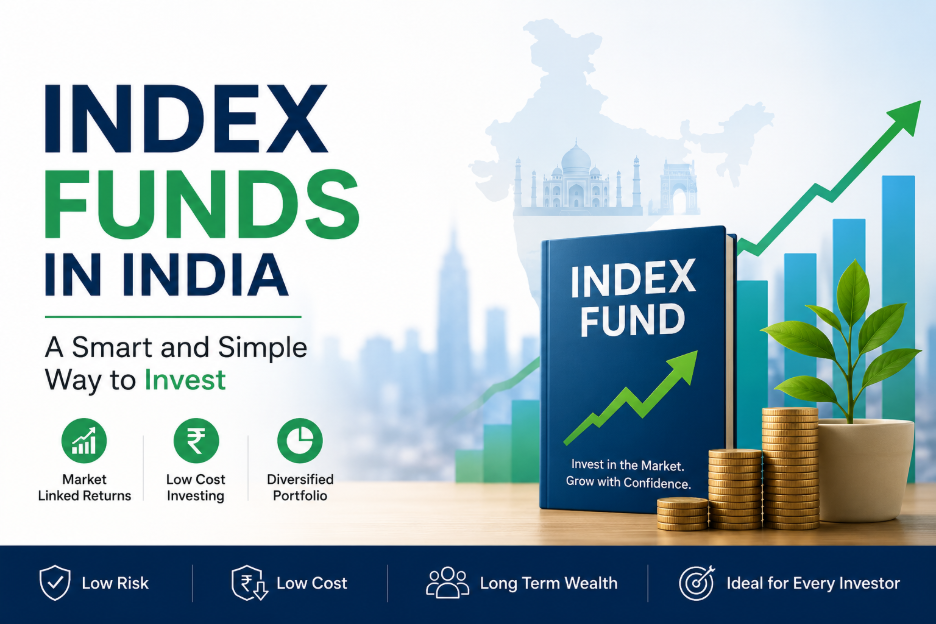
Passive investing has moved from a niche idea to a mainstream habit among Indian investors. Index funds and ETFs together now make up close to a fifth of total mutual fund assets in the country, up from barely 2% ten years ago. That shift did not happen by accident. Investors got tired of paying high fees for active funds that, in most cases, failed to beat their own benchmark.
This guide covers what index funds are, why they work, the different types available in India, how to pick one, and how to actually start investing. Whether you are searching for the best Nifty 50 index fund, comparing Sensex funds, or trying to decide between a large-cap and midcap index fund, you will find the answer here.
What Is an Index Fund?
An index fund is a mutual fund (or ETF) built to copy a specific market index, such as the Nifty 50, Sensex, Nifty Next 50, or Nifty Midcap 150. There is no fund manager trying to guess which stocks will outperform. The fund simply buys the same stocks as the index, in the same proportion, and holds them.
That single design choice explains almost everything good about index funds:
- No active stock picking – the fund manager’s job is to track, not predict.
- Low cost – expense ratios typically run between 0.05% and 0.3%, compared to 1–2% for actively managed equity funds.
- Broad diversification – one purchase gives you exposure to dozens, sometimes hundreds, of companies across sectors.
- Full transparency – the portfolio is public and matches the index exactly, so you always know what you own.
Why Index Funds Make Sense for Most Investors
They are cheap. Over a 15–20 year investing horizon, a 1.5% difference in annual fees compounds into a very large gap in final corpus. Index funds keep more of your money invested and working for you.
They match the market instead of trying to beat it. Data going back decades shows that a large majority of actively managed large-cap funds fail to beat their benchmark over any ten-year stretch. An index fund does not try to win against the market. It simply becomes the market, delivering whatever return the Nifty 50 or Sensex delivers, minus a small fee. The Nifty 50 TRI has returned roughly 12–14% annualised over the last decade, and an index fund tracking it comes close to that number by design.
They are simple. There is no fund manager risk, no style drift, and no surprise sector bet you did not sign up for. You get exactly what the index gives.
They suit long-term goals. Retirement, a child’s education, or a wealth-building target 10+ years away are the kind of goals index funds are built for. Held over short periods, they will move with the market’s ups and downs like any equity investment. Held over years, that volatility tends to smooth out.
Types of Index Funds Available in India
Large-Cap Index Funds
These track the Nifty 50 or Sensex and hold India’s biggest, most established companies. They are the least volatile category of equity index funds and are usually the starting point for first-time investors. Popular examples include the UTI Nifty 50 Index Fund and the HDFC Nifty 50 Index Fund, both known for large AUM and low expense ratios in the 0.17–0.2% range.
Nifty Next 50 / Large-Midcap Index Funds
These track companies ranked 51st to 100th by market capitalisation, essentially the “next generation” of large caps. They sit between the stability of a Nifty 50 fund and the growth potential of a midcap fund, and many advisors treat them as a satellite holding around a core Nifty 50 position.
Mid-Cap Index Funds
Tracking indices like the Nifty Midcap 150, these funds hold mid-sized companies with stronger growth potential and higher volatility than large caps. The Motilal Oswal Nifty Midcap 150 Index Fund is a well-known name in this space.
Small-Cap Index Funds
These track benchmarks such as the Nifty Smallcap 250 and carry the highest risk and highest long-term growth potential in the index fund universe. They suit investors with a long horizon and a higher risk appetite.
Sectoral and International Index Funds
Some index funds focus on a single theme, such as banking, IT, or defence, and carry concentrated risk. Others give Indian investors access to global markets, for example funds tracking the Nasdaq 100, offering diversification beyond Indian equities.
Key Metrics to Check Before You Invest
Picking the “best” index fund is less about chasing past returns and more about checking a handful of fundamentals:
- Benchmark index – know exactly which index the fund tracks (Nifty 50, Sensex, Nifty Next 50, Nifty Midcap 150, Nifty Smallcap 250, and so on).
- Expense ratio – lower is better, since this fee is deducted every year regardless of performance.
- Tracking error – this shows how closely the fund’s returns follow its benchmark. A tracking error under roughly 0.1–0.3% is considered tight.
- AUM (assets under management) – a larger, stable asset base generally means better liquidity and lower tracking issues.
- 3–5 year CAGR – useful context, but never the only factor, since index funds by design will not deviate much from their benchmark’s return.
Always compare like with like. A Nifty 50 fund should be measured against another Nifty 50 fund, not against a smallcap fund, since the risk and return profile is completely different.
Index Funds vs Active Mutual Funds
The core difference comes down to management style and cost. An active fund manager tries to beat the index through stock selection and typically charges 1–2% a year for that attempt. An index fund manager does not try to beat anything; the fund simply mirrors the benchmark and charges a fraction of that fee.
The uncomfortable truth for the active fund industry is that most large-cap active funds have failed to beat their benchmark over a ten-year period. That single statistic is the reason passive investing has grown so quickly in India over the past decade.
Taxation on Index Funds in India
Index funds are equity-oriented funds for tax purposes, so the same rules that apply to equity mutual funds apply here:
- Short-Term Capital Gains (STCG): units sold within 12 months are taxed at 20%.
- Long-Term Capital Gains (LTCG): units held beyond 12 months are taxed at 12.5%, with gains up to ₹1.25 lakh in a financial year exempt.
Tax rules can change with each Union Budget, so it is worth checking the current rate before making a large redemption.
How Much Should You Allocate to Each Type?
There is no single correct split. It depends on your risk appetite, time horizon, and goals. A few common approaches:
- Conservative: 100% in a Nifty 50 or Sensex index fund.
- Balanced: 60–70% large-cap, 20–30% Nifty Next 50 or large-midcap.
- Aggressive: 40–50% large-cap, 30–40% midcap, remainder in smallcap.
A simple three-fund starter portfolio some investors use looks like this: half in a Nifty 50 index fund, roughly a third in a Nifty Next 50 fund, and the remainder in a midcap or smallcap index fund. This spreads exposure across market-cap tiers while keeping the number of funds manageable.
SIP or Lump Sum?
For most retail investors, a Systematic Investment Plan (SIP) works better than a one-time lump sum. SIPs use rupee cost averaging: you automatically buy more units when the market is down and fewer when it is up, without needing to time anything. Many platforms allow an index fund SIP starting from as little as ₹500 a month.
Lump sum investing can work well specifically during sharp market corrections, when valuations are lower, but it requires a level of market timing that most investors are not comfortable with. For steady, long-term wealth building, a monthly SIP into a core index fund remains the simpler and more disciplined route.
How to Start Investing in Index Funds
- Complete your KYC if you have not already, through any AMC website, registrar, or investment platform.
- Pick your benchmark – Nifty 50 for stability, Nifty Next 50 or a midcap index for more growth potential.
- Compare expense ratio, tracking error, and AUM across funds tracking the same index.
- Choose the direct plan over the regular plan to avoid distributor commissions eating into your returns.
- Set up a SIP rather than trying to time a lump sum entry.
- Review once a year, rebalance if your allocation has drifted, and avoid reacting to short-term market noise.
Frequently Asked Questions
Which is the best index fund in India for beginners? A Nifty 50 index fund is generally the safest starting point. It tracks the 50 largest companies on the NSE, carries a low expense ratio, and needs no stock-picking knowledge.
Is a Nifty 50 index fund better than a Sensex index fund? Neither is strictly better. A Nifty 50 fund tracks 50 large-cap companies, offering slightly broader diversification, while a Sensex fund tracks 30. In practice, returns between the two tend to be close over the long run.
How much should I invest monthly in an index fund SIP? Many platforms allow you to start with as little as ₹500 a month. What matters more than the amount is consistency: staying invested through market dips rather than pausing the SIP.
Are index funds safe? Index funds carry the same market risk as the index they track. They are not “safe” in the way a fixed deposit is safe, but they remove fund-manager risk and concentrated stock bets, which makes them more predictable than most actively managed equity funds.
What is tracking error and why does it matter? Tracking error measures how much a fund’s return deviates from its benchmark’s return. A lower tracking error means the fund is doing its job well; a higher one suggests inefficiencies in how the fund is managed.
Can I lose money in an index fund? Yes. Since an index fund mirrors the market, it falls when the market falls. This is why index funds are best suited to long-term goals rather than money you might need in the short term.
Final Word
Index funds give Indian investors a low-cost, transparent, and simple way to participate in the country’s equity markets without needing to pick individual stocks or actively managed schemes. Start with a core Nifty 50 or Sensex fund, add a Nifty Next 50 or midcap fund if your risk appetite allows it, and stay invested through a SIP over the long term. The strategy will not make headlines, but it has quietly outperformed a large share of actively managed funds over the past decade, and that track record is exactly why it keeps gaining ground.
This article is for informational purposes only and is not investment advice. Mutual fund investments are subject to market risk. Please verify current expense ratios, AUM, and tracking error from AMFI or the respective AMC before investing, and consult a registered financial advisor for guidance specific to your situation.