
Car Loan vs Paying Cash: Which Is Financially Smarter?
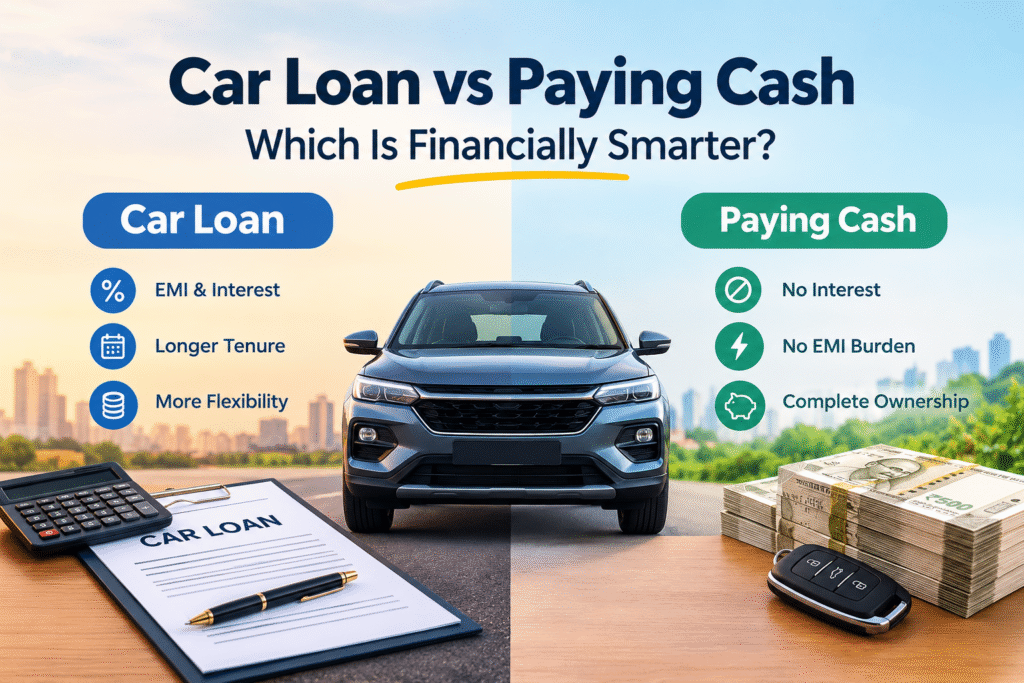
You have the money sitting in your savings account. The car you want costs eight lakh rupees, and you could clear the whole amount today without touching a loan form. So why does almost everyone around you still take a car loan, even the ones who can clearly afford to pay cash?
The honest answer is that the “right” choice is not the same for every buyer. A car loan can be the smarter route for one person and a costly habit for another, depending on what that cash would otherwise be doing for you. This article walks through the actual numbers, the traps in each option, and a simple way to work out which path fits your situation.
The Quick Answer
If your savings are earning less than what the car loan costs you in interest, paying cash usually wins. If your money is parked in investments that reasonably outperform the loan’s interest rate, and you can comfortably handle the EMI without straining your monthly budget, a car loan often works out better, provided you keep the tenure short. There is no universal winner. The decision comes down to a comparison between your car loan interest rate and your opportunity cost, which is what your cash would have earned elsewhere.
That said, a car is a depreciating asset either way, so this is never a question of “which option makes you money.” It is a question of which option loses you the least.
How Car Loans Actually Work in India Right Now
Car loan interest rates in India currently range roughly between 7.4% and 14% per annum, and where you land in that range depends heavily on your CIBIL score, your income, whether you are salaried or self-employed, the loan tenure, and how much you put down upfront. Public sector banks such as SBI, Bank of India, and Union Bank tend to offer the lowest starting rates, often close to 7.5% to 8.5% for well-qualified applicants, while private banks and NBFCs run somewhat higher.
A few things move your rate more than people expect:
- Your credit score matters the most. A drop of 100 points in your CIBIL score can add roughly 0.75% to 1.25% to your interest rate, which sounds small until you multiply it across a five-year loan.
- Down payment size changes your risk profile. Putting down 20% or more instead of financing the full on-road price lowers your loan-to-value ratio, and many lenders reward that with a better rate.
- Tenure length cuts both ways. Shorter tenures usually come with lower rates, but the real saving is not the rate itself, it is the fact that you pay interest for fewer years.
- New versus used matters. New car loans are priced lower than used car loans, sometimes by two to three percentage points, because the vehicle itself is better collateral.
On a ten lakh rupee loan at 9.5% over five years, you would end up paying close to two and a half lakh rupees in interest alone, on top of the principal. That number is the starting point for every comparison in this article.
The Case for Paying Cash
Paying cash has one advantage that no loan can match: certainty. You know exactly what the car costs you, and that number never changes. There is no EMI to track, no processing fee, no loan insurance add-on that dealers quietly bundle in, and no risk of your interest cost climbing if you had chosen a floating rate that later moved against you.
There is also a psychological argument that gets underrated in personal finance conversations. A car loan is a fixed monthly commitment sitting on top of your other obligations, rent or a home loan EMI, insurance premiums, SIPs, and daily expenses. If your income takes a hit, whether from a job change, a pay cut, or a slow month for a self-employed professional, a car EMI is one more fixed cost you are locked into for years. Paying cash removes that pressure entirely.
Cash buyers also skip a cost that rarely gets discussed: the value of the car itself is falling from the day you drive it out of the showroom. A new car typically loses 15% to 20% of its value in the first year and can be worth roughly half its original price by year five. When you finance that same depreciating asset, you are paying interest on a value that keeps shrinking under you. That mismatch, paying rising interest costs on a falling asset value, is the single strongest argument in favour of cash.
The drawback, of course, is opportunity cost. Once that lump sum leaves your account, it stops earning for you. If that money was sitting in a fixed deposit, a mutual fund SIP, or even a PPF account compounding steadily, withdrawing it to pay for a car means giving up whatever return it would have generated over the years you would otherwise have spent repaying a loan.
The Case for a Car Loan
The strongest argument for taking a car loan is not about the car at all. It is about what else your cash could be doing.
Suppose you have ten lakh rupees invested in equity mutual funds that have historically delivered returns in the range of 10% to 12% annually over long periods, though this is never guaranteed and can vary significantly year to year. If you can get a car loan at 8.5%, the arithmetic favours keeping your investments untouched and financing the car instead. You are effectively borrowing at a lower rate than what your money is earning elsewhere, and the gap works in your favour over the loan tenure.
A car loan also preserves your liquidity. Emptying your savings for a car purchase leaves you without a cushion for medical emergencies, job loss, or other unplanned expenses, which is a real risk given how unpredictable life can be. Financial advisors typically recommend keeping at least three to six months of expenses in an easily accessible emergency fund, and a large one-time cash outflow for a car can quietly eat into that buffer without you realising it until you actually need the money.
There is also a smaller but genuine benefit: a car loan, repaid on time, adds a positive entry to your credit history. For someone building a CIBIL score, especially early in their financial journey, a well-managed EMI can strengthen the profile that later helps with a home loan or a larger personal loan at a better rate.
The catch is discipline. A car loan only makes financial sense if the cash you did not spend is actually invested somewhere productive, rather than sitting idle in a savings account earning 3% to 4%, or worse, getting spent on other things simply because it was available. A car loan taken purely because “EMIs are convenient,” with no corresponding investment plan for the freed-up cash, is the worst version of this decision. You end up paying interest with nothing to show for the trade-off.
Running the Actual Numbers
Here is a simplified comparison to make this concrete. Assume a car costing ten lakh rupees on road, and two buyers with identical income and identical ten lakh rupees in savings.
Buyer A pays cash. The car costs exactly ten lakh rupees. No further outflow. But the ten lakh rupees that would have stayed invested at an assumed 10% annual return is gone, along with roughly five years of compounding on it.
Buyer B takes a loan at 9% for five years, financing the full amount, while keeping the ten lakh rupees invested. Over five years, the loan costs approximately two and a half lakh rupees in interest. Meanwhile, if the ten lakh rupees continues compounding at 10% annually, it could grow to roughly sixteen lakh rupees over that same period, assuming no withdrawals and consistent market performance, which real markets rarely deliver every single year.
On paper, Buyer B comes out ahead by a wide margin, but this comparison rests entirely on two assumptions: that the investment return genuinely outpaces the loan rate over the full tenure, and that Buyer B does not touch that invested money for anything else. Remove either assumption and the advantage shrinks or disappears. Markets do not move in a straight line, and money that is “available” has a way of getting spent on things other than long-term compounding.
Factors That Should Actually Drive Your Decision
Rather than treating this as a one-size-fits-all rule, work through these questions honestly before deciding:
- What is the interest rate gap? If your car loan rate is close to or higher than what your savings realistically earn, cash is the safer bet. If the gap favours your investments by two to three percentage points or more, a loan starts making sense.
- How stable is your income? If your earnings are unpredictable, whether you are self-employed, on commission, or in a volatile industry, avoid adding a fixed EMI. Cash removes that risk entirely.
- Do you already have an emergency fund? If paying cash for the car would wipe out your emergency reserve, take the loan instead and preserve that cushion.
- Will you actually keep the freed-up cash invested? Be honest with yourself here. If the money is likely to sit idle or get spent elsewhere, the loan route loses its main advantage.
- How long is the loan tenure? Shorter tenures, three years instead of seven, reduce the total interest paid and shrink the window during which your asset is depreciating faster than you are repaying it.
Common Mistakes Buyers Make
A few patterns show up again and again among buyers who later regret their choice. Stretching the loan tenure to the maximum just to lower the EMI ends up costing far more in total interest, even though the monthly outflow feels manageable. Taking a loan without comparing rates across at least three or four lenders is another common misstep, since even a one percentage point difference can mean tens of thousands of rupees over five years. Buyers also frequently ignore add-on costs bundled into the loan, such as loan protection insurance or extended warranties sold at the time of financing, which quietly inflate the effective interest rate well beyond the quoted figure. And on the cash side, some buyers drain their entire emergency fund for a car purchase and then find themselves taking a personal loan at a much higher rate months later when an unplanned expense arrives.
The Bottom Line
There is no permanently correct answer to car loan versus paying cash. It depends on the gap between your loan rate and your realistic investment returns, how stable your income is, whether you already have an emergency fund in place, and whether you will actually keep the freed-up cash invested rather than let it drift into everyday spending. Run your own numbers before deciding, using your actual interest rate quote and your actual savings return, rather than relying on general assumptions. The car itself will lose value either way. Your job is simply to make sure the financing decision loses you the least.
Frequently Asked Questions
Is it better to pay cash for a car or take a loan in India? It depends on the gap between your car loan interest rate and the return your savings would otherwise earn. If your loan rate is lower than your realistic investment returns and your income is stable, a loan can work out better. If your savings are earning less than the loan costs, or your income is unpredictable, paying cash is usually the safer choice.
What is a good car loan interest rate in India in 2026? Car loan rates currently range from roughly 7.4% to 14% per annum depending on the lender, your CIBIL score, income type, and loan tenure. Public sector banks tend to offer the lowest starting rates for well-qualified applicants, typically between 7.5% and 8.5%.
Does paying cash for a car save money in the long run? Paying cash avoids interest entirely, but it also means giving up whatever return that cash could have earned if invested elsewhere. Whether it saves money overall depends on how that opportunity cost compares to the loan’s interest cost.
Should I use my emergency fund to buy a car in cash? Generally no. Financial planners recommend keeping three to six months of expenses in an easily accessible emergency fund. Draining it for a car purchase can leave you exposed to unplanned expenses and may force you into a costlier loan later.
Does taking a car loan help build a credit score? Yes. A car loan repaid on time and in full adds a positive record to your credit history, which can help when applying for a home loan or other larger credit in the future.