
Decumulation Strategies: How to Convert a Retirement Corpus Into Sustainable Income
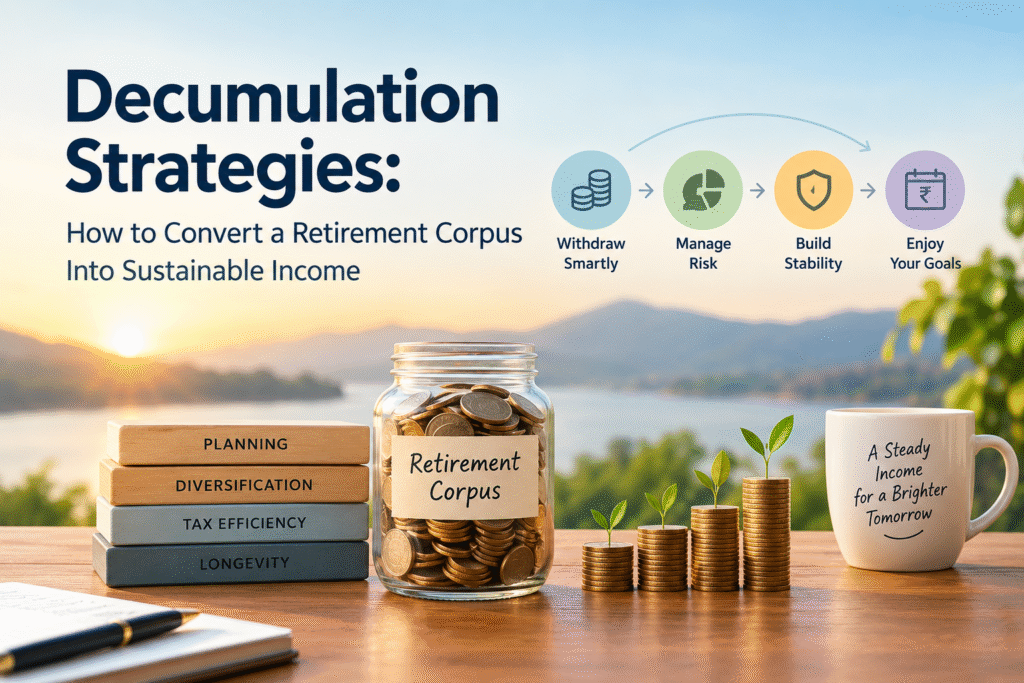
Building a retirement corpus takes twenty, thirty, sometimes forty years of discipline. Spending it well takes a different skill altogether, and almost nobody teaches it. Most Indian investors spend decades learning how to save, invest in SIPs, and chase compounding, then retire with a large number in their account and no real plan for turning that number into a monthly income that lasts as long as they do.
This is the decumulation problem, and it is arguably harder than accumulation. During your working years, a bad month in the market is a paper loss you can wait out. After retirement, a bad sequence of market returns in the first five years, combined with regular withdrawals, can permanently damage a corpus that looked more than sufficient on paper. Getting decumulation strategies right is not optional. It is the difference between a retirement that stays comfortable at seventy-five and one that runs short at seventy.
This article lays out how retirement corpus decumulation actually works in the Indian context, the main tools available (SWP, SCSS, POMIS, NPS annuities), how to think about a safe withdrawal rate, and how to combine these into a plan that gives you sustainable retirement income without gambling your later years on market timing.
What Decumulation Actually Means
Decumulation is simply the process of converting a lump sum of savings into a regular income stream during retirement, while managing two risks at the same time: the risk of running out of money too soon, and the risk of dying with far more money than you ever spent, having lived too frugally out of fear.
Accumulation has one goal: grow the corpus as large as possible. Decumulation has three goals working against each other:
- Generate enough monthly income to cover living expenses, which rise every year with inflation
- Preserve enough capital so the income keeps flowing for twenty-five to thirty-five years of retirement
- Keep some flexibility for medical emergencies, family needs, and the occasional splurge without guilt
Because these goals pull in different directions, no single product solves decumulation on its own. A fixed deposit gives certainty but loses to inflation over three decades. An all-equity portfolio can beat inflation handsomely but can also fall thirty percent in the exact year you need to start withdrawing. A retirement income plan, therefore, is not a product. It is a structure built from several products working together.
Why the Accumulation Playbook Fails in Reverse
Financial advisors in India spend a lot of time telling young investors to stay invested through market falls because time is on their side. That advice quietly assumes you are adding money, not withdrawing it. Reverse the direction of cash flow and the same volatility becomes dangerous. This is known as sequence of returns risk, and it is the single most important concept in decumulation planning that most retail investors have never heard of.
Here is a simple way to see it. Imagine two retirees, both starting with a corpus of one crore rupees, both withdrawing eight lakh rupees a year, and both earning the same average return of ten percent a year over fifteen years, just in a different order.
- Retiree A gets good returns in the first five years and weak returns later
- Retiree B gets weak returns, even a couple of down years, in the first five years and strong returns later
Even though the average return is identical for both, Retiree A ends up with a materially larger corpus at the end of fifteen years, and Retiree B can run out of money years earlier. Withdrawing a fixed amount from a shrinking corpus during a downturn locks in losses that a purely accumulating investor never has to face, because the accumulating investor is not pulling money out while prices are down. This single idea is why “just put it all in equity mutual funds and start an SWP” is incomplete advice on its own, and why a serious decumulation strategy needs more than one moving part.
The Building Blocks of a Decumulation Strategy
1. Systematic Withdrawal Plan (SWP) from Mutual Funds
An SWP lets you redeem a fixed number of units, or a fixed rupee amount, from a mutual fund on a set date each month, while the rest of the corpus continues to stay invested and grow. It has become the preferred tool for generating monthly income from equity and hybrid mutual funds because of one quiet advantage: taxation.
Each SWP withdrawal is a redemption, and only the capital gain embedded in the units sold is taxed, not the entire withdrawal amount. Compare that to a fixed deposit, where the entire interest is added to your income and taxed at your slab rate every year, sometimes touching thirty percent.
Under current rules, gains on equity mutual fund units held for more than twelve months are taxed as long-term capital gains at 12.5 percent, and only on gains above ₹1.25 lakh in a financial year. Gains on units held less than twelve months are taxed as short-term capital gains at 20 percent. Because withdrawals follow the First In, First Out method, your earliest, longest-held units are redeemed first, which usually works in your favour and pushes more of your withdrawals into the lower long-term bracket.
A working example: suppose you built a corpus of ₹80,000 through units bought years ago at a much lower NAV. If a ₹12,000 monthly withdrawal contains only ₹2,400 of actual gain, and that gain qualifies as long-term, the tax bill on that withdrawal can be a few hundred rupees or even zero, well within the annual exemption. That is a far smaller tax drag than an equivalent FD interest payout, and it is the core reason planners now favour SWP over the older IDCW dividend option, where the full payout is taxed at your slab rate.
The catch: SWP performance depends entirely on your withdrawal rate versus the fund’s return. Pull out more than the fund earns, and the corpus erodes, slowly at first, then faster as the base shrinks. This is where a withdrawal rate discipline matters more than the fund’s star rating.
2. Senior Citizens Savings Scheme (SCSS) and Post Office Monthly Income Scheme (POMIS)
If SWP is the growth engine, SCSS and POMIS are the guaranteed income floor. SCSS currently pays 8.2 percent per annum, credited quarterly, government-backed, with a five-year tenure extendable by three more years. Whatever rate is in effect when you open the account is locked for the full five-year term, regardless of what happens to rates afterward. The individual ceiling is ₹30 lakh, so a retired couple opening separate accounts can place up to ₹60 lakh between them, generating well over ₹4 lakh a year in interest with zero market exposure.
POMIS complements SCSS with a monthly payout instead of quarterly, at a lower but still respectable rate, useful for retirees who want cash flow every month rather than every quarter to match household bills.
| Instrument | Indicative Rate | Payout | Tenure | Backing |
|---|---|---|---|---|
| SCSS | 8.2% p.a. | Quarterly | 5 years (+3) | Government of India |
| POMIS | 7.4% p.a. | Monthly | 5 years | Government of India (Post Office) |
| 5-year Post Office Time Deposit | 7.5% p.a. | Annual | 5 years | Government of India |
| Public Provident Fund | 7.1% p.a. | On maturity | 15 years | Government of India |
The interest from both SCSS and POMIS is fully taxable at your income slab, so they suit the portion of a corpus earmarked purely for safety and near-term expenses, not the entire retirement corpus.
3. NPS Annuity: The Lifetime Income Layer
For those who accumulated retirement savings through the National Pension System, exit rules changed meaningfully after PFRDA’s reforms in December 2025. Non-government subscribers with a corpus above ₹12 lakh can now withdraw up to 80 percent as a lump sum, with a minimum of only 20 percent required to go into an annuity, a sharp relaxation from the earlier 60:40 structure. Government sector subscribers continue under the older 60 percent lump sum, 40 percent mandatory annuity rule. Where the total corpus is ₹8 lakh or below, a full lump sum withdrawal is permitted without any mandatory annuity at all.
The mandatory annuity portion buys you a lifetime pension from a PFRDA-empanelled insurer, taxable at your slab rate but guaranteed to keep paying for as long as you live, regardless of how long that turns out to be. This makes NPS annuity the one piece in a decumulation strategy that directly addresses longevity risk, the risk of simply outliving your money, something no SWP or fixed deposit ladder can fully guarantee on its own.
4. The Bucket Strategy: Bringing It All Together
Rather than picking one instrument, most sound decumulation strategies in India use a bucket approach, splitting the corpus by time horizon instead of by product:
- Bucket 1 (Years 1–3): Safety and liquidity. Held in liquid funds, short-term FDs, or a POMIS-style monthly payout instrument, covering near-term living expenses that must never be exposed to a market downturn.
- Bucket 2 (Years 4–10): Stability with moderate growth. Held in SCSS, high-quality debt funds, and conservative hybrid funds, refilling Bucket 1 periodically while earning more than pure cash.
- Bucket 3 (Years 10 onward): Growth. Held in equity and equity-oriented hybrid mutual funds, left largely untouched for the first decade of retirement so it can compound and later refill Buckets 1 and 2 through periodic rebalancing or an SWP.
This structure directly solves the sequence of returns problem described earlier. Because near-term expenses are funded from Bucket 1 and Bucket 2, a market fall in year three of retirement does not force you to sell equity at depressed prices. You simply wait it out, exactly the way you would have during your accumulating years, while the safe buckets keep the household running.
How Much Can You Safely Withdraw
The well-known “four percent rule” from American retirement research suggests withdrawing four percent of a corpus in year one, then adjusting that amount for inflation every year after, and expecting the money to last roughly thirty years. It is a useful starting reference, but applying it directly to an Indian retirement plan without adjustment is a common and costly mistake.
India’s inflation history, equity market volatility, and even life expectancy patterns differ from the US data the four percent rule was built on. Indian retail inflation has run consistently higher than developed-market inflation over long stretches, and food and healthcare costs, the two categories retirees spend the most on, tend to rise faster than the headline number. A more conservative withdrawal rate of three to three and a half percent in the first year, revisited annually against actual portfolio performance rather than followed blindly, tends to hold up better for a thirty-year Indian retirement horizon.
The safest approach is not a fixed percentage locked in forever. It is a flexible withdrawal rule: reduce withdrawals slightly in years following poor market returns, and allow yourself a little more in strong years, rather than drawing an identical inflation-adjusted amount no matter what the market has just done.
A Sample Allocation for a ₹1 Crore Retirement Corpus
There is no single right answer, but a reasonable starting structure for a retiree seeking roughly ₹55,000 to ₹65,000 a month, adjusted to individual expenses and existing pension income, might look like this:
- ₹25–30 lakh in SCSS and POMIS for a guaranteed income floor
- ₹20–25 lakh in a mix of short-duration debt funds and a liquid fund as Bucket 1
- ₹45–55 lakh in equity and hybrid mutual funds running a modest SWP, left to compound for the buckets further out
A retiree with an existing NPS corpus would layer the annuity income on top of this structure as a guaranteed lifetime floor, reducing how much the SWP portion needs to generate each month.
Common Mistakes to Avoid
- Treating the corpus as one pool instead of time-based buckets. Selling equity in a down year to fund this month’s expenses is the single most damaging decumulation mistake.
- Chasing the highest yielding product without checking taxation. A fixed deposit paying 7.5 percent taxed at 30 percent slab can leave less in hand than an SWP structured around long-term capital gains.
- Ignoring healthcare inflation. Medical costs for retirees often rise faster than general inflation, and a plan that only tracks the consumer price index tends to fall short in the later years.
- Withdrawing a fixed amount regardless of market conditions. A rigid withdrawal schedule that never adjusts for a poor year accelerates corpus depletion exactly when the portfolio can least afford it.
- Delaying the decumulation plan until the day of retirement. Bucket allocations and SWP instructions work best when set up two to three years before retirement, giving Bucket 1 and 2 time to be funded before the paycheck actually stops.
Frequently Asked Questions
What is decumulation in retirement planning? Decumulation is the process of converting a retirement corpus into a regular income stream, while balancing the risk of running out of money against the risk of underspending out of excessive caution. It is the reverse of the accumulation phase, where the sole aim is growing savings.
What is a safe withdrawal rate for retirement in India? There is no fixed rule, but a starting withdrawal rate of three to three and a half percent of the corpus in the first year, adjusted flexibly each year based on actual market performance rather than a rigid inflation formula, tends to be more sustainable for a thirty-year Indian retirement than the commonly cited four percent rule from US research.
Is SWP better than SCSS for retirement income? They serve different purposes. SCSS offers a fixed, government-backed rate and complete safety of capital, making it suited to near-term guaranteed income. SWP offers better long-term, tax-efficient growth potential from equity or hybrid funds but carries market risk. Most well-built retirement income plans use both rather than choosing one over the other.
How is SWP taxed in India? Only the capital gain portion of each SWP withdrawal is taxed, not the full withdrawal amount. Gains on equity fund units held over twelve months are taxed at 12.5 percent above an annual exemption of ₹1.25 lakh, while gains on units held under twelve months are taxed at 20 percent.
What are the new NPS withdrawal rules for 2026? Following PFRDA’s December 2025 reforms, non-government NPS subscribers with a corpus above ₹12 lakh can withdraw up to 80 percent as a lump sum, with a minimum 20 percent mandatory annuity purchase. Government sector subscribers continue under the earlier 60 percent lump sum, 40 percent annuity structure. Corpuses of ₹8 lakh or below can be withdrawn entirely as a lump sum without any mandatory annuity.
What is the bucket strategy in retirement planning? The bucket strategy divides a retirement corpus into three segments by time horizon: a near-term safety bucket in liquid instruments, a mid-term bucket in debt and schemes like SCSS, and a long-term bucket in equity left to grow. It protects retirees from being forced to sell growth assets during a market downturn to meet current expenses.
The Closing Thought
A retirement corpus is not a finish line. It is the starting balance for a new, thirty-year financial project with a very different goal from the one you spent your career pursuing. The investors who retire comfortably are rarely the ones who accumulated the largest number. They are the ones who built a decumulation strategy that matched their withdrawals to their time horizon, respected the quiet danger of sequence of returns risk, and left enough growth exposure in the corpus to keep pace with three decades of rising costs. Getting the accumulation right earns you the corpus. Getting the decumulation right is what actually pays for your retirement.
This article is for general educational purposes and does not constitute personalised investment advice. Interest rates, tax rates, and withdrawal rules referenced here are current as of the time of writing and are revised periodically by the relevant authorities; readers should verify the latest applicable rates before acting.