
Enterprise Value vs Equity Value: Understanding the Difference in Company Valuation
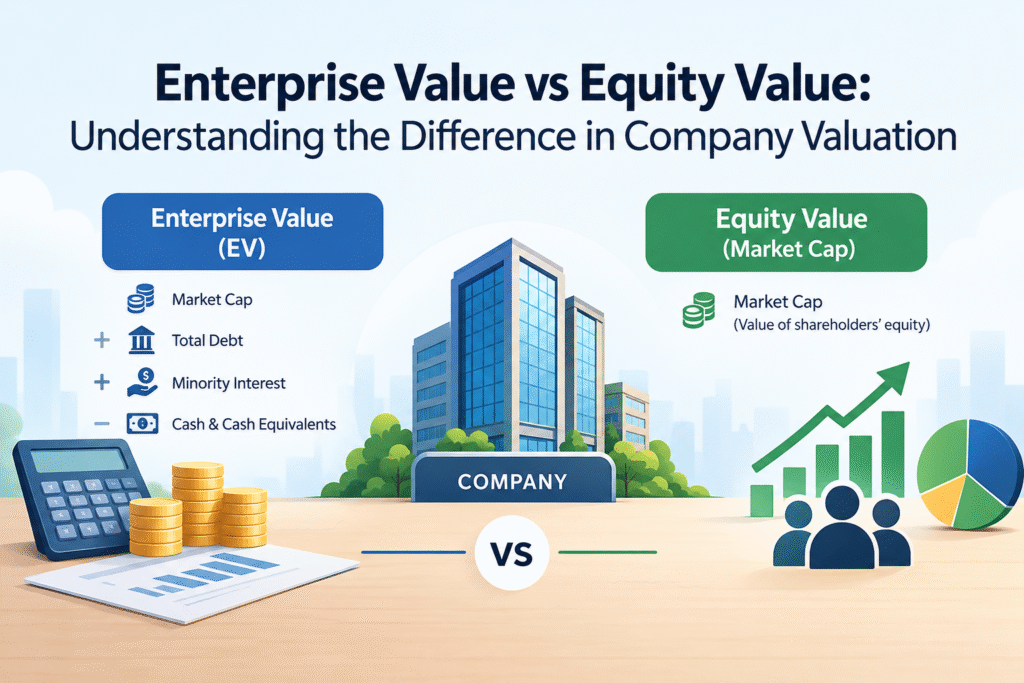
Two companies can show the same market cap and still be priced very differently. One may carry a heavy loan book while the other sits on a pile of cash. If you only look at the share price, you will miss that difference completely.
This is where enterprise value and equity value come in. Both numbers try to answer the same question, “What is this company worth?”, but they answer it from two different seats. One seat belongs to the shareholder. The other belongs to a buyer who would take over the entire business.
In this guide, we explain what enterprise value and equity value mean, how to calculate each one, how they connect, and when an Indian investor should use one over the other. We also work through a simple example in rupees so the formulas make sense on paper.
Quick Answer: What Is the Difference Between Enterprise Value and Equity Value?
Equity value is the value of a company that belongs to its shareholders. For a listed company, it is the share price multiplied by the number of shares outstanding. It is the same number most people call market capitalisation.
Enterprise value (EV) is the value of the whole business, including the claims of lenders, after removing the cash the company holds. It shows what a buyer would effectively pay to own the entire operating business.
The main difference is debt and cash. Enterprise value includes debt and subtracts cash. Equity value does not.
Enterprise Value = Equity Value + Total Debt – Cash and Cash Equivalents
Equity Value = Enterprise Value – Total Debt + Cash and Cash Equivalents
What Is Equity Value?
Equity value is the portion of a company’s worth that is left for its owners after all lenders have been paid. It is also called market capitalisation for a listed company, and for a startup it is close to the post-money valuation.
Equity Value Formula
For a listed company:
Equity Value = Current Share Price x Total Number of Shares Outstanding
If a company trades at ₹250 per share and has 20 crore shares outstanding, its equity value is ₹5,000 crore.
For a more careful calculation, analysts use diluted shares. This count includes shares that could be created from employee stock options (ESOPs), convertible bonds, and warrants. The diluted figure gives a truer picture of what existing shareholders actually own.
Why Equity Value Changes Every Day
Because equity value depends on the share price, it moves with every tick on the NSE and BSE. A good quarterly result can lift it. A market sell-off can pull it down. The company’s business has not changed overnight, but the price the market is willing to pay for its shares has.
What Is Enterprise Value?
Enterprise value measures the total value of a company’s operating business, whether the money came from shareholders or lenders. Think of it as the takeover price of the whole business.
Enterprise Value Formula
The most common formula is:
Enterprise Value = Market Capitalisation + Total Debt + Minority Interest + Preferred Shares – Cash and Cash Equivalents
For a simple company with no minority interest or preferred shares, this reduces to:
EV = Market Cap + Total Debt – Cash
Why Is Cash Subtracted?
This question comes up often. The logic is simple. If you buy a company, you take over its debt, but you also get its cash. That cash can be used to pay off part of the debt on day one. So the cash reduces your real cost of buying the business.
A house is a good comparison. Suppose a house is valued at ₹1 crore and has a home loan of ₹40 lakh against it. The total value of the house is ₹1 crore. That is like enterprise value. Your ownership stake after the loan is ₹60 lakh. That is like equity value. The bank owns a claim on the rest.
The EV to Equity Value Bridge
Analysts often talk about the “bridge” between enterprise value and equity value. It is just the set of items that sit between the two numbers.
Starting from enterprise value and moving down to equity value:
- Start with enterprise value.
- Subtract total debt (short-term and long-term borrowings).
- Subtract preferred shares, if any.
- Subtract minority interest, also called non-controlling interest.
- Add cash and cash equivalents.
- Add non-operating investments, where relevant.
- The result is equity value.
Going the other way, from equity value up to enterprise value, you reverse each step.
Worked Example: Same Enterprise Value, Different Equity Value
Let us compare two imaginary companies. All figures are for illustration only.
| Item (₹ crore) | Alpha Ltd | Beta Ltd |
|---|---|---|
| Equity Value (Market Cap) | 1,200 | 900 |
| Total Debt | 300 | 800 |
| Cash and Equivalents | 100 | 300 |
| Enterprise Value | 1,400 | 1,400 |
| EBITDA | 200 | 200 |
| EV/EBITDA | 7.0x | 7.0x |
Both companies have an enterprise value of ₹1,400 crore.
- Alpha: 1,200 + 300 – 100 = 1,400
- Beta: 900 + 800 – 300 = 1,400
Both earn the same EBITDA of ₹200 crore, so both trade at 7 times EV/EBITDA. From the point of view of an acquirer, they cost the same.
But the equity value is very different. Alpha’s shareholders own a business valued at ₹1,200 crore. Beta’s shareholders own only ₹900 crore, because lenders hold a much bigger claim on Beta’s business.
This is the main lesson. If two companies have the same enterprise value, they do not necessarily have the same equity value. The difference comes from capital structure, which means the mix of debt and equity a company uses to fund itself.
Now consider what a buyer pays for Alpha. The buyer pays shareholders ₹1,200 crore for their shares. The buyer also takes over ₹300 crore of debt, and receives ₹100 crore of cash. The net cost is 1,200 + 300 – 100 = ₹1,400 crore. That is the enterprise value.
Enterprise Value vs Equity Value: Key Differences at a Glance
| Point | Enterprise Value | Equity Value |
|---|---|---|
| What it measures | Value of the whole operating business | Value belonging to shareholders only |
| Includes debt? | Yes | No |
| Cash treatment | Subtracted | Not subtracted |
| Formula | Equity Value + Debt – Cash | Share Price x Shares Outstanding |
| Who cares most | Acquirers, lenders, analysts comparing companies | Shareholders, retail investors |
| Affected by capital structure? | Largely neutral | Strongly affected |
| Common multiples | EV/EBITDA, EV/Sales, EV/EBIT | P/E, P/B, Price to Sales |
| Typical use | Mergers and acquisitions, peer comparison | Share price, dividends, portfolio value |
Adjustments That Make the Calculation More Accurate
The basic formula works for a first look. For serious analysis, a few extra items matter.
Minority interest. When a company owns a majority stake in a subsidiary, its consolidated financial statements include 100 percent of that subsidiary’s earnings, even though part of the subsidiary belongs to outside shareholders. To keep the numbers consistent, add minority interest to enterprise value.
Preferred shares. Preference shareholders get paid before ordinary shareholders, so they are treated more like lenders than owners. Add them to enterprise value.
Lease liabilities. Under Ind AS 116, companies show lease obligations on the balance sheet. Analysts disagree on whether to treat them as debt. The most important rule is to be consistent when you compare two companies.
Cash and liquid investments. Many Indian companies, especially in the IT sector, hold large amounts of treasury investments and liquid mutual funds in addition to bank balances. Most analysts count these as cash equivalents.
Associates and non-operating assets. If a company holds a stake in another business that does not feed into its EBITDA, some analysts subtract the value of that stake from enterprise value.
Diluted shares. Use the diluted share count so that ESOPs and convertibles are not ignored.
Which Valuation Multiples Go With Which Value?
There is one simple rule. Match the numerator to the denominator.
Enterprise value includes money owed to lenders. So it should be compared with a profit figure that is earned before lenders are paid. That profit figure is EBITDA, EBIT, or sales. This gives you EV/EBITDA, EV/EBIT, and EV/Sales.
Equity value belongs to shareholders. So it should be compared with a profit figure that is left after lenders are paid. That figure is net profit, book value, or free cash flow to equity. This gives you the P/E ratio, price to book (P/B), and price to free cash flow.
Mixing the two is a common mistake. Dividing equity value by EBITDA, for example, gives a number that means very little, because EBITDA is a profit that belongs to both lenders and shareholders.
When Should You Use Enterprise Value?
Enterprise value is the better tool in these situations:
- Comparing companies with different debt levels. A debt-heavy company and a debt-free company can look very different on P/E. EV/EBITDA puts them on more equal footing.
- Valuing capital-intensive sectors. Telecom, power, infrastructure, cement, and real estate often carry large debts. EV gives a clearer view here.
- Looking at companies that are not yet profitable. Net profit may be negative, which makes P/E useless. EV/Sales or EV/EBITDA can still work.
- Evaluating takeovers. A buyer needs to know the total cost of owning the business, including debt.
- Comparing companies with different tax rates or depreciation policies. EBITDA ignores these, so EV/EBITDA is cleaner.
When Should You Use Equity Value?
Equity value fits better in these cases:
- Measuring what your shares are worth. Your portfolio value depends on equity value, not enterprise value.
- Valuing banks and NBFCs. For lenders, deposits and borrowings are the raw material of the business, not just a financing choice. So EV is not meaningful, and analysts use P/B and P/E instead.
- Calculating per-share value. Intrinsic value per share from a discounted cash flow model ends up as equity value divided by shares.
- Looking at dividends and buybacks. These are paid out of money that belongs to shareholders.
Why This Matters in Mergers and Acquisitions
In a takeover, two different numbers show up in the discussion.
The offer price per share multiplied by the number of shares gives the equity purchase price. This is what the shareholders receive.
The enterprise value is what the acquirer is really taking on, because the acquirer inherits the debt and gets the cash.
In India, SEBI’s takeover regulations require an open offer to public shareholders when an acquirer crosses certain ownership thresholds, such as 25 percent. The price in that open offer is an equity price per share. But a smart acquirer always looks at the EV behind it, because a cheap-looking share price on a heavily indebted company may cost far more once the debt is counted.
Common Mistakes to Avoid
- Using market cap alone to judge whether a stock is cheap. Two companies with the same market cap can carry very different levels of risk.
- Forgetting to subtract cash. This overstates the cost of cash-rich companies.
- Ignoring minority interest. This understates enterprise value for companies with partly owned subsidiaries.
- Mixing book value of debt with market value of debt. Most retail investors use book value from the balance sheet, which is fine as long as you stay consistent.
- Applying EV/EBITDA to banks. It does not work for financial companies.
- Comparing EV multiples across unrelated sectors. A software company and a steel company will naturally trade at different multiples. Compare a company with its own peers.
- Using stale numbers. Share prices change daily, and debt and cash change every quarter. Refresh both before you compare.
How to Calculate Enterprise Value Yourself: A Simple Checklist
You do not need special software. Here is a practical way to do it with public data.
- Find the current market capitalisation on the NSE, BSE, or any stock screener such as Screener.in.
- Open the latest balance sheet from the company’s quarterly or annual results.
- Add up total borrowings, which means both short-term and long-term debt.
- Note down cash, bank balances, and liquid investments.
- Check for minority interest and preference capital.
- Apply the formula: EV = Market Cap + Debt + Minority Interest + Preference Shares – Cash.
- Divide EV by EBITDA from the latest twelve months to get EV/EBITDA, then compare it with similar companies.
Many stock screeners already show EV and EV/EBITDA, but each platform has its own way of treating cash and lease liabilities. So it helps to know how the number is built before you rely on it.
Frequently Asked Questions
What is the difference between enterprise value and equity value?
Equity value is the value that belongs to shareholders, calculated as share price times shares outstanding. Enterprise value is the value of the whole business, calculated as equity value plus debt minus cash. The main difference is that enterprise value includes debt and removes cash.
How do you calculate enterprise value?
Enterprise value equals market capitalisation plus total debt plus minority interest plus preferred shares, minus cash and cash equivalents.
How do you calculate equity value from enterprise value?
Equity value equals enterprise value minus total debt, minus preferred shares and minority interest, plus cash and cash equivalents.
Is equity value the same as market cap?
For a listed company, yes, in most cases. Both equal share price times shares outstanding. Equity value is the broader valuation term, and it can also be used for private companies where no market price exists.
Can enterprise value be lower than market cap?
Yes. If a company holds more cash than debt, its enterprise value will be lower than its market cap. This is common among cash-rich companies with little or no borrowing.
Can enterprise value be negative?
Yes, though it is rare. It happens when cash is greater than market cap plus debt. It can signal that the market values the operating business at almost nothing, or that the cash may not be fully accessible to shareholders. It deserves a closer look before you draw any conclusion.
Why do analysts prefer EV/EBITDA over P/E?
EV/EBITDA is not affected by how a company is financed, by its tax rate, or by its depreciation policy. This makes it easier to compare companies with different debt levels. P/E is still very useful, particularly for stable, profitable companies and for banks.
Does debt reduce equity value?
Yes, when enterprise value stays the same. More debt means a bigger claim for lenders and a smaller slice for shareholders.
Which is better for valuing a company, enterprise value or equity value?
Neither is better in every case. Use enterprise value when you compare whole businesses or study a takeover. Use equity value when you want to know what the shareholders’ stake is worth.
Final Thoughts
Enterprise value and equity value are two views of the same company. Equity value tells you what the shareholders own. Enterprise value tells you what the whole business costs once debt and cash are taken into account.
For an Indian retail investor, the practical lesson is simple. Do not judge a company by its share price or market cap alone. Check its debt and its cash. Compare EV-based multiples with peers in the same sector, and use equity-based multiples like P/E for banks and stable earners. When you use both numbers together, you get a far clearer idea of whether a stock is fairly priced.
Disclaimer: This article is for educational purposes only and is not investment advice. The companies and figures in the worked example are imaginary. Please consult a SEBI-registered investment adviser before making investment decisions.