
Home Loan vs Renting: Which Makes More Financial Sense?
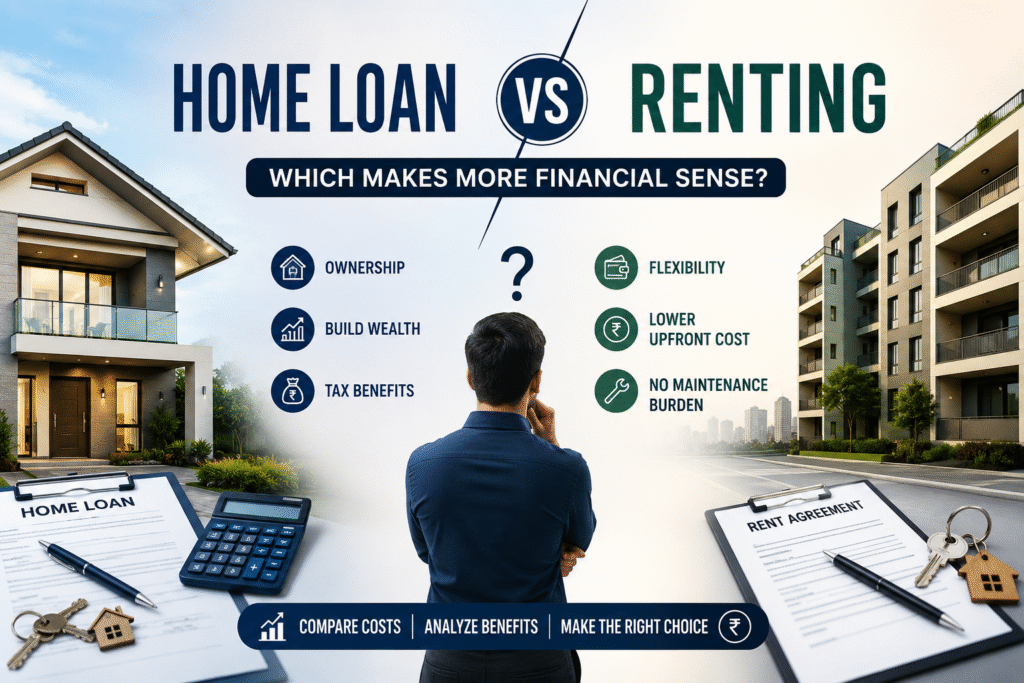
Every few years, this question comes back to the dinner table. A cousin buys a flat in Bangalore and everyone starts asking if they should do the same. A colleague sells his apartment in Pune and moves to a rented place, and suddenly renting looks smart again. There is no shortage of opinions on this. What is missing, most of the time, is a proper look at the numbers.
This article walks through the real financial comparison between taking a home loan and renting in India, using today’s interest rates, tax rules, and rental yields. There is no verdict handed out at the start. The goal is to give you a way to work out the answer for your own situation, because the honest truth is that the right choice depends heavily on the city you live in, how long you plan to stay there, and what else you would do with your money if you did not put it into a house.
The Basic Math: EMI vs Rent
Start with the numbers most people actually compare, the monthly EMI against the monthly rent.
As of August 2026, home loan interest rates in India for well-qualified borrowers with a CIBIL score above 750 range roughly between 7.25% and 8.75% per annum across major lenders such as SBI, HDFC Bank, ICICI Bank, and Bajaj Housing Finance. Public sector banks tend to offer the lower end of this range, while private banks and NBFCs often start slightly higher but process faster.
Take a flat worth ₹80 lakh in a Tier 1 city. Assume a 20% down payment of ₹16 lakh, leaving a loan amount of ₹64 lakh over 20 years at 8% interest. The EMI works out to roughly ₹53,500 a month. Over the full tenure, the total interest paid comes to more than ₹64 lakh, which means you end up paying almost double the original loan amount by the time the loan closes.
Now compare that to renting a similar flat in the same area. In most Indian metros, monthly rent for a comparable 2BHK runs somewhere between ₹25,000 and ₹40,000, depending on the locality. That gap between EMI and rent, often ₹15,000 to ₹25,000 a month, is the number that decides a lot of what follows. If that difference is invested instead of spent on a bigger EMI, it can grow into a substantial sum over the same 20 years.
This is the core tension in the home loan vs renting debate. Buying locks you into a fixed, large monthly outgo in exchange for eventual ownership. Renting keeps your monthly cost lower but leaves you with no asset at the end of it.
Home Loan Tax Benefits: What You Actually Get
A lot of people assume home loans are automatically tax efficient. That used to be more true than it is today, and the reason comes down to which tax regime you are under.
Under the old tax regime, a home loan borrower can claim up to ₹2 lakh a year as a deduction on interest paid under Section 24(b) for a self-occupied property, and up to ₹1.5 lakh a year on principal repayment under Section 80C. Combined, that is a meaningful ₹3.5 lakh of taxable income shielded every year, which for someone in the 30% tax bracket can mean a real saving of over ₹1 lakh annually.
Under the new tax regime, which is now the default option for most salaried taxpayers, these deductions are not available for a self-occupied home. This changes the calculation significantly. If you have shifted to the new regime for its lower slab rates, the tax advantage of a home loan mostly disappears unless the property is rented out, in which case interest deduction rules still apply against rental income.
Before you compare home loan versus renting, check which tax regime you are actually filing under. Someone who assumes they are getting ₹2 lakh of interest deduction while filing under the new regime is working with the wrong numbers from the start.
What Renting Actually Costs You Long Term
Renting has a reputation for being the “throwing money away” option, but that framing misses a few things.
First, rent in India is generally not a fixed number for 20 years. Most rental agreements in Indian cities include an annual increase of 5% to 10%, and every two to three years many tenants also face a bigger jump when they move or renegotiate. Over two decades, a rent that starts at ₹30,000 a month can realistically climb past ₹70,000 to ₹80,000 a month, depending on the city and the rate of increase.
Second, renting does not build any asset. At the end of 20 years of paying rent, you own nothing tied to that money. This is the strongest argument in favour of buying, and it is a fair one. Ownership gives you a physical asset, a hedge against future rent inflation, and eventually, a home with no EMI at all.
But renting has a quieter advantage that often gets ignored, which is flexibility. A tenant can move cities for a job, downsize after children move out, or shift to a cheaper locality without dealing with a sale, a buyer, registration costs, or capital gains tax. A homeowner carrying a 20-year loan does not have that same freedom, especially in the first ten years when prepayment penalties and low equity make an early sale less attractive.
Rental Yield in India: A Number Worth Knowing
Here is a fact that surprises a lot of first-time buyers. Rental yield in most major Indian cities, which is the annual rent as a percentage of the property’s market value, typically sits between 2% and 3.5%. Compare that to a fixed deposit or a debt mutual fund, both of which can offer similar or higher post-tax returns with far less hassle.
What this means in plain terms is that Indian real estate, as a pure rental investment, does not generate strong cash yield. Most of the return that property investors talk about comes from capital appreciation, meaning the hope that the property’s price goes up over time, not from the rent it earns along the way.
For someone deciding between home loan and renting, this number matters because it tells you something important. If you buy a home purely as an investment and plan to rent it out, the yield alone will not make you rich. The real financial case for buying, if there is one, comes from living in the property yourself and avoiding the rising cost of rent over the decades to come, combined with whatever price appreciation the location eventually delivers.
The Opportunity Cost Argument
This is the part of the comparison that gets skipped most often, and it is arguably the most important one.
Suppose your EMI would be ₹53,500 a month but your rent for a similar home is ₹32,000. That leaves a difference of ₹21,500 a month. If you choose to rent and invest that difference every month into a diversified equity mutual fund or an index fund, assuming a conservative long-term return of 11% to 12% annually, that monthly SIP of ₹21,500 could grow to well over ₹2 crore over 20 years.
Compare that to the equity you build in a home. After 20 years, assuming the property appreciates at a moderate 6% to 7% annually, an ₹80 lakh flat could be worth somewhere between ₹2.5 crore and ₹3 crore. Once you account for the ₹16 lakh down payment and the ₹64 lakh in interest paid over the loan tenure, the actual return on the money put into the home starts looking a lot closer to the return on the invested rent difference than most people expect.
This does not mean renting and investing always wins, or that buying always wins. It means the comparison is closer than the popular wisdom suggests, and the outcome depends heavily on real estate price growth in your specific city, the discipline to actually invest the rent difference every single month without fail, and how long you plan to stay in one place.
When Buying a Home Makes More Sense
There are situations where taking a home loan is clearly the better financial and personal decision.
- You plan to stay in the same city for at least 10 to 15 years, which is usually the point where the cost of buying starts to beat the cost of renting.
- Your job and family situation are stable, with no major relocation on the horizon.
- You are filing under the old tax regime and can make full use of the Section 24(b) and Section 80C deductions.
- You want the psychological comfort of ownership and the certainty of a fixed EMI that eventually ends, versus a rent that keeps climbing indefinitely.
- Property prices in your target locality have a genuine growth story, backed by infrastructure development, job creation, or metro connectivity, rather than just speculation.
When Renting Makes More Sense
On the other side, renting tends to be the smarter financial move in a few common scenarios.
- You are early in your career and expect to change cities for better job opportunities within the next five to seven years.
- You do not have enough savings for a healthy down payment and would need to stretch into a loan that eats up more than 40% of your monthly income.
- You are disciplined enough to actually invest the EMI-rent difference every month rather than spending it.
- The rental yield in your city is low relative to home prices, meaning property looks overpriced compared to what it earns in rent.
- You value flexibility over stability at this stage of life.
A Simple Way to Decide
If you want one number to anchor this decision, look at the price-to-rent ratio for your target property. Divide the property price by the annual rent for a similar home. As a rough guide, a ratio under 15 usually favours buying, a ratio between 15 and 20 is a grey zone where either choice can work depending on your plans, and a ratio above 20 usually favours renting, since it means the property is expensive relative to what it would cost to rent the same space.
Run this calculation for the actual property and locality you are considering rather than relying on national averages, since prices and rents can vary enormously even within the same city.
Final Thought
Home loan versus renting is not a question with one correct answer for everyone. It is a question about your timeline, your discipline with money, your career stability, and the specific city and locality you are looking at. Buying gives you an asset and protection from rising rent, but it comes with debt, maintenance costs, and reduced flexibility. Renting keeps you light on your feet and can, if you invest wisely, build wealth just as effectively, but it means never owning the roof over your head.
The best approach is to run your own numbers rather than trusting either side of this argument blindly. Work out your EMI, compare it honestly against local rent, check your tax regime, and be realistic about how long you intend to stay put. That is what will actually tell you which option makes more financial sense for you.
Frequently Asked Questions
Is it better to buy a home or rent in India in 2026? It depends on your city, your timeline, and your tax regime. Buying tends to work out better if you plan to stay in one place for over 10 years and can use home loan tax deductions under the old regime. Renting often works out better if you expect to relocate within a few years or if local property prices are high relative to rent.
What is a good rental yield in Indian cities? Most major Indian cities see rental yields between 2% and 3.5%, which is lower than what fixed deposits or debt funds typically offer. This means property in India generates most of its return through price appreciation rather than rental income.
Do I still get tax benefits on a home loan under the new tax regime? No, for a self-occupied property, the new tax regime does not allow deductions under Section 24(b) or Section 80C. These benefits are only available if you continue filing under the old tax regime, or if the property is rented out, where interest deduction against rental income still applies.
How much home loan EMI is considered affordable compared to income? As a general rule, your EMI should not exceed 40% of your monthly take-home income. Going beyond this can strain your monthly budget and leave little room for savings or emergencies.
Is renting a waste of money compared to buying? Not necessarily. Renting only looks like a waste of money if the difference between rent and EMI is not invested elsewhere. If that gap is consistently put into equity mutual funds or other long-term investments, renting can build comparable or even greater wealth over 15 to 20 years, though it will not leave you owning a home.
What is the price-to-rent ratio and how do I use it? It is the property price divided by the annual rent of a similar home. A ratio below 15 generally favours buying, a ratio above 20 generally favours renting, and anything in between depends on personal factors like how long you plan to stay and your comfort with debt.