
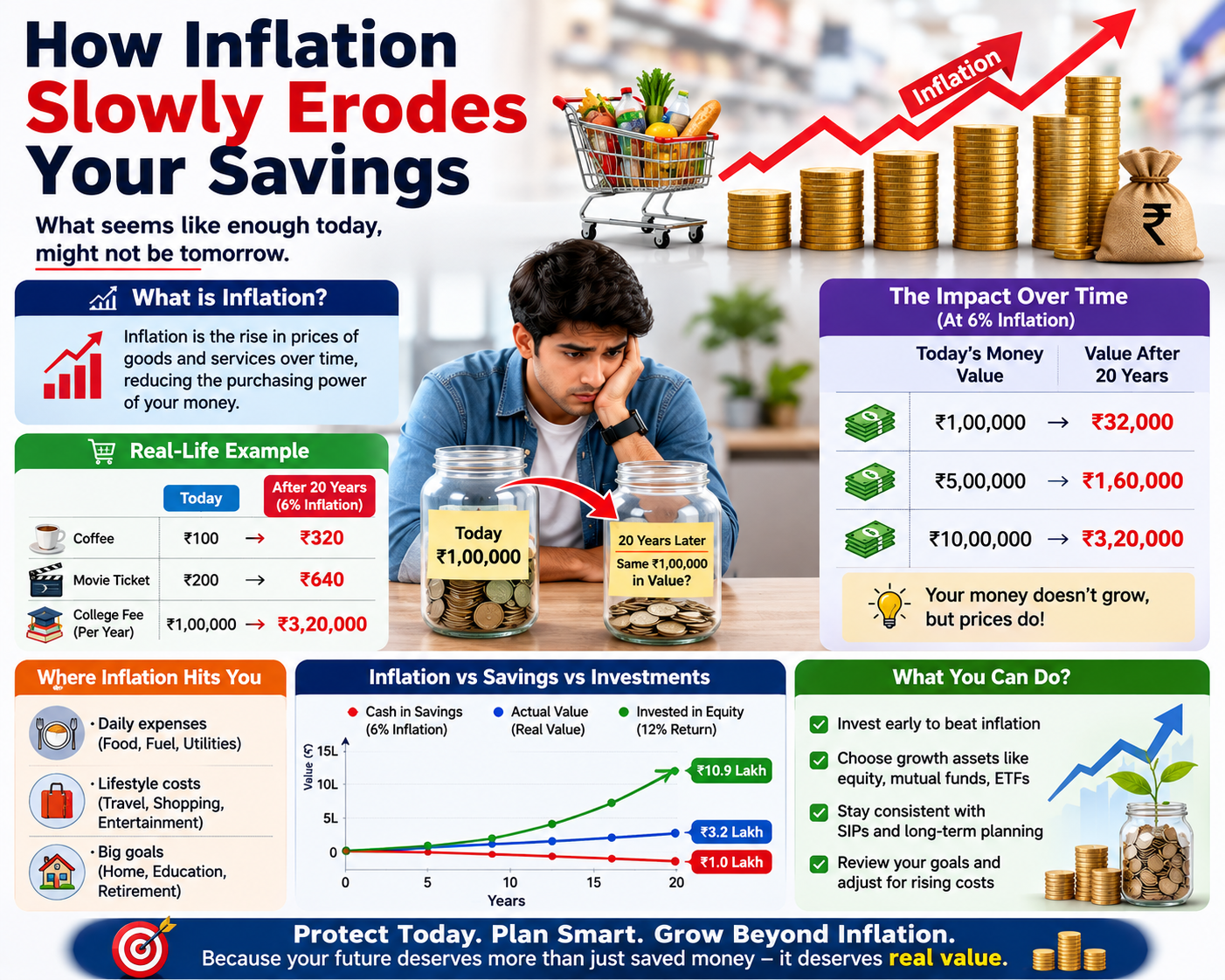
Inflation erodes your savings even when your bank statement shows a growing balance every month. That gap between what your account shows and what your money can actually buy is easy to miss. It builds slowly, year after year, until the damage becomes obvious. India’s retail inflation climbed to 4.45% in July 2026, its highest level since December 2024, according to official CPI data. So the numbers in your savings account may be rising, but their real value could be quietly shrinking at the same time.
In this article, we will explain exactly how inflation erodes your savings, why it feels invisible day to day, and what steps can help protect your money from this slow decline.
What Does It Mean When Inflation Erodes Your Savings?
Inflation erodes your savings by reducing how much your money can actually purchase over time. Prices for everyday goods rise gradually. Your rupees stay the same in number but buy less with each passing year. A savings account balance of Rs 100,000 today will not have the same purchasing power five years from now, even if you never touch it.
This is not a hypothetical concern. Analysts note that even a modest 5% annual inflation rate means something costing Rs 100 today will cost roughly Rs 110 in just two years. Stretch that same math across a decade, and the erosion becomes impossible to ignore.
Why Inflation Erodes Your Savings So Quietly
Interest Rates Rarely Keep Pace
Most savings accounts and fixed deposits offer interest rates that barely outpace inflation, and sometimes fall short entirely. The Reserve Bank of India has kept its key repo rate at 5.25% through much of 2026, while inflation has climbed steadily toward that same level. When your account’s return sits close to the inflation rate, your real gains shrink to almost nothing.
Compounding Works Against You Too
Compounding usually gets credit for building wealth. It works the opposite way against idle cash. Each year that inflation outpaces your returns, the gap between nominal and real value compounds further. This is exactly why inflation erodes your savings faster the longer money sits without earning a real return.
The Damage Feels Invisible Day to Day
Nobody notices their savings losing value on any single day. Prices rise gradually across groceries, transportation, and rent. It is only when you compare purchasing power across several years that the erosion becomes clear and, often, uncomfortable.
How Much Can Inflation Erode Your Savings Over Time?
The math here is worth sitting with directly. India’s central bank targets inflation within a 2% to 6% band, with a medium-term goal of 4%. Even at that “acceptable” target rate, your money loses meaningful value over a decade. A savings account earning 3.5% interest while inflation runs at 4.5% is not actually growing your wealth. It is losing roughly 1% of real value every single year.
What Can Protect Your Money From Inflation
Equity Investments Built for the Long Term
Historically, equity markets have delivered returns that outpace inflation over long time horizons, unlike most fixed-income options. This is part of why many younger investors increasingly choose equity, even when working with limited savings to start. Our earlier piece on why younger investors with limited savings gravitate toward equity explores that shift in more detail, including how small, consistent contributions can build real wealth over time.
Diversification Across Asset Classes
Relying on a single asset type rarely protects against inflation effectively. Spreading investments across equity, debt, and other instruments helps balance short-term stability with long-term growth potential.
Reviewing Your Savings Strategy Regularly
Inflation rates shift over time, and so should your approach to saving. What worked when inflation sat near 2% may not work as well when it climbs toward 5%. Checking in on your savings strategy at least once a year helps you catch erosion before it compounds into a real problem.
This article is for informational purposes only and is not personalized financial advice. Consider speaking with a qualified financial advisor before making decisions based on inflation trends or interest rate changes.
Final Thoughts
Inflation erodes your savings quietly, but the effect is real and measurable over time. A growing bank balance can still represent shrinking purchasing power if returns fail to outpace rising prices. Understanding this gap is the first step toward protecting your money. From there, choosing investments built to outpace inflation, rather than simply parking cash, makes the real difference over the long run.