
Immunisation Strategies: How Institutions Manage Interest-Rate Risk
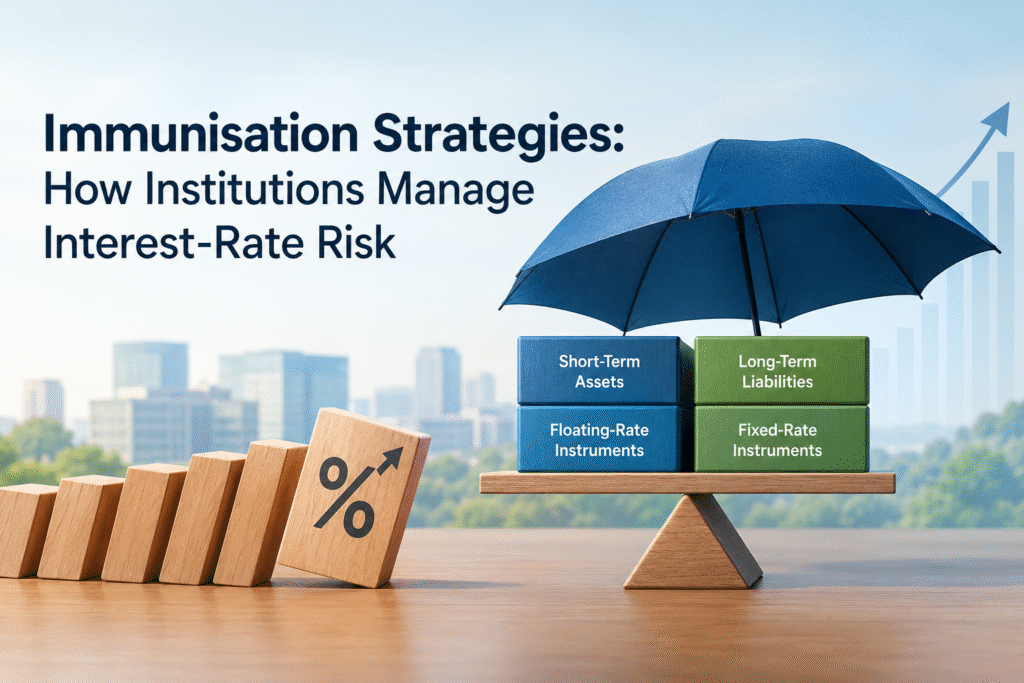
Bond immunisation (also spelt immunization) is an investment strategy that protects a portfolio from interest-rate risk by matching the duration of its assets to the duration of its liabilities. When the two match, a change in interest rates moves both sides by about the same amount, so the institution can still meet its future payments.
Interest rates never sit still. Reports from October 2026 put the yield on India’s 10-year government bond near 7.37%, a three-year high, after a sharp selloff. A move like that is good news for a new buyer of bonds and bad news for anyone already holding them. For a life insurer, a pension fund or a bank, it raises a bigger question. The institution owes fixed sums on fixed dates. How does it make sure the money will be there, whatever rates do?
The answer, in large part, is immunisation. This guide explains what an immunisation strategy is, how duration matching works, what the main variants look like, where they fail, and what a retail investor can take from the way institutions think.
What Is Interest-Rate Risk?
Interest rate risk is the chance that a change in market interest rates reduces the value of an investment or the income it produces. For a bond holder, it shows up in two ways, and the two pull in opposite directions.
Price risk (also called market value risk). When yields rise, the market price of an existing bond falls, because new bonds pay more. When yields fall, the price rises.
Reinvestment risk. The coupons a bond pays, and the principal returned at maturity, have to be invested again at whatever rates exist then. When yields fall, those cash flows earn less. When yields rise, they earn more.
Here is the point that makes immunisation possible. A rise in rates hurts the price but helps reinvestment. A fall in rates helps the price but hurts reinvestment. Somewhere in between, the two effects can cancel out. That balancing point is what an immunisation strategy is built to find.
Why Institutions Care So Much
A retail investor can wait out a bad year. An institution often cannot, because its obligations come with dates attached.
- Life insurers promise maturity benefits, annuity payments and death claims years in advance.
- Pension funds owe monthly pensions to retirees for decades.
- Banks fund long-term loans with deposits that may reprice much sooner, which is the classic asset liability management (ALM) problem.
- Corporate treasuries may need a fixed sum on a known date to repay a debenture or fund a project.
If assets fall in value while liabilities stay the same, a gap opens. The institution then has less money than it owes. This is why risk teams track the duration gap, which is the difference between the duration of assets and the duration of liabilities.
Duration: The Core Idea Behind Immunisation
Macaulay duration is the weighted average time, in years, until a bond’s cash flows are received. Each cash flow is weighted by its present value. A bond that pays everything at the end, such as a zero-coupon bond, has a duration equal to its maturity. A coupon-paying bond has a duration shorter than its maturity, because some money comes back earlier.
Modified duration takes Macaulay duration and turns it into a measure of price sensitivity. It tells you the approximate percentage change in a bond’s price for a 1% change in yield. A bond with a modified duration of 5 will lose about 5% of its value if yields rise by 1 percentage point. Many practitioners also use DV01 (dollar value of a basis point), which is the rupee change in value for a one basis point move in yield.
Duration also has a second meaning that matters here. It is the holding period at which price risk and reinvestment risk offset each other. If you hold a bond for exactly its Macaulay duration, the rise or fall in its price is balanced by the opposite change in reinvestment income. This is the mathematical heart of bond immunisation.
The Three Conditions for Classic Immunisation
The theory goes back to the British actuary F. M. Redington, who published it in 1952 while studying how life insurers should protect themselves. For an immunisation strategy to work against a small, one-time change in rates, three conditions must hold.
- Present value match. The present value of the assets must be at least equal to the present value of the liabilities.
- Duration match. The duration of the assets must equal the duration of the liabilities.
- Convexity condition. The convexity of the assets must be greater than or equal to the convexity of the liabilities.
Convexity measures how the duration of a bond itself changes as yields move. A portfolio with higher convexity gains more when yields fall and loses less when yields rise, compared with a portfolio of the same duration but lower convexity. This is why institutions like having assets that are a little more convex than their liabilities. It acts as a cushion.
A Worked Example in Rupees
Suppose a pension trust must pay ₹1,00,00,000 in exactly 6 years. The market yield today is 7%, and the yield curve is flat. For simplicity, we use zero-coupon bonds.
The present value of the liability is ₹1,00,00,000 divided by 1.07 raised to the power 6. That comes to about ₹66,63,400. The duration of the liability is 6 years.
The trust could simply buy a 6-year zero-coupon bond and be done. In practice, such a bond may not exist at the right size or price. So the trust builds a mix of a 3-year zero and a 10-year zero that gives a combined duration of 6.
- Weight in the 3-year zero: 4/7, or about 57.14% (₹38,07,670)
- Weight in the 10-year zero: 3/7, or about 42.86% (₹28,55,750)
Check the duration: (0.5714 × 3) + (0.4286 × 10) = 6.0 years. Good.
Now suppose yields move instantly and in parallel. Here is what happens, with figures rounded.
| Market yield | Value of liability | Value of asset mix | Surplus |
|---|---|---|---|
| 6% | ₹70,49,600 | ₹70,53,300 | +₹3,700 |
| 7% | ₹66,63,400 | ₹66,63,400 | ₹0 |
| 8% | ₹63,01,700 | ₹63,04,950 | +₹3,250 |
Whether rates rise or fall by one percentage point, the asset mix stays slightly ahead of the liability. The small surplus comes from convexity. The 3-year and 10-year mix is a “barbell,” and a barbell is more convex than a single bond with the same duration. The trust has protected itself against a move in rates without having to guess which way rates will go.
Main Types of Immunisation Strategies
1. Single-period (classic) immunisation
This is the example above. It targets one liability on one future date by matching duration, present value and convexity. It is simple and widely taught, and it is the starting point for most other approaches.
2. Multi-period immunisation
Most institutions face a stream of payments, not one. In multi-period immunisation, the portfolio is built so that its duration equals the duration of the entire liability stream, and the asset cash flows are spread so that they bracket the liabilities on both sides of the duration point. This is harder to build and needs more careful monitoring.
3. Cash flow matching (dedication)
Cash flow matching, also called a dedicated portfolio, takes a different route. Instead of matching duration, the manager buys bonds whose coupons and principal payments line up, date by date, with the liabilities. If a payment of ₹5 crore is due in March 2030, the portfolio holds a bond that returns at least that sum in March 2030.
The advantage is that it takes almost all interest-rate risk off the table, because nothing needs to be sold before maturity. The cost is that it is usually more expensive to set up, it needs a wide supply of suitable bonds, and it leaves little room to earn extra return. Many institutions use a combination: cash flow matching for the nearest years, and duration matching for the distant ones.
4. Contingent immunisation
Contingent immunisation, developed by Martin Leibowitz and Alfred Weinberger in the early 1980s, allows active management as long as the portfolio stays above a safety floor. The manager can pursue higher returns while the portfolio value is comfortably above the amount needed to meet the liability. If the portfolio value falls to the floor, the manager must switch to full immunisation and lock in the result. It gives some freedom without giving up the guarantee.
5. Liability-driven investing (LDI)
Liability driven investing is the modern, broader version of the same idea. The investment portfolio is designed around the liabilities and not around a market benchmark. LDI frameworks often combine bonds with interest rate swaps, so that the duration of the liabilities can be matched even when long-dated bonds are scarce. Defined-benefit pension schemes in the United Kingdom and the United States have used LDI heavily, and the 2022 gilt market stress showed how leverage inside these programmes can create its own risks.
Tools Institutions Use to Manage Duration
Immunisation is not only about picking bonds. Practitioners use a set of tools.
- Government securities and zero-coupon instruments. G-Secs carry little credit risk. Where available, strips and zero-coupon bonds give a cleaner duration profile.
- Interest rate swaps and futures. These allow an institution to lengthen or shorten duration without buying or selling the underlying bonds, where regulations allow.
- Key rate durations. Real yield curves rarely move in parallel. Key rate duration measures sensitivity to a move at one maturity point, such as the 2-year, 5-year or 10-year yield, so managers can control exposure to twists and steepening.
- Gap analysis and scenario testing. Banks run repricing gap reports and stress test their balance sheets against rate shocks, as part of regular ALM discipline.
- Rebalancing. Duration changes as time passes and as yields move. A portfolio that was matched on day one will drift. Managers rebalance on a schedule or when the gap crosses a set limit.
The Indian Context
Indian institutions deal with interest rate risk every day, and they have some features that are specific to the market here.
Insurers. Life insurers hold long-dated liabilities, in some cases 20 to 30 years, but the supply of very long-dated government bonds is limited. This creates a duration mismatch that is hard to close using bonds alone, which is one reason there has been regular discussion about interest rate derivatives for insurers.
Pension and provident funds. Retirement funds such as the EPFO and NPS managers hold large portfolios of G-Secs and state development loans, and they think about duration against long-term payout patterns.
Banks. Banks in India manage interest rate risk in the banking book through repricing gap and duration gap tools, and they hold bonds under different accounting categories. A sharp rise in yields can lead to mark-to-market losses on bonds held outside the hold-to-maturity category.
Yield behaviour. Indian yields can move against the direction of policy rates, as the RBI’s own concern about elevated yields during the 2025 rate-cut cycle showed. The repo rate was cut by 100 basis points that year, yet the 10-year benchmark yield fell only about 30 basis points. For a manager who assumed yields would follow the repo rate, that gap was a costly surprise. Immunisation reduces dependence on such forecasts.
Where Immunisation Falls Short
A good strategy is one whose limits you know. Immunisation has several.
- Parallel shift assumption. Classic immunisation assumes that all yields move by the same amount. Real curves twist and bend. Matching key rate durations and using a barbell or ladder can reduce this risk, but not remove it.
- Rebalancing cost. Duration drifts, so portfolios need regular adjustment. Each trade costs money, and in a market with thin liquidity the cost can be large.
- Credit risk. Immunisation protects against rate moves, not defaults. A downgrade or default in a corporate bond can break the match.
- Call and prepayment risk. Bonds that can be called early or loans that can be prepaid change the expected cash flows, and with them the duration.
- Liability uncertainty. An insurer does not know exactly when a policyholder will claim or surrender. Estimates of liability duration can be wrong.
- Reinvestment and horizon issues. Immunisation works best when the horizon is known and the portfolio is monitored. If the horizon shifts, the match breaks.
What Retail Investors Can Learn From This
You are not a pension fund, but the logic carries over to personal goals.
Match duration to your time horizon. If you need money for a child’s college fees in five years, a bond fund with an average duration near five years is a closer match than a fund with a duration of two or ten. A fund that is too long takes on price risk. A fund that is too short takes on reinvestment risk.
Look at target maturity funds and hold-to-maturity bonds. A bond held until maturity returns its face value no matter what happened to its price in between, provided the issuer pays. Target maturity funds, which hold bonds that mature around a set date, follow a similar idea, though they carry their own costs and credit risks.
Build a ladder for several goals. If you have goals at different dates, spreading money across bonds that mature in different years gives you cash flows when you need them and reduces the impact of any single rate move.
Check duration, not only yield. Two funds may show the same yield, but the one with a higher duration will fall more when rates rise. Fund factsheets list average maturity and modified duration. Read both.
This is general education and not personal investment advice. Check the current yields, fund details and your own situation before you act, and speak to a SEBI-registered investment adviser if you need personalised guidance.
Frequently Asked Questions
What is an immunisation strategy in bonds?
An immunisation strategy is a method of building a bond portfolio so that changes in interest rates do not stop it from meeting a future liability. The usual method is to match the duration of the assets to the duration of the liabilities, so that price changes and reinvestment changes cancel each other out.
How does duration matching work?
Duration matching sets the weighted average life of a bond portfolio equal to the weighted average timing of the liabilities. If rates rise, the portfolio falls in price but reinvests at higher rates. If rates fall, the price rises but reinvestment earns less. With matched duration, the gain on one side offsets the loss on the other.
What is the difference between immunisation and cash flow matching?
Immunisation matches duration, and the portfolio value moves with rates but stays in step with the liabilities. Cash flow matching, also called dedication, buys bonds whose payments arrive on the same dates as the liabilities, so there is little need to sell bonds before maturity. Cash flow matching is more certain but usually more costly.
What are the conditions for bond immunisation?
There are three. The present value of assets must be at least equal to the present value of liabilities. The duration of assets must equal the duration of liabilities. The convexity of assets must be at least as high as the convexity of liabilities.
Why does convexity matter in immunisation?
Convexity measures how much a bond’s duration changes as yields change. Assets with higher convexity than the liabilities gain more when yields fall and lose less when yields rise, so they leave a margin of safety against large rate moves.
Who uses immunisation strategies?
Life insurers, pension funds, banks, endowments and corporate treasuries use them, because all of these have fixed future obligations. Some mutual fund managers use related ideas when they build target maturity funds.
Does immunisation remove all risk?
No. It reduces interest-rate risk, but it does not remove credit risk, liquidity risk, call risk or errors in estimating the liabilities. It also assumes yields move in parallel, which is often not the case, so portfolios need regular rebalancing.
What is the duration gap?
The duration gap is the difference between the duration of a firm’s assets and the duration of its liabilities. A large gap means the net worth of the institution is sensitive to interest rate moves. Banks and insurers track it as part of asset liability management.
Key Takeaways
- Interest-rate risk has two parts, price risk and reinvestment risk, and they move in opposite directions.
- Immunisation balances the two by matching asset duration to liability duration.
- Classic immunisation needs a present value match, a duration match and enough convexity.
- Cash flow matching, contingent immunisation and liability driven investing are close relatives of the same idea.
- Real-world limits include non-parallel yield moves, credit risk, rebalancing costs and uncertain liabilities.
- Retail investors can borrow the logic by matching bond fund duration to their goal dates.
This article is for education only and is not investment advice. Bond prices and yields change daily, so check current data before making a decision.