
Loss Aversion and Portfolio Decisions: Why Investors Hold Losing Positions Too Long
Quick Answer: Why Do Investors Hold Losing Stocks Too Long?
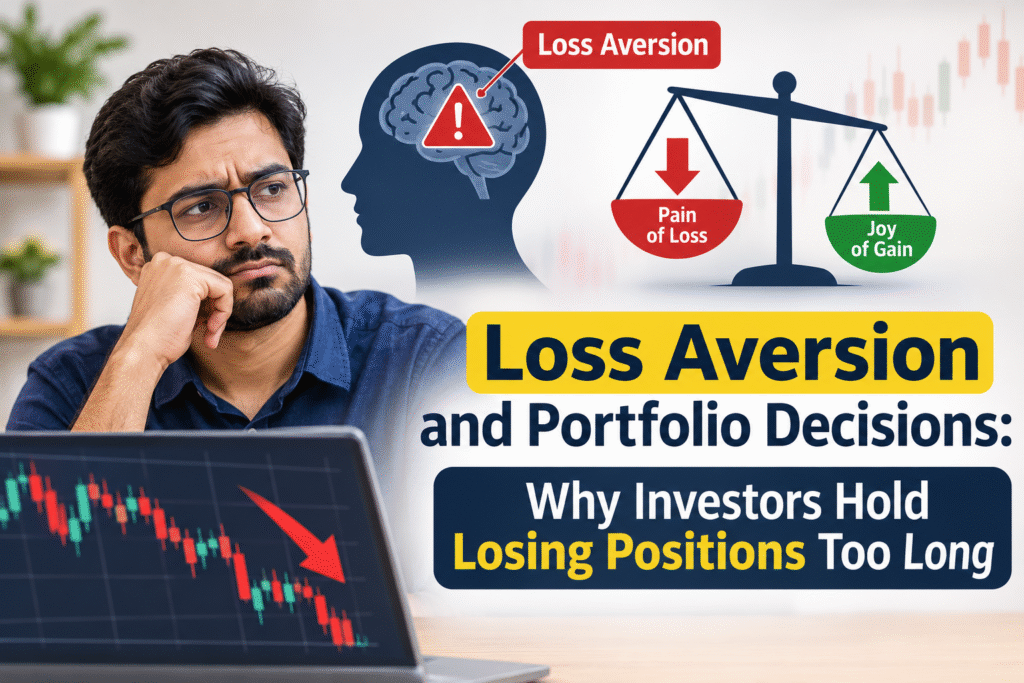
Investors hold losing stocks too long because of loss aversion. Loss aversion is a behavioral finance bias where a loss hurts about twice as much as an equal gain feels good. Selling a stock at a loss turns a paper loss into a real one, so many investors wait and hope for the price to come back to their buying price. This habit is also called the disposition effect, and it often leaves money stuck in weak investments while better options go untouched.
If you have ever said, “I will sell once it comes back to my buying price,” this article is for you.
What Is Loss Aversion in Investing?
Loss aversion is the tendency to feel the pain of a loss more strongly than the pleasure of a gain of the same size. In simple words, losing ₹10,000 feels worse than gaining ₹10,000 feels good.
The idea comes from prospect theory, which psychologists Daniel Kahneman and Amos Tversky introduced in 1979. Their research showed that people do not judge money in a cold, logical way. We judge it against a starting point, usually the price we paid, and we react far more strongly when we fall below that point than when we rise above it. In later work, Tversky and Kahneman estimated that losses weigh roughly twice as much as gains in our minds. Kahneman later received the Nobel Prize in Economics for this body of work.
For an investor, the starting point is almost always the purchase price. That is the problem. The market does not know or care what you paid for a stock. Your buying price is a memory, not a fact about the company’s future.
What Is the Disposition Effect?
The disposition effect is the habit of selling winning investments too early and holding losing investments too long. Economists Hersh Shefrin and Meir Statman gave it this name in 1985.
A well known study by Terrance Odean looked at the trading records of thousands of brokerage accounts. He found that investors sold winners at a noticeably higher rate than losers. Roughly 14.8 percent of available gains were sold, compared with about 9.8 percent of available losses. In other words, people were quick to lock in a profit and slow to admit a mistake.
This is a double hit on your returns. You cut your good stocks short, and you let your weak stocks drag on.
Why Do Investors Hold on to Losing Positions? 6 Reasons
1. A loss is not a loss until you sell it
This is the most common thought. As long as you hold the stock, the loss stays on paper, and there is still a chance it will recover. Selling makes the loss final, and that feels painful. So investors choose to wait, even when waiting has no good reason behind it.
2. The urge to break even
Many investors set one goal for a falling stock: get back to the buying price and then leave. This is called the break-even effect. The trouble is that a stock has no duty to return to your price. While you wait, your money earns nothing, and the opportunity cost keeps growing.
There is also a simple math problem here. A 50 percent fall needs a 100 percent rise to get back to even. If your ₹1,00,000 becomes ₹50,000, the stock has to double just to bring you back to where you started.
3. The sunk cost fallacy
The sunk cost fallacy means we keep putting time, money or effort into something because we have already put a lot into it. In investing, it sounds like, “I have held this for four years, I cannot sell now.” The four years are gone either way. The only useful question is whether this stock is the best use of your money from today.
4. Regret and ego
Selling at a loss means admitting you made a wrong call. For many people that feels personal, especially if they told friends, family or colleagues about the stock. Holding on protects the ego, even though it can hurt the portfolio.
5. Hope and tips from others
Many retail investors buy because of a tip, a social media video or a hot sector. When the stock falls, they hold on because they still believe the original story, even when the facts have changed. Hope is not an investment strategy.
6. Checking the portfolio too often
Research in behavioral finance suggests that people who look at their holdings very often see more small losses, and that makes them feel the pain more. Daily checking can push investors into emotional decisions, either panic selling or stubborn holding.
How Loss Aversion Hurts Your Portfolio
Holding losing stocks for too long can damage your long-term returns in a few clear ways.
- Opportunity cost. Money stuck in a weak stock cannot be used in a stronger investment, such as an index fund or a good quality company.
- Poor diversification. One or two big losers can grow into an oversized part of your portfolio, or sit there as dead weight.
- Lower risk-adjusted returns. You carry the risk of a weak business without a fair reward for it.
- Missed tax benefits. In India, capital losses can be used to reduce tax on capital gains, but only if you book them (more on this below).
- Stress. A portfolio full of red numbers makes it harder to think clearly about any decision.
A Simple Example
Take two investors, Ravi and Meena. Both bought ₹2,00,000 worth of the same mid-cap stock, and it fell 40 percent to ₹1,20,000.
Ravi decides to wait until the price returns to his buying level. Five years later, the stock is still down 25 percent, at ₹1,50,000.
Meena sells at ₹1,20,000 after her review, and puts the money in a diversified Nifty 50 index fund. If that fund grows at a long-term average of around 11 to 12 percent a year, her ₹1,20,000 could grow to somewhere near ₹2,00,000 in five years. These figures are only an example and not a promise, because market returns are never fixed. But the point is clear. Meena was willing to accept the loss, and it gave her money a better place to work.
When Should You Sell a Losing Stock?
Not every falling stock should be sold. A price drop alone is not a reason to sell, and a price drop alone is not a reason to hold. What matters is why the stock fell and what you expect next.
You may want to sell a losing position when:
- The original reason for buying is broken. The business model has weakened, management has lost trust, or debt has become a real risk.
- The company’s earnings and fundamentals keep getting worse for several quarters, and not just because of a temporary market dip.
- You would not buy it today. If you had cash instead of this stock, would you buy it at the current price? If the honest answer is no, that is a strong signal.
- A better option exists. Your money could do more work elsewhere, in a stronger stock, an index fund or a mutual fund SIP.
- The position is too large for your risk level, and it keeps you awake at night.
On the other hand, a stock that is down because the whole market is down, while the business remains strong, may be worth holding or even adding to. The key is to decide using facts about the company, and not feelings about your buying price.
7 Practical Ways to Beat Loss Aversion
1. Ask the fresh money question
For every holding, ask: “If I had this amount in cash today, would I buy this stock at this price?” If not, you are probably holding it for emotional reasons.
2. Write down your reason before you buy
Keep a short note for every investment: why you bought it, what you expect, and what would prove you wrong. When the stock falls, read that note. If the reason no longer holds, you have your answer.
3. Use a stop loss or exit rule
A stop loss is a pre-decided price or condition at which you will sell. Setting it in advance, when you are calm, takes emotion out of the moment. Some investors use a fixed percentage, such as 15 to 20 percent below the purchase price. Long-term investors may prefer a rule based on fundamentals, such as selling if the company misses earnings for three quarters in a row. Pick the method that suits your style and keep to it.
4. Review your portfolio on a schedule
Choose a fixed review date, for example once every quarter or twice a year. Reviewing on a schedule keeps you from reacting to daily price moves, and it forces you to look at every holding, including the ones you would rather ignore.
5. Think in terms of the whole portfolio
Do not judge each stock on its own. Look at your overall portfolio return and asset allocation. A single loser looks smaller, and easier to let go of, when you see it as one part of a bigger picture.
6. Use tax loss harvesting
In India, if you sell a stock or equity mutual fund units at a loss, you can set that capital loss against capital gains. As per the Income Tax rules, a short-term capital loss can be set off against both short-term and long-term capital gains, while a long-term capital loss can only be set off against long-term capital gains. Unused losses can be carried forward for up to eight assessment years, as long as you file your income tax return on time. Rules and tax rates can change, so check the latest provisions or speak with a qualified tax advisor before you act.
This gives you a practical reason to sell, and it turns a painful loss into something useful.
7. Automate where you can
Investing through a monthly SIP in index funds or diversified mutual funds takes many of these decisions out of your hands. You do not have to decide when to buy or sell each stock, and that removes a big part of the emotional pressure.
Common Mistakes to Avoid
- Averaging down without a reason. Buying more of a falling stock only to bring down your average price is the sunk cost fallacy in action. Add to a position only if you would be happy to buy it fresh at the new price.
- Selling all your winners and keeping all your losers. This leaves a portfolio full of weak stocks.
- Ignoring the loss completely. Not opening your demat app does not make the problem go away.
- Going to the other extreme. Selling every stock the moment it drops is also a mistake. The goal is clear thinking, not constant trading.
Loss Aversion Is Normal, but Manageable
Loss aversion is not a sign of weakness or poor intelligence. It is a built-in part of how human beings think, and even experienced investors and professionals face it. You cannot switch it off. What you can do is build a system of rules, reviews and written reasons that works even when your emotions pull in the other direction.
The next time you look at a stock that has been red for a long time, do not ask, “How do I get my money back?” Ask a better question: “Where will my money work best from here?” That one change in thinking can improve your portfolio decisions for years.
Frequently Asked Questions
What is loss aversion in simple words?
Loss aversion means a loss hurts more than a gain of the same size feels good. Because of this, people take steps to avoid realizing losses, even when doing so is the wrong financial choice.
What is the difference between loss aversion and the disposition effect?
Loss aversion is the underlying bias, the stronger feeling of pain from losses. The disposition effect is the behavior that results from it: selling winning investments too soon and holding losing ones too long.
Why do investors hold losing stocks?
Investors hold losing stocks mainly because selling makes the loss real. Other reasons include the wish to break even, the sunk cost fallacy, ego, hope and trust in tips from others.
Is it a good idea to hold a stock until it breaks even?
Not always. The market has no reason to return to your buying price. Waiting for break even can lock up your money for years and cost you better returns elsewhere. Decide based on the company’s future, not your past price.
How do I know when to sell a losing stock?
Sell when the reasons you bought it no longer hold, when the company’s fundamentals keep getting worse, when you would not buy it again today, or when a better use for the money exists.
What is a stop loss, and does it help with loss aversion?
A stop loss is a pre-set price or rule at which you sell an investment to limit your loss. It helps because you decide in advance, when you are calm, instead of making a decision under emotional pressure.
Can I use stock market losses to save tax in India?
Yes. Capital losses from shares and equity mutual funds can be set off against capital gains, and unused losses can be carried forward for eight assessment years if you file your return on time. Short-term and long-term losses follow different set-off rules, so check the current rules or consult a tax professional.
Does a SIP help reduce loss aversion?
A SIP can help because it spreads your buying over time and removes the need to time the market. It does not remove losses, but it reduces emotional decision making.
Key Takeaways
- Loss aversion makes losses feel roughly twice as painful as equal gains feel good.
- The disposition effect leads investors to sell winners early and hold losers too long.
- Your buying price is not a reason to hold a stock. Future prospects are.
- Use written reasons, scheduled reviews, exit rules and tax loss harvesting to stay objective.
- Ask yourself every time: “Would I buy this today?”
Disclaimer: This article is for education only and is not investment, tax or legal advice. Investing in the stock market carries risk, including loss of capital. The example figures are illustrative and not a guarantee of returns. Please consult a SEBI registered investment adviser or a qualified tax professional before making decisions.
Be Part of Something Bigger!
Whether you’re exploring new ideas, learning something new, or looking for opportunities, Enigma Community brings you closer to a world of possibilities.
Join Us: https://www.enigmacommunity.com/