
Mobile Wallets vs UPI: Which Is Safer for Indian Users?
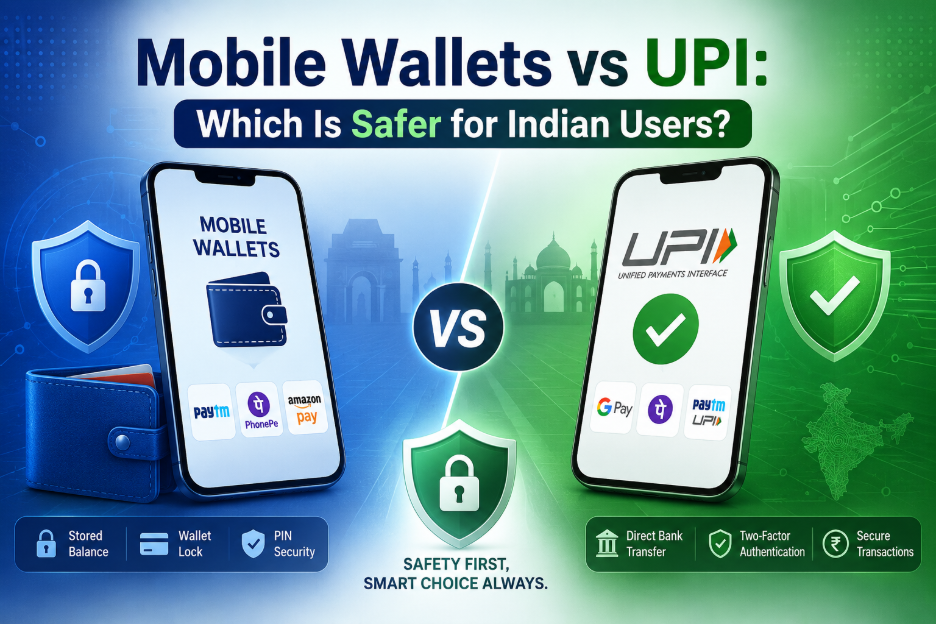
Mobile Wallets vs UPI: Which Is Safer for Indian Users?
India has quietly become one of the largest digital payment markets on earth, and two names come up in almost every conversation about it — mobile wallets and UPI. Both let you pay a shopkeeper, split a dinner bill, or send money to a cousin in another city without touching cash. But convenience is not the same thing as safety, and the two systems are built on different foundations. If you have ever wondered which one deserves more of your trust, this guide walks through the technology, the rules, the fraud numbers, and the habits that actually keep your money safe.
Two Different Ways of Moving Money
Mobile wallets — Paytm, PhonePe Wallet, MobiKwik, and similar apps — work on a prepaid model. You load money in from your bank account or card, and from that point on, spending happens inside the wallet itself, without the bank being consulted for every transaction. The Reserve Bank of India regulates these apps as Prepaid Payment Instruments (PPIs), sorting them into closed, semi-closed, and open categories depending on how widely the balance can be used.
UPI, short for Unified Payments Interface, works differently. Instead of holding a balance, it moves money directly between bank accounts in real time, using a virtual payment address such as name@bank. The National Payments Corporation of India (NPCI) built and runs the system, and it operates under the direct supervision of the RBI through the Payment and Settlement Systems Act.
The distinction matters because it shapes how each system fails, if it fails at all.
Where the Security Actually Sits
Wallets lean on a few structural habits. Most lock your account to a single registered device, which cuts down on the chance of a stranger logging in from elsewhere. Because money is loaded ahead of time rather than pulled from a bank account on demand, the amount at risk in any single incident tends to be smaller. Full KYC verification is required before higher transaction limits open up, which adds a layer of identity checking before serious money can move.
UPI takes a different route. Every transaction needs a PIN entered on the spot, alongside the authentication built into the app itself — a two-step check that happens every single time, not just at login. Behind the scenes, NPCI runs a Central Payment Fraud Information Registry that uses machine learning to flag suspicious transactions as they happen. NPCI also enforces a broader security framework across every bank and provider on the network, including yearly audits and ongoing vulnerability checks.
Neither approach is flawless. Wallets can still be drained if someone gets into your phone or email. UPI can still be exploited through scams that trick the user rather than break the technology.
The Rules Behind Each System
Wallet providers answer to RBI’s Master Directions on PPIs, first laid out in 2021 and updated since. These rules cover know-your-customer requirements, spending caps, and licensing for anyone issuing a wallet, bank or otherwise. Semi-closed wallets need explicit RBI authorization, and open PPIs — the ones that allow cash withdrawal or ATM use — face the tightest scrutiny.
UPI sits under NPCI’s day-to-day management, with RBI oversight above it. NPCI issues frequent technical notices to the banks and apps that plug into the network — things like weekly checks on dormant mobile numbers, caps on “collect” requests above ₹2,000, and limits on how often an app can check your account balance. These are small, unglamorous rules, but they close off some of the more common tricks used in scams.
What the Fraud Numbers Actually Say
UPI’s fraud figures look large mostly because UPI itself is enormous. Roughly one in five UPI users say they have run into fraud over a three-year stretch. In FY24 alone, UPI-related fraud came to about ₹1,087 crore across 13.42 lakh cases — more than double the 7.25 lakh cases recorded the year before. Most of this isn’t a flaw in the technology; it comes down to phishing links, fake QR codes, rigged payment requests, and people impersonating banks or relatives. More than half of victims never even report what happened to them, which means the real number is likely higher still.
Wallet fraud gets far less press, partly because there’s less public data to draw from. The risks that do show up tend to involve someone taking over an account through a compromised phone or email, misusing KYC details to push through an unauthorized top-up, or sending fake cashback offers designed to look like a real promotion.
So Which One Is Actually Safer?
On paper, UPI has the stronger architecture — direct bank-level checks, live fraud monitoring, and a regulator watching the whole network closely. In practice, though, a wallet limits how much you stand to lose, simply because it only ever holds the balance you chose to load into it. RBI has also made it possible to move money between wallets and UPI, which means the two aren’t really competitors so much as two tools that work better together.
The honest answer is that the safer option is less about which system you pick and more about how carefully you use it.
Staying Safe: A Short Checklist
If you use UPI:
- Set a strong PIN and never share it, not even with someone claiming to be from your bank.
- Treat every unexpected link with suspicion, even one that appears to come from a friend.
- Report anything unusual right away through your UPI app, your bank, or the national cybercrime helpline at 1930 (cybercrime.gov.in).
- Clean out UPI IDs and app permissions you no longer use.
If you use a mobile wallet:
- Keep only what you need in the wallet at any given time.
- Complete full KYC so you get access to the stronger compliance protections.
- Use wallet-to-UPI transfers when you want to limit how much sits exposed in one place.
- Install the app only on your own device, and download it only from an official app store.
The Bigger Picture
UPI and mobile wallets are both pushing India’s digital economy forward, and neither is going away. UPI wins on infrastructure and regulatory muscle; wallets win on containing the damage if something goes wrong. The most resilient approach isn’t choosing a side — it’s keeping wallet balances modest, finishing KYC properly, and treating every UPI transaction with the same caution you’d use handing cash to a stranger.
As digital payments keep growing across India, so will the attempts to exploit them. But between tighter NPCI rules, RBI’s ongoing oversight, and a more alert user base, the country’s digital payment ecosystem is better equipped today than it was even two years ago — and it keeps improving from here.
This article is for general informational purposes and does not constitute financial advice. For guidance specific to your situation, consult a qualified financial advisor.