
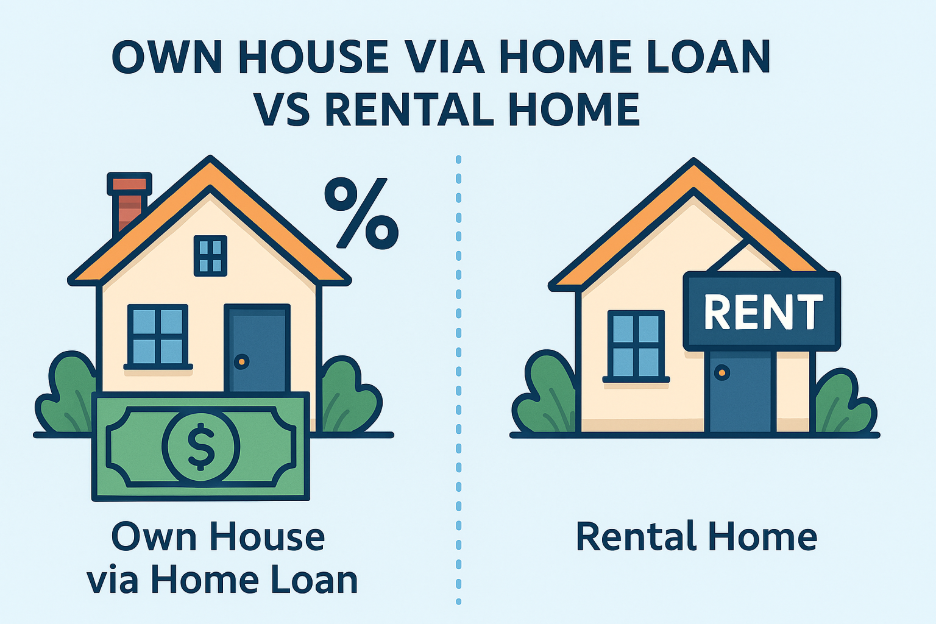
Which is better for an average investor in India?
For decades, owning a home has been considered one of the most important milestones for Indian families. It is not just a financial decision but an emotional one, associated with stability, security, and social status. At the same time, a growing number of young professionals and financially aware investors are questioning this traditional belief. With rising property prices, moderate rental yields, and increasing awareness of equity and mutual fund investments, the classic question has returned with renewed intensity: should you buy a house using a home loan, or should you rent and invest the difference?
This article looks at the buy versus rent decision purely from the perspective of an average investor in India, balancing numbers, risk, lifestyle, and long-term wealth creation.
Understanding the Indian context
Before comparing options, it is important to understand the Indian real estate and financial landscape.
Residential property prices in most Indian cities have grown steadily over the long term, but the growth has not been uniform. Certain micro-markets have delivered strong appreciation, while others have remained stagnant for years. At the same time, rental yields in India are relatively low compared to global standards. In most large cities, gross rental yields typically range between 2 percent and 4 percent annually.
On the financing side, home loan interest rates generally hover between 8 percent and 9.5 percent, depending on the borrower profile and lender. This means the cost of borrowing is significantly higher than the income generated through rent.
This gap between rental yield and loan interest is the foundation of the buy versus rent debate in India.
Option 1: Buying a house with a home loan
How buying works financially
When you buy a house using a home loan, you commit to three major financial components:
- A large upfront down payment, usually 20 percent or more of the property value
- Monthly EMIs for 15 to 30 years
- Additional costs such as stamp duty, registration, maintenance, and property tax
In return, you build ownership in a tangible asset. Each EMI increases your equity in the property, even though the interest component is high in the initial years.
Advantages of buying
Forced savings and discipline
For many salaried individuals, an EMI acts as a forced savings mechanism. Even if you are not disciplined about investing, paying an EMI ensures that some portion of your income goes toward asset creation every month.
Long-term capital appreciation
Residential property in India has historically appreciated over long periods, especially in cities with strong job growth and infrastructure development. While returns are not guaranteed, quality properties held for 15 to 20 years can create substantial wealth.
Tax benefits under the old tax regime
Home loan borrowers can claim deductions on both principal repayment and interest payments under the old tax regime. While these benefits have reduced in relevance due to the new tax regime, they can still provide meaningful savings for some households.
Emotional and lifestyle security
Owning a home provides stability. There is no risk of eviction, rent hikes, or sudden relocation. This non-financial benefit is extremely valuable for families with children or individuals seeking long-term settlement.
Disadvantages of buying
High opportunity cost
The down payment and EMIs lock a large portion of your capital into a single, illiquid asset. This money could potentially earn higher returns if invested in equities or mutual funds over the long term.
Low rental yield relative to loan cost
From an investment perspective, buying a house to live in rarely makes sense purely on cash flow. The EMI is usually much higher than the rent for a similar property.
Illiquidity and concentration risk
Real estate is not easy to sell quickly, especially during market downturns. Additionally, many Indian households end up with a large percentage of their net worth tied to one property.
Maintenance and hidden costs
Repairs, society charges, renovations, and vacancy risk if you move out are often underestimated when calculating the true cost of ownership.
Option 2: Renting a home and investing the difference
How renting works financially
When you rent, your upfront cost is limited to a security deposit and brokerage in some cases. Your monthly outflow is the rent, which is usually significantly lower than the EMI for the same property.
The key assumption behind renting as a wealth strategy is that you invest the difference between what your EMI would have been and what you actually pay as rent.
Advantages of renting
Higher financial flexibility
Renting keeps your capital free. You are not locked into one city, one property, or one loan. This is particularly useful for professionals whose careers involve relocation or job changes.
Potentially higher wealth creation
If the surplus cash is consistently invested in equity mutual funds or similar growth assets, long-term returns can exceed real estate appreciation. Historically, equities in India have delivered higher long-term returns than residential property in many markets.
Lower risk and liquidity
Financial investments are easier to rebalance, redeem, or redirect based on changing goals. This flexibility reduces long-term financial risk.
Lower stress in uncertain phases
During early career stages or volatile income phases, renting reduces financial pressure compared to a long-term EMI commitment.
Disadvantages of renting
No asset ownership at the end
After decades of paying rent, you do not own the house you live in. This can be psychologically uncomfortable for many people, especially later in life.
Requires high investment discipline
The rent-and-invest strategy only works if you actually invest the savings every month. If the surplus is spent instead of invested, renting can significantly weaken long-term wealth creation.
Uncertainty and lifestyle constraints
Rent hikes, landlord restrictions, and the need to relocate can affect quality of life, especially for families.
A simple comparison for the average investor
For an average salaried investor in India, the decision usually depends on three key factors.
Time horizon
If you plan to live in the same city and same house for at least 10 to 15 years, buying becomes more attractive. Shorter time horizons usually favor renting.
Investment discipline
If you are confident about investing regularly and staying invested through market cycles, renting and investing the difference can build more wealth. If not, buying provides structure and discipline.
Emotional priorities
Financial optimization is important, but peace of mind matters. For many, the emotional security of owning a home outweighs potential financial trade-offs.
So which is better?
There is no universal answer, but some broad conclusions can be drawn.
For young professionals in their 20s and early 30s, especially in high-cost cities, renting and investing the surplus is often financially superior, provided there is strong discipline.
For families seeking stability, long-term settlement, and emotional security, buying a home using a reasonably sized loan can be a sound decision, even if it is not the most optimal investment mathematically.
For the average Indian investor, the best approach is often a hybrid one. Rent during early career years while aggressively building financial assets. Buy a home later, once income is stable, the down payment does not strain finances, and the EMI comfortably fits within long-term cash flows.
Final thoughts
The buy versus rent debate is not about right or wrong. It is about alignment with life stage, risk appetite, and financial behavior. A home is both an asset and a liability, both a financial instrument and an emotional anchor.
The smartest decision is not the one that looks best on a spreadsheet alone, but the one that allows you to sleep peacefully at night while steadily building long-term wealth.