
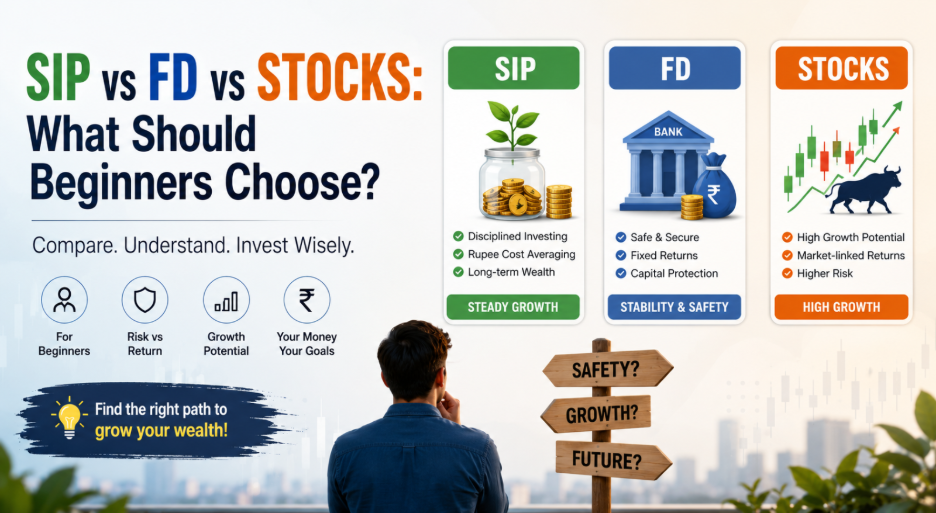
SIP vs FD vs Stocks: What Should Beginners Choose?
Introduction
When you start your investment journey, the choices can feel overwhelming. Should you go for the safety of Fixed Deposits (FDs), the disciplined approach of Systematic Investment Plans (SIPs), or dive into the high-risk, high-reward world of stocks? Each option has its own merits and drawbacks, and the right choice depends on your risk appetite, financial goals, and investment horizon.
In this blog, we’ll break down FDs, SIPs, and Stocks from the perspective of a seasoned financial expert, using real-world examples and actionable insights to help beginners make informed decisions.
1. Fixed Deposits (FD): The Safe Haven
FDs have been the traditional favorite for Indian investors. They offer guaranteed returns and capital protection, making them ideal for risk-averse individuals.
Key Features
- Returns: 6%–7.5% annually (2025 average)
- Risk: Almost zero; backed by banks and regulated by RBI.
- Liquidity: Moderate; premature withdrawal incurs penalties.
- Taxation: Interest is fully taxable as per your income slab.
Example:
Invest ₹1,00,000 in an FD for 5 years at 6.5%. You’ll receive approximately ₹1,38,225 at maturity. Safe, but does it beat inflation? Not really.
Best For:
- Short-term goals (≤3 years)
- Emergency funds
- Senior citizens seeking stability
2. Systematic Investment Plans (SIP): The Disciplined Wealth Builder
SIPs allow you to invest small amounts regularly in mutual funds, leveraging rupee cost averaging and compounding.
Key Features
- Returns: Historically 10%–14% annually for equity-oriented SIPs over 7+ years.
- Risk: Market-linked; moderate to high in the short term, but risk reduces over time.
- Liquidity: High; you can stop or redeem anytime.
- Taxation:
- Equity funds: LTCG taxed at 10% beyond ₹1 lakh/year.
- Debt funds: Taxed as per slab post-2023 changes.
Example:
Invest ₹2,000/month for 5 years at 12% average return. Total investment = ₹1,20,000; maturity value ≈ ₹1,62,000. That’s ₹42,000 more than FD returns for the same horizon.
Best For:
- Long-term goals (retirement, education)
- Beating inflation
- Investors with moderate risk appetite
3. Stocks: The High-Risk, High-Reward Game
Direct stock investing offers the highest growth potential but comes with significant volatility. Beginners often underestimate the knowledge and discipline required.
Key Features
- Returns: Can range from -20% to +30% annually; long-term average ~12% for Nifty 50 stocks.
- Risk: Very high; market fluctuations can erode capital quickly.
- Liquidity: High; you can sell anytime, but timing matters.
- Taxation:
- Short-term gains: 15%
- Long-term gains: 10% beyond ₹1 lakh/year
Example:
If you invested ₹1 lakh in Nifty 50 stocks five years ago, your portfolio could have grown by 60%–80%, but only if you stayed invested through volatility.
Best For:
- Experienced investors
- Those with high risk tolerance
- Long-term wealth creation
Comparison Table
| Feature | FD | SIP (Mutual Funds) | Stocks |
| Returns | 6%–7.5% | 10%–14% (long-term avg) | Highly variable (up to 30%) |
| Risk | Very Low | Moderate to High | Very High |
| Liquidity | Medium | High | High |
| Taxation | Fully taxable | LTCG/STCG rules apply | LTCG/STCG rules apply |
| Best For | Short-term, safety | Long-term, disciplined growth | Aggressive investors |
Actionable Insights for Beginners
- Start Small with SIPs: Begin with ₹500–₹1,000/month in a balanced or equity mutual fund. It’s beginner-friendly and beats inflation over time.
- Use FDs for Safety: Keep 6–12 months of expenses in FDs for emergencies.
- Avoid Direct Stocks Initially: Unless you have market knowledge, stick to mutual funds or ETFs.
- Diversify: Combine SIPs for growth and FDs for stability.
- Review Annually: Adjust your portfolio as income and goals evolve.
Final Verdict
- Choose FD if you want guaranteed returns and zero risk.
- Choose SIP if you aim for long-term wealth creation and can handle moderate risk.
- Choose Stocks only after gaining experience and understanding market dynamics.
For most beginners, SIPs are the sweet spot. they offer growth, flexibility, and the power of compounding without the complexity of stock picking.