
Tax-Aware Asset Allocation: How Taxes Change Portfolio Construction
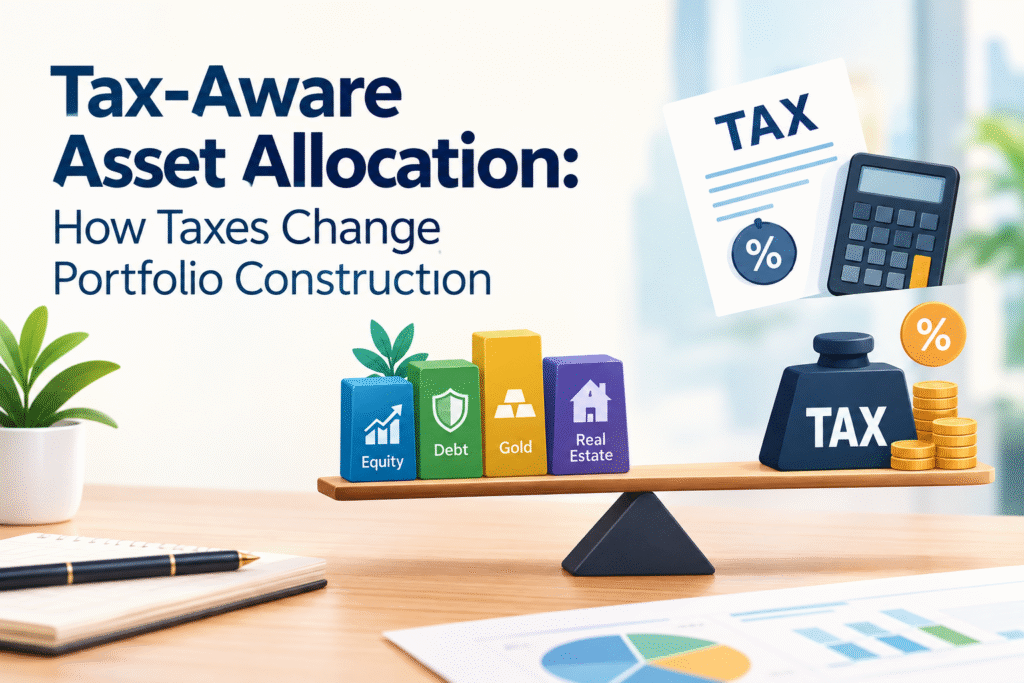
Most investors build a portfolio around one question: how much should go into equity, and how much into debt. That question matters, but it stops halfway. A portfolio is not judged by what it earns before tax. It is judged by what lands in your bank account after the tax department has taken its share. Two investors can hold the identical 70:30 equity-debt mix and still end up with noticeably different take-home returns, simply because one of them thought about where each asset sits and when each gain gets booked, and the other did not.
This is what tax-aware asset allocation means. It is not a separate investment strategy sitting next to your regular portfolio. It is the practice of building the same portfolio with one extra filter applied at every step: what does this decision cost me in tax, and is there a cheaper way to reach the same destination.
For Indian retail investors, this filter has become more important since July 2024, when the capital gains regime was rewritten almost from scratch. The old assumptions many of us carried around indexation, holding periods, and exemption limits no longer hold in several cases. This piece walks through what has changed, how taxes actually change the mechanics of portfolio construction, and the practical moves that separate a tax-aware investor from one who finds out the hard way at return-filing time.
Why Pre-Tax Returns Are the Wrong Number to Chase
Fund fact sheets and app dashboards love to show pre-tax CAGR. It is the easiest number to display and the easiest one to compare across products. But pre-tax return is not the return you get to spend, reinvest, or retire on.
Consider two funds delivering an identical 12% pre-tax CAGR over ten years. One is an equity mutual fund. The other is a debt fund bought after April 2023. On paper, they look the same. After tax, they are not remotely the same, because the equity fund benefits from the ₹1.25 lakh annual long-term exemption and a 12.5% long-term rate, while the debt fund is taxed every single year at your income tax slab rate, with no long-term concession at all under Section 50AA. Run that gap over a decade of compounding and the difference in final corpus is not small change, it is often the difference between meeting a goal and falling short of it.
This is the core argument for tax-aware construction: the asset that wins on a pre-tax comparison sheet can lose on an after-tax basis, and the only way to know which one actually wins is to do the after-tax math before you invest, not after you redeem.
How the Capital Gains Rules Actually Work Now (FY 2025-26)
The Union Budget of July 2024 reset capital gains taxation across almost every asset class, and these are the rates now fully in force for FY 2025-26 (AY 2026-27):
Listed equity shares and equity-oriented mutual funds (funds with at least 65% domestic equity exposure)
- Short-term capital gains (held up to 12 months): taxed at 20% under Section 111A
- Long-term capital gains (held beyond 12 months): taxed at 12.5% under Section 112A, with the first ₹1.25 lakh of such gains in a financial year exempt from tax altogether
Debt mutual funds and other non-equity mutual funds bought on or after 1 April 2023
- Taxed at your income tax slab rate in the year the gain is realised, regardless of how long you have held the units, under Section 50AA
- There is no long-term rate and no indexation benefit for these units, so a debt fund gain can sit in the 30% bracket for a high earner while an equity gain of the same size may attract nothing at all
Debt mutual funds bought before 1 April 2023
- Still eligible for the older long-term treatment if held beyond 24 months, taxed at 12.5% without indexation
Physical gold, gold ETFs and gold mutual funds
- Long-term (held beyond 24 months): 12.5% without indexation
- Short-term: taxed at slab rate
Real estate
- For property bought on or after 23 July 2024: long-term gains (held beyond 24 months) are taxed at 12.5% without indexation
- For property bought before that date, resident individuals and HUFs get a choice between 12.5% without indexation or 20% with indexation using the Cost Inflation Index, and the lower of the two figures applies. The CII for FY 2025-26 has been notified at 376
REITs and InvITs
- Follow the same long-term threshold as listed equity, more than 12 months for long-term status, but the components of the payout (interest, dividend, capital repayment) can each be taxed differently, so check the breakup before assuming REIT distributions are tax-free
The pattern worth remembering: equity investments are structurally the cheapest asset class to hold from a tax standpoint, because of the flat 12.5% rate, the annual exemption, and the fact that unrealised gains are never taxed. Debt and slab-rate assets are the most expensive to hold outside tax-advantaged wrappers, because every rupee of gain gets added to your income and taxed at your marginal rate, which can run as high as 30% plus surcharge and cess for higher income brackets.
Asset Location: Deciding Not Just What to Hold, But Where to Hold It
Traditional asset allocation asks what percentage of your money goes into equity, debt, gold, and real estate. Tax-aware asset allocation adds a second question that most retail investors never ask: given that I need a certain amount in debt-like, low-volatility assets, which specific account or instrument should hold that debt exposure?
This is called asset location, and it is one of the most underused tools available to Indian investors, mostly because our product menu makes it easy to overlook.
Here is the practical hierarchy for placing your fixed-income allocation, from most tax-efficient to least:
- Employees’ Provident Fund (EPF) and Public Provident Fund (PPF). Both fall under the EEE category, meaning contributions, accumulated interest, and maturity proceeds are all exempt from tax, subject to the usual contribution limits and lock-in rules. If you have room left in your PPF and EPF contribution limits, that room is almost always the cheapest place to park your debt allocation.
- National Pension System (NPS). Offers an additional deduction under Section 80CCD(1B) over and above the 80C limit, and the accumulated corpus grows tax-deferred. The trade-off is a long lock-in and mandatory annuitisation of part of the corpus at retirement, so it suits money you genuinely will not need before then.
- Debt mutual funds bought before 1 April 2023, if you still hold any. These retain the older long-term concessional treatment and should generally be the last ones you redeem, not the first.
- Debt mutual funds bought after 1 April 2023, fixed deposits, and other slab-taxed instruments. These sit at the bottom of the efficiency ladder for a high tax bracket investor, because gains are added to income every year they are booked, with fixed deposit interest taxed annually on accrual even if you never touch the money.
The same logic runs in reverse for equity. Because equity carries the lowest effective tax rate of any mainstream asset class, and because unrealised gains cost nothing, there is rarely a reason to hold your equity allocation inside a tax-inefficient wrapper when a direct equity mutual fund or ETF is available and does the same job for less tax drag.
A simple rule many financial planners use: hold your most tax-inefficient assets in your most tax-sheltered accounts first, and let your taxable, open accounts carry the assets that are already cheap to hold. Building your allocation in this order, rather than splitting every account into an identical 70:30 mix, can meaningfully raise your after-tax return without changing your overall risk profile at all.
Tax Loss Harvesting: Turning a Bad Year Into a Tax Credit
Every portfolio has some position sitting below its purchase price at some point in the year. Tax loss harvesting is the practice of selling that losing position deliberately, before the financial year closes, so the loss can be set off against gains elsewhere in your portfolio and your overall tax bill for the year comes down.
The rules that govern this in India are specific, and getting them wrong defeats the purpose:
- Short-term capital losses can be set off against both short-term and long-term capital gains in the same year.
- Long-term capital losses can only be set off against long-term capital gains, not against short-term gains and never against salary or other income.
- Losses that cannot be fully absorbed in the current year can be carried forward for eight assessment years, provided the loss is reported in a return filed on or before the due date.
- India has no wash sale rule of the kind that applies in the United States. There is no mandatory waiting period before repurchasing the same or a similar security, which means you can book the loss and re-enter a comparable fund or stock almost immediately if you still want that exposure, without losing the tax benefit.
Where investors typically go wrong is treating harvesting as a strategy in its own right rather than a bookkeeping exercise layered on top of an existing plan. Selling a fundamentally sound holding purely to generate a loss, and then struggling to find an equally good replacement, usually costs more in missed upside than it saves in tax. The better approach is to review your portfolio each January or February, identify positions that are already candidates for trimming or rebalancing on investment grounds, and check whether any of them happen to be sitting at a loss that can be harvested as part of that same trade.
It is also worth remembering that the ₹1.25 lakh annual LTCG exemption on equity resets every financial year and does not carry forward if unused. An investor sitting on long-term equity gains comfortably under that threshold can book them deliberately each year, pay zero tax, and reinvest the same amount immediately at a higher cost base, which quietly reduces the tax bill on future gains. This is sometimes called tax gain harvesting, and it works precisely because the exemption is a use-it-or-lose-it allowance rather than a running balance.
Rebalancing Without Triggering an Unnecessary Tax Bill
Standard portfolio advice says to rebalance back to your target allocation on a fixed schedule, once a year or once every time an asset class drifts by a set percentage. That advice is sound for a tax-free account. Applied blindly to a taxable Indian portfolio, it can generate an avoidable tax bill every single year, particularly for anyone who has built up large unrealised gains in equity.
A few adjustments make rebalancing tax-aware rather than tax-blind:
- Use fresh contributions to rebalance first. If equity has run ahead of its target weight, the cheapest fix is often to direct new SIP money or a lump sum into debt or gold instead of selling equity outright. This restores balance without booking any gain at all.
- Rebalance inside tax-sheltered wrappers before touching taxable ones. If you hold both a taxable equity fund and equity exposure inside an NPS or ULIP wrapper, adjust the wrapper first, since internal switches inside these structures typically do not trigger a personal capital gains event the way redeeming a mutual fund does.
- Time redemptions around the ₹1.25 lakh exemption. If you must sell equity to rebalance, doing it in tranches that stay near the annual exemption threshold, rather than one large redemption that blows past it, can meaningfully cut the tax owed on the same total amount sold.
- Check holding periods before selling. An asset sitting one or two months short of the 12-month or 24-month long-term threshold is often worth holding a little longer, if your broader plan allows it, purely to move from a short-term slab rate to a far cheaper long-term rate.
None of this means avoiding rebalancing altogether. Letting risk drift unmanaged to save on tax is its own kind of mistake. The point is sequencing: reach for the least taxable lever first, and treat an outright taxable sale as the last resort rather than the default move.
Building the Portfolio: A Practical Framework
Bringing this together, a tax-aware approach to portfolio construction in India tends to follow a sequence like this:
- Decide your overall asset allocation first, based on goals, time horizon, and risk capacity, exactly as a conventional financial plan would. Tax awareness refines how you implement the plan; it should not override the plan itself.
- Fill tax-advantaged limits before taxable ones. Maximise PPF, EPF, and NPS contributions relevant to your goals before routing the equivalent debt allocation into taxable debt funds or fixed deposits.
- Hold equity in the most direct, low-cost wrapper available, since it is already the most tax-efficient asset class and rarely benefits from being nested inside a more expensive structure.
- Sequence withdrawals by tax cost when the time comes to spend from the portfolio. Drawing first from tax-free or already-taxed sources, and last from assets carrying the steepest embedded gain, stretches a retirement corpus considerably further than drawing proportionally from everything at once.
- Review for harvesting opportunities every financial year, not just at the point of an emergency sale, so losses and the annual exemption are used as they arise rather than wasted.
- Revisit the framework whenever the law changes. The 2024 overhaul is a reminder that capital gains rules in India do shift meaningfully every few years, and a portfolio built around last decade’s rates can quietly become inefficient under this decade’s rules if nobody checks.
The Bottom Line
Asset allocation decides how much risk you take. Tax-aware asset allocation decides how much of your return you actually keep. Both matter, and neither should be built in isolation from the other. With India’s capital gains framework now clearly split between a low, exemption-backed rate for equity and a full slab-rate treatment for most debt instruments bought after April 2023, the cost of ignoring tax placement has gone up, not down. The investors who build this filter into their process from the start, rather than bolting it on at tax-filing time, are the ones who end up compounding a meaningfully larger number over the long run.
Frequently Asked Questions
What is tax-aware asset allocation? It is the practice of building an investment portfolio by considering not only the target mix of equity, debt, and other assets, but also the tax treatment of each holding, including where it is held and when gains are booked, so that the after-tax return is optimised rather than just the pre-tax return.
Is tax-aware asset allocation only useful for high-income investors? No. While the benefit is larger for investors in higher tax brackets, since slab-taxed debt gains cost them more, even a basic-rate taxpayer benefits from using PPF and EPF room before taxable debt funds, and from using the annual ₹1.25 lakh LTCG exemption on equity every year instead of letting it go unused.
How much LTCG on equity is tax-free in FY 2025-26? The first ₹1.25 lakh of long-term capital gains from listed equity shares and equity-oriented mutual funds in a financial year is exempt from tax under Section 112A. Gains above that threshold are taxed at 12.5%.
Are debt mutual funds still worth holding after the 2023 and 2024 tax changes? Debt funds still play a role for liquidity, capital protection, and diversification, but units bought on or after 1 April 2023 no longer get any long-term tax concession and are taxed at your slab rate every year gains are booked. For pure tax efficiency, many investors now prefer PPF, EPF, or specific debt instruments over new debt mutual fund purchases, while continuing to hold any older debt fund units that still qualify for legacy long-term treatment.
Does India have a wash sale rule that blocks tax loss harvesting? No. Unlike the United States, India does not have a wash sale rule, so there is no mandatory waiting period before repurchasing the same or a similar security after selling it at a loss for tax purposes.
Should I change my asset allocation because of tax rules? Generally no. Your target allocation should still come from your goals, time horizon, and risk tolerance. Tax awareness changes how and where you implement that allocation, not what the allocation itself should be.
This article is for educational purposes and does not constitute personalised tax or investment advice. Tax rules referenced are applicable for FY 2025-26 (AY 2026-27) as per the Income Tax Act provisions in force at the time of writing, and readers should confirm current rates and consult a qualified tax professional before making investment decisions based on tax treatment.