
Understanding Small Cap Funds: Returns, Risks, and How They Compare to Other Funds
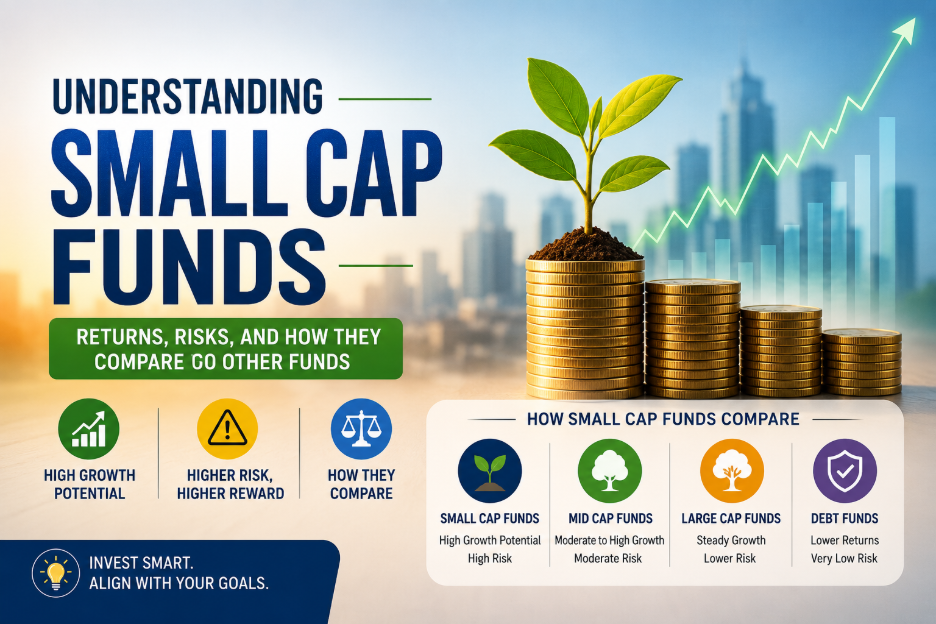
Understanding Small Cap Funds: Returns, Risks, and How They Compare to Other Funds
If you’ve spent any time scrolling through mutual fund apps or talking to a friend who’s “into investing,” chances are small cap funds have come up. They get talked about a lot, usually with a mix of excitement and a little bit of fear. And honestly? Both reactions are fair.
Small cap funds have a reputation for being the high-risk, high-reward corner of the mutual fund world. Some years they’re the best-performing category on the table. Other years, they’re the ones giving investors sleepless nights. So what’s actually going on with small cap funds, and should they have a place in your portfolio? Let’s break it down without the jargon.
What Exactly Are Small Cap Funds?
In simple terms, small cap mutual funds invest in companies that are, well, small, at least in terms of market capitalization. In India, SEBI draws the line clearly: small cap companies are anything ranked 251st or lower by market cap. So we’re not talking about the household names that dominate the news. We’re talking about smaller, often lesser-known businesses that are still figuring out how big they can get.
That’s really the whole appeal in one sentence: these are companies with room to grow. A large cap company like a top bank or a major FMCG player has already captured a huge share of its market. A small cap company might be five years into building something that could become the next big name, or it might not make it at all. That uncertainty is the trade-off you’re signing up for.
How Do Small Cap Funds Actually Perform?
Let’s talk numbers, because this is usually what people care about most.
Over the long run, think 10 years or more, small cap funds have historically outpaced their larger counterparts. Many have delivered annualized returns somewhere in the 12–16% range over a decade. Compare that to mid cap funds, which have typically landed between 10–14%, and large cap funds, which tend to sit in the more modest 8–12% zone.
The logic isn’t complicated. Bigger companies have less room left to expand, they’re already large. Smaller companies have a much longer runway, so when things go right, the growth (and the returns) can be dramatic.
But here’s the part people sometimes gloss over: those higher returns come with real bumps along the way. It’s not unusual for small cap funds to fall 30–40% during a rough market phase, sometimes within just a few months. Large cap funds usually weather the same storm with far less damage. If you’ve ever wondered why your small cap SIP shows wild swings on your app while your large cap fund barely moves, this is why.
Why Small Cap Funds Carry More Risk
A few specific things make small cap investing riskier than sticking with bigger, more established companies:
Market volatility. Small cap stocks react strongly to economic news: interest rate hikes, global slowdowns, policy changes. They don’t have the size or diversification to absorb shocks the way large companies can.
Liquidity concerns. Smaller companies usually see lower trading volumes. That can make it harder to buy or sell large quantities of a stock without moving its price, which adds another layer of risk during volatile periods.
Business uncertainty. Many small cap companies operate in niche or emerging industries. Some will scale into major players. Others will struggle to survive competition or a shift in the market. There’s simply more variance in outcomes.
Less visibility. Large caps get covered extensively by analysts and financial media. Small caps often fly under the radar, meaning there’s less publicly available research to lean on when evaluating them.
None of this means small cap funds are a bad idea, it just means they demand a different mindset than, say, a large cap index fund.
Small Cap vs Mid Cap vs Large Cap: A Side-by-Side Look
| Parameter | Small Cap Funds | Mid Cap Funds | Large Cap Funds |
|---|---|---|---|
| Return Potential | High (12–16% long term) | Moderate (10–14%) | Stable (8–12%) |
| Risk Level | Very High | High | Low |
| Volatility | Significant | Moderate | Low |
| Liquidity | Low | Moderate | High |
| Ideal Investment Horizon | 7+ years | 5+ years | 3+ years |
Seeing it laid out this way makes the trade-off pretty clear: small cap funds ask for more patience and a stronger stomach, in exchange for a shot at meaningfully higher returns.
So, Who Should Actually Invest in Small Cap Funds?
Small cap funds aren’t a one-size-fits-all product. They tend to work best for:
Long-term investors who can stay invested for 7–10 years and ride out the inevitable rough patches.
Investors comfortable with volatility, who won’t panic-sell during a 20–30% dip.
People building a diversified portfolio, where small caps are one slice of the pie, not the whole thing.
If you’re closer to retirement, need the money in the next few years, or simply lose sleep over market swings, a heavier allocation to large cap or balanced funds is probably a better fit. There’s no prize for taking on more risk than you can actually handle.
A Few Practical Things to Know
Expense ratios tend to run higher. Actively researching and managing a portfolio of smaller, less-covered companies takes more work, and fund houses typically price that in.
Taxation follows standard equity fund rules. Long-term capital gains (holding period over one year) are taxed at 10% beyond the exemption threshold, while short-term gains are taxed at 15%.
SIPs help smooth out the ride. Because small cap funds are volatile, investing through a Systematic Investment Plan, rather than a lump sum, can reduce the impact of bad timing and average out your purchase cost over time.
The Bottom Line
Small cap funds aren’t inherently “good” or “bad,” they’re a tool that suits a specific kind of investor and a specific kind of goal. If you have the time horizon and the risk appetite to match, they can meaningfully boost long-term wealth creation. If you don’t, forcing yourself into them just because they’re trending is a good way to make an emotional decision at the worst possible moment (usually right after a market dip).
The smartest approach for most people isn’t “all in” or “avoid entirely,” it’s a mix. A portfolio that blends large cap stability, mid cap growth, and small cap upside tends to handle market cycles far better than betting everything on one category.
This article is for general informational purposes and shouldn’t be taken as personalized investment advice. Mutual fund investments are subject to market risks, read all scheme-related documents carefully, and consider speaking with a registered financial advisor before making investment decisions.