
Best Tax Saving Schemes Under Section 80D in India (2026 Guide)
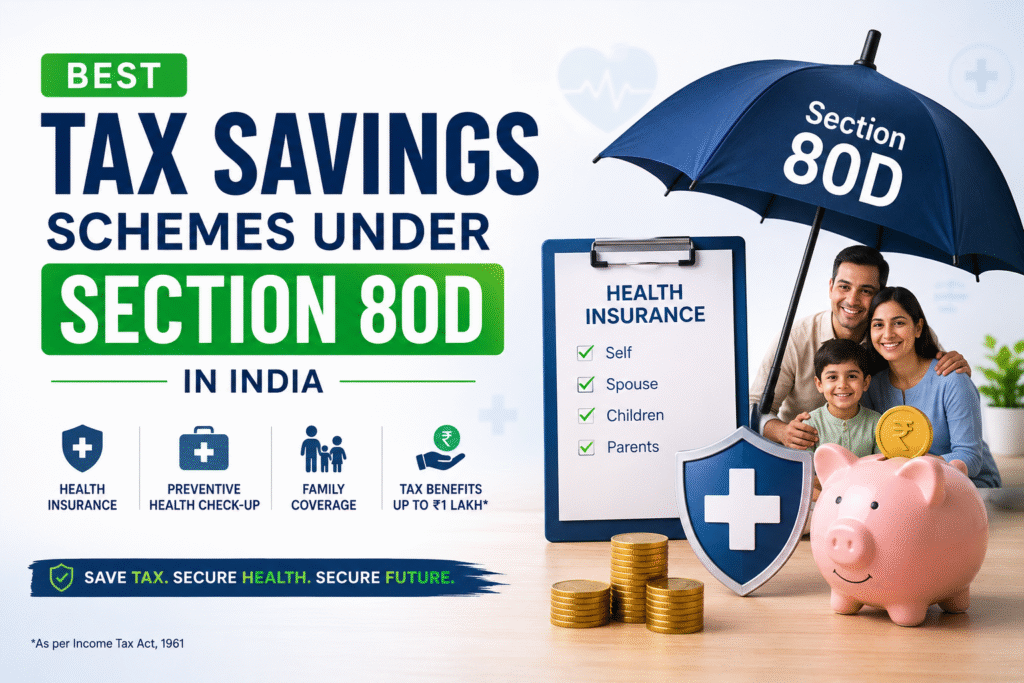
Most people know about Section 80C. Fewer people actually use Section 80D the right way, and that is a shame because it is one of the easiest deductions to claim if you already have health insurance for yourself or your parents. If you don’t have health cover yet, this section alone is a good enough reason to buy it.
Section 80D of the Income Tax Act, 1961 lets you cut your taxable income by claiming a deduction on the premium you pay for health insurance, along with a small allowance for preventive health check-ups. It sits separately from the ₹1.5 lakh limit under Section 80C, so it is basically free tax saving room that many taxpayers leave unused every year.
This guide breaks down exactly how much you can claim, who qualifies, what mistakes to avoid, and how to structure your health insurance so you get the maximum benefit for AY 2026-27.
What Exactly Is Section 80D?
Section 80D allows individuals and Hindu Undivided Families (HUFs) to claim a deduction for money spent on:
- Health insurance premiums for self, spouse, and dependent children
- Health insurance premiums for parents, whether or not they are dependent on you
- Preventive health check-ups for the family
- Medical expenses for senior citizens who don’t have any health insurance policy
The deduction reduces your total taxable income, which in turn lowers the tax you owe. It is one of the most claimed deductions after 80C, and for families with senior citizen parents, it can genuinely save tens of thousands of rupees a year.
One thing worth flagging early: this deduction is available only if you are filing under the old tax regime. If you have opted for the new tax regime, Section 80D does not apply to you, so factor that into your regime choice at the start of the year rather than at the end.
Section 80D Deduction Limits for FY 2025-26 (AY 2026-27)
The amount you can claim depends on two things: who the insurance covers, and whether that person is a senior citizen (60 years or above).
| Insured Person | Age Below 60 | Age 60 and Above (Senior Citizen) |
|---|---|---|
| Self, spouse, and dependent children | Up to ₹25,000 | Up to ₹50,000 |
| Parents (father and/or mother) | Up to ₹25,000 | Up to ₹50,000 |
This means the maximum deduction you can claim in a year is ₹1,00,000, and that happens when both you (or your spouse) and your parents fall in the senior citizen bracket.
A quick example makes this clearer. Say Ramesh, who is 35, pays ₹22,000 a year for a family floater policy covering himself, his wife, and their daughter. He also pays ₹40,000 for a separate policy for his parents, both of whom are above 60. Ramesh can claim ₹22,000 under the first slab and the full ₹40,000 under the parents’ slab, taking his total 80D deduction to ₹62,000 for the year.
Preventive Health Check-up Deduction
Within the overall limit mentioned above, you can also claim up to ₹5,000 for preventive health check-ups done for yourself, your spouse, your children, or your parents. This is not an amount added on top of the ₹25,000 or ₹50,000 limit, it sits inside it. So if your premium already uses up the full limit, you won’t get anything extra for the check-up.
This sub-limit was introduced to nudge people toward regular health screening rather than waiting until something goes wrong, and it is one of the rare parts of the tax code where cash payments are actually allowed. Every other part of Section 80D requires a non-cash payment mode.
Deduction for Uninsured Senior Citizen Parents
Here is a part many taxpayers miss. If your parents are senior citizens and don’t have any health insurance policy at all, you can still claim a deduction of up to ₹50,000 for the actual medical expenses incurred on their treatment during the year. This applies whether you pay the medical bills yourself or your parents pay them, as long as no insurance is covering that cost.
This provision exists because a lot of elderly people, especially those with pre-existing conditions, either can’t get affordable cover or choose to skip it. The tax law still gives their children a way to get relief for the money spent on their care.
Who Can Claim Section 80D
Both individual taxpayers and HUFs can claim this deduction, but the eligibility rules are specific.
- An individual can claim for premiums paid for self, spouse, dependent children, and parents.
- Parents do not need to be financially dependent on you. Even if your father earns a pension, you can still claim the deduction as long as you are the one paying the premium.
- Siblings, grandparents, in-laws, and other relatives are not covered under this section.
- An HUF can claim a deduction for premiums paid on health insurance for any member of the HUF, up to ₹25,000, or ₹50,000 if that member is a senior citizen.
- If your employer pays or reimburses your health insurance premium, you cannot claim that amount as a personal deduction, since you haven’t actually borne the cost.
Payment Mode Rules You Cannot Ignore
This trips up more people than you’d expect. To claim a deduction under Section 80D, the premium must be paid through a non-cash mode, meaning net banking, UPI, debit card, credit card, or cheque. If you hand over cash for a health insurance premium, that amount simply won’t qualify.
The one exception is preventive health check-ups. For that specific ₹5,000 sub-limit, cash payment is allowed. So if you’re paying for your parents’ annual health check-up in cash at a local diagnostic centre, you’re still covered, but the moment it comes to the actual insurance premium, stick to digital payments or a cheque.
Section 80D vs Section 80C: Don’t Mix Them Up
A lot of people assume health insurance premiums fall under the same ₹1.5 lakh bucket as PPF, ELSS, or life insurance. They don’t. Section 80C and Section 80D are entirely separate deductions with their own limits. This is actually good news, because it means your health insurance premium doesn’t eat into the room you have for EPF, PPF, ELSS, or a life insurance policy under 80C. Using both sections properly can bring your total deduction well past ₹2 lakh in a good year, especially if you have senior citizen parents.
The Shift to the Income Tax Act, 2025
The Income Tax Act, 2025 comes into force from 1 April 2026, and under the new law, the health insurance deduction that currently lives under Section 80D moves to Section 126. For any income you earned up to 31 March 2026, meaning your filing for AY 2026-27, the old Section 80D rules under the 1961 Act still apply. From FY 2026-27 onward, you will see the same benefit referred to as Section 126, with broadly similar limits and conditions. If you’re a content creator, financial advisor, or just someone filing returns next year, it helps to know both names, since older articles and forms will still reference 80D for a while even after the new Act takes over.
Common Mistakes People Make With Section 80D
- Paying premiums in cash and losing the deduction entirely. Always route the payment through a bank.
- Assuming the ₹5,000 check-up limit is separate from the main limit. It isn’t, it’s a sub-limit within the overall ceiling.
- Forgetting to claim for parents because they are financially independent. Dependency is not a condition here, only the payment source matters.
- Not checking if the new tax regime was selected, then trying to claim 80D anyway. The deduction simply won’t be allowed under the new regime.
- Ignoring the uninsured senior citizen parent provision. If your parents don’t have a policy, you’re still entitled to claim actual medical expenses up to ₹50,000.
How to Maximise Your Section 80D Benefit
If you’re still deciding how to structure your family’s health cover, a few practical habits go a long way. Buy a separate policy for your parents rather than adding them to a large family floater, since this makes it much easier to track and claim the parent-specific limit correctly. Always pay premiums through net banking or a card rather than cash, and keep the payment receipts and policy documents together at the start of the financial year rather than scrambling for them in March. If your parents are senior citizens without insurance, keep a folder of medical bills through the year so you can claim the ₹50,000 provision without missing anything at filing time.
Frequently Asked Questions
What is the maximum deduction I can claim under Section 80D? The maximum possible deduction is ₹1,00,000 in a financial year. This applies when both you (or your spouse) and your parents are senior citizens, giving you ₹50,000 for your own family and ₹50,000 for your parents.
Can I claim Section 80D under the new tax regime? No. The deduction under Section 80D is available only if you file your return under the old tax regime. Taxpayers who opt for the new regime cannot claim this benefit.
Is the ₹5,000 preventive health check-up deduction over and above the regular limit? No, it is included within the overall limit of ₹25,000 or ₹50,000, not an additional amount on top of it.
Can I claim a deduction for my parents’ health insurance even if they are not dependent on me? Yes. As long as you are the one paying the premium, you can claim the deduction regardless of whether your parents are financially dependent on you.
Can I pay my health insurance premium in cash and still claim the deduction? No, except for preventive health check-ups. All other payments under Section 80D must be made through a non-cash mode such as net banking, UPI, debit card, credit card, or cheque.
What happens if my employer pays for my health insurance? If your employer pays or reimburses the premium, you cannot claim a personal deduction for that amount under Section 80D, since you have not actually incurred the expense.
Will Section 80D still exist after the Income Tax Act, 2025 comes into effect? The benefit itself continues, but it will be referred to as Section 126 under the new Income Tax Act, 2025, effective from 1 April 2026. Returns for AY 2026-27 still follow the old Section 80D rules.
Can HUFs claim a deduction under Section 80D? Yes, an HUF can claim a deduction of up to ₹25,000 for health insurance premiums paid for any member of the HUF, rising to ₹50,000 if that member is a senior citizen.
Final Word
Section 80D is one of those parts of the tax code that rewards you for doing something you should be doing anyway, which is protecting your family with proper health cover. The rules are not complicated once you know the two or three things that actually matter: who the policy covers, how the premium is paid, and which tax regime you’re under. Get those right, and you’re looking at a deduction that can comfortably run into tens of thousands of rupees every year, on top of whatever you’re already claiming under 80C.