
SIP vs FD: Which Is Better for Beginners
Introduction
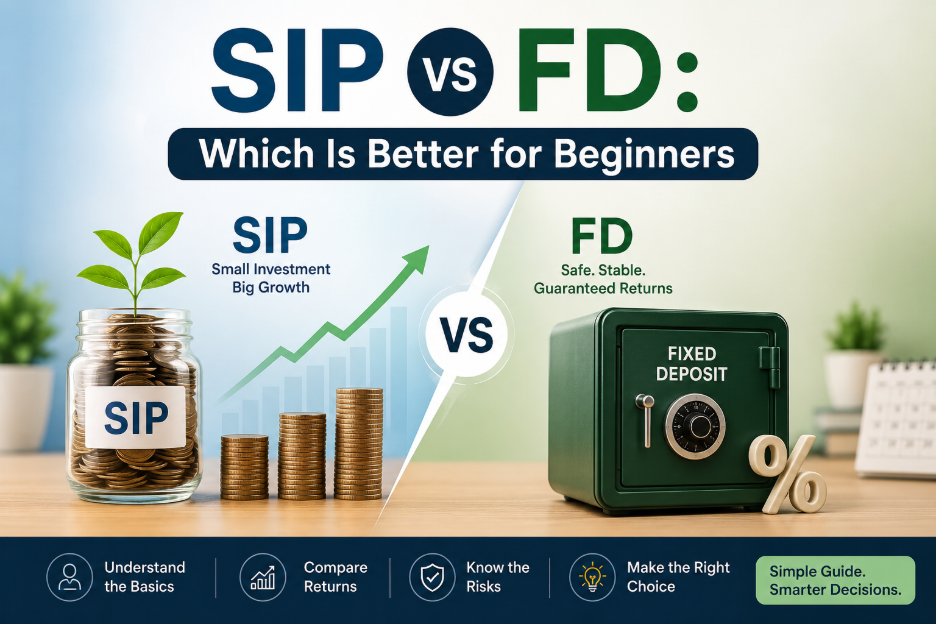
In 2026, the investment landscape continues to evolve, offering a wide array of options for beginners. Among the most debated choices are Systematic Investment Plans (SIPs) and Fixed Deposits (FDs). Both are popular, accessible, and relatively simple to understand, but they serve very different purposes.
If you’re just starting your financial journey and wondering whether to go with the safety of FDs or the growth potential of SIPs, this guide will help you make an informed decision. We’ll compare SIP vs FD across returns, risk, taxation, liquidity, and suitability for beginners, using real data and actionable insights.
What Is SIP and FD?
Systematic Investment Plan (SIP)
A SIP is a disciplined way to invest in mutual funds. You contribute a fixed amount regularly monthly or quarterly into a mutual fund scheme. SIPs benefit from rupee cost averaging and compounding, making them ideal for long-term wealth creation.
- Minimum investment: ₹500/month
- Returns: Market-linked (10–14% average for equity funds)
- Risk: Moderate to high (depends on fund type)
- Liquidity: High (can withdraw anytime, except ELSS)
- Taxation: LTCG taxed at 10% beyond ₹1 lakh/year
Fixed Deposit (FD)
FDs are traditional savings instruments offered by banks and NBFCs. You deposit a lump sum for a fixed tenure and earn a guaranteed interest rate.
- Minimum investment: ₹1,000
- Returns: Fixed (6.5%–7.5% in 2025)
- Risk: Very low
- Liquidity: Medium (penalty on premature withdrawal)
- Taxation: Interest taxed as per income slab
SIP vs FD: Key Comparison Table
| Feature | SIP (Equity Mutual Fund) | FD (Fixed Deposit) |
| Expected Returns | 10–14% (market-linked) | 6.5–7.5% (fixed) |
| Risk | Moderate to High | Very Low |
| Taxation | LTCG @10% beyond ₹1L/year | Interest taxed as per slab |
| Liquidity | High | Medium |
| Inflation Protection | Yes | No |
| Ideal For | Long-term goals | Short-term safety |
Real-Life Example: ₹5,000/Month for 5 Years
Let’s compare SIP and FD with a monthly investment of ₹5,000 over 5 years:
- Total Investment: ₹3,00,000
SIP (12% Avg Return)
- Estimated Value: ₹4,10,000+
- Wealth Gain: ₹1,10,000+
FD (7% Interest)
- Estimated Value: ₹3,51,000
- Wealth Gain: ₹51,000
Difference: SIP earns ₹59,000 more than FD over 5 years.
Taxation: SIP vs FD
SIP Taxation
- Equity Funds:
- LTCG: 10% on gains above ₹1 lakh/year
- STCG: 15% if sold within 1 year
- Debt Funds:
- Taxed as per income slab (post-April 2023 changes)
FD Taxation
- Interest is fully taxable as per your income slab
- TDS: 10% if interest exceeds ₹40,000 (₹50,000 for senior citizens)
Tax Efficiency Winner: SIP, especially for long-term investors.
Which Is Better for Beginners?
Choose SIP If You:
- Want to beat inflation
- Are investing for 5+ years
- Can tolerate short-term volatility
- Seek wealth creation
Choose FD If You:
- Need money in 1–3 years
- Prefer capital protection
- Are building an emergency fund
- Are a senior citizen seeking fixed income
Expert Insights: Diversification Is Key
You don’t have to choose one over the other. A balanced strategy using both SIPs and FDs can help you:
- FDs for short-term needs and emergency funds
- SIPs for long-term goals like retirement, child’s education, or buying a home
Example Strategy:
- Keep 6–12 months of expenses in FDs
- Invest surplus monthly income in SIPs for long-term growth.
Actionable Tips for Beginners
- Start Small: Begin SIPs with ₹500/month and increase gradually.
- Use ELSS Funds: Save up to ₹46,800 under Section 80C.
- Avoid Premature FD Withdrawals: Ladder FDs for better liquidity.
- Track Your Goals: Use SIP calculators to estimate future corpus.
- Review Annually: Rebalance your portfolio based on income and market changes.
Conclusion: SIP Wins for Long-Term, FD Wins for Safety
In 2025, SIPs outperform FDs in terms of returns, tax efficiency, and inflation protection. However, FDs remain unmatched for safety and short-term certainty. For beginners, the best approach is to combine both, aligning each with specific financial goals.
Final Verdict:
- Emergency Fund → FD
- Retirement Planning → SIP
- Child’s Education (10+ yrs) → SIP
- Vacation in 1 Year → FD