
Bonds vs Fixed Deposits: Which Is Better?
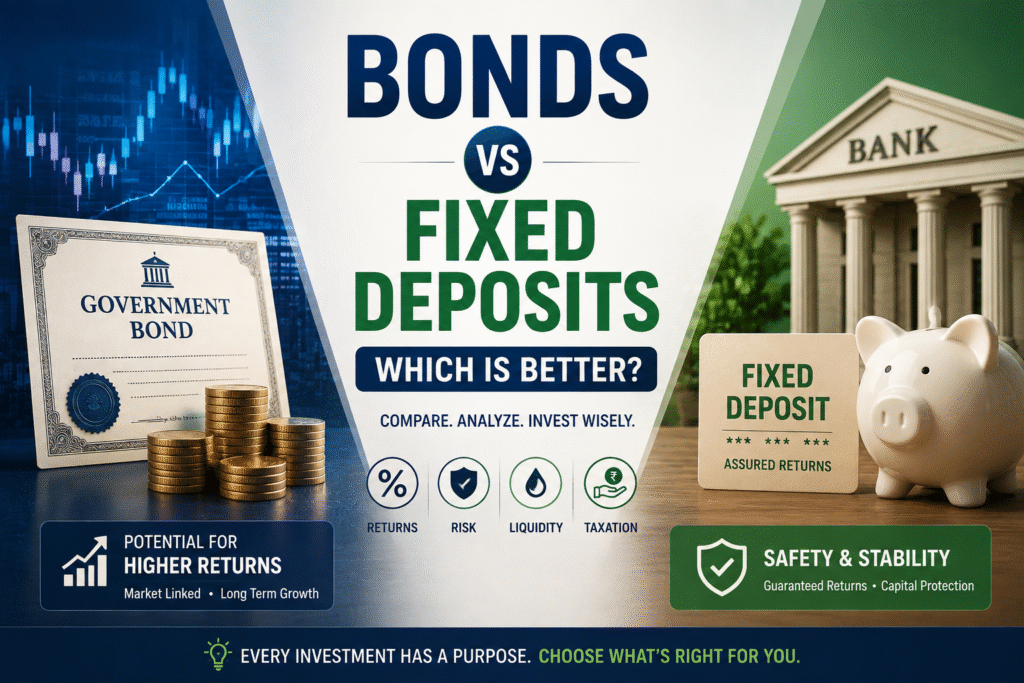
Ask any parent in India what a safe investment looks like, and the answer comes back almost every time: a fixed deposit. It is familiar, it is simple, and every bank from the corner branch to the biggest private lender will happily open one for you. But over the last few years, bonds have quietly moved from being a product for institutions and high net worth investors to something an ordinary saver can buy with a few taps on a phone.
So the question that keeps coming up in comment sections and WhatsApp forwards is a fair one. Between bonds and fixed deposits, which one actually deserves your money?
The honest answer is that neither wins outright. They solve different problems, and the right pick depends on your tax slab, how long you can leave the money untouched, and how much risk you are willing to carry for a better return. This guide walks through both instruments in plain language, using current 2026 numbers, so you can make that call with confidence rather than guesswork.
What Is a Fixed Deposit?
A fixed deposit, or FD, is a lump sum you place with a bank, post office, or non-banking finance company for a fixed period at a fixed rate of interest. You know on day one exactly what you will get on the day of maturity. There is no ambiguity, no market movement to track, and no paperwork beyond the initial application.
As of 2026, most large banks in India offer FD rates in the range of 6.5% to 7.5% per annum for general depositors, with senior citizens typically earning an extra 0.50%. Small finance banks and select NBFCs push this further, with some crossing 8% on longer tenures. Deposits up to five lakh rupees per bank are insured by the DICGC, which is the main reason FDs enjoy such deep public trust.
What Is a Bond?
A bond is essentially a loan. When you buy a bond, you are lending money to a government, a public sector company, or a private corporation, and in return they promise to pay you periodic interest, known as the coupon, along with your principal back at maturity.
Bonds come in several flavours in the Indian market:
- Government securities (G-Secs), issued by the central government, considered virtually risk free
- RBI Floating Rate Savings Bonds, which currently offer 8.05% per annum for the July to December 2026 period, reset every six months against the National Savings Certificate rate plus a fixed spread
- State Development Loans, issued by state governments
- Corporate bonds, issued by companies, where yields can range anywhere from around 8% to well over 13%, depending on the credit rating of the issuer
- Sovereign Gold Bonds, a special category linked to gold prices rather than a fixed coupon
Unlike an FD, many bonds can be bought and sold before maturity through stock exchanges or platforms like the RBI Retail Direct portal, which gives them a flexibility that a traditional deposit simply does not offer.
Bonds vs Fixed Deposits: A Side by Side Look
1. Returns
This is usually where the conversation starts. Top bank FDs currently sit around 6.5% to 7.5%, and small finance bank FDs occasionally touch 8%. RBI Floating Rate Savings Bonds are running at 8.05% right now, and well rated corporate bonds routinely offer 9% to 14%, though the higher end of that range comes with meaningfully higher risk.
In short, if pure yield is your only concern, bonds usually edge ahead, particularly government backed floating rate bonds and investment grade corporate paper.
2. Safety
Here the picture flips. A bank FD is protected by deposit insurance up to five lakh rupees per depositor per bank, so even if the bank were to fail, a chunk of your money is guaranteed. Government bonds and RBI bonds carry a sovereign guarantee, which many analysts consider even safer than bank insurance since there is no cap on the amount protected.
Corporate bonds sit at the riskier end of the spectrum. An AAA rated bond from a well known company is fairly dependable, but a lower rated bond chasing a double digit yield can carry real default risk. The golden rule with corporate bonds is simple: never chase the yield without first checking the rating.
3. Liquidity
Fixed deposits can technically be broken early, but banks charge a penalty, usually around 0.50% to 1% on the applicable rate, which quietly eats into your returns. Government and RBI bonds are often locked in for a set tenure with limited or no early exit windows, though listed government securities and corporate bonds can be sold on the exchange before maturity if you need cash urgently, subject to prevailing market prices.
So if you expect to need the money at short notice, an FD with a small penalty is often more predictable than trying to exit a bond in a thin secondary market.
4. Taxation
Both instruments are taxed similarly on the interest or coupon income. FD interest and bond interest are added to your total income and taxed at your slab rate under “Income from Other Sources.” Banks deduct TDS once your FD interest crosses a threshold in a financial year, and the same applies to bonds once the interest income crosses the prescribed limit.
Where bonds sometimes pull ahead is in capital gains. If you buy a government bond or corporate bond in the secondary market and sell it after holding it for more than a year, any profit is treated as a long term capital gain, taxed at a lower rate than your slab rate would apply to interest income. Sovereign Gold Bonds go a step further. If you hold them until maturity as an individual investor, the maturity proceeds are entirely tax free, which is a benefit no fixed deposit can match.
5. Ease of Investing
Fixed deposits win comfortably on convenience. You can open one in minutes through net banking, with no demat account, no market knowledge, and no ongoing tracking required. Bonds usually need a demat account, at least a basic understanding of how coupon rates and yields work, and in the case of tradeable bonds, some willingness to watch prices move.
Quick Comparison Table
| Factor | Fixed Deposit | Bonds |
|---|---|---|
| Typical Returns (2026) | 6.5% to 8% | 8% to 14%, varies by issuer |
| Safety | DICGC insured up to ₹5 lakh | Sovereign guarantee for G-Secs and RBI bonds; credit risk for corporate bonds |
| Liquidity | Early exit with penalty | Locked in, or tradeable depending on the bond |
| Taxation | Fully taxed at slab rate | Taxed at slab rate; long term capital gains may get lower rates |
| Minimum Investment | As low as ₹1,000 | As low as ₹1,000 for RBI bonds, varies for corporate bonds |
| Best Suited For | Beginners, short term parking, risk averse savers | Investors seeking higher yield, willing to hold longer or track credit quality |
Which One Should You Choose?
There is no universal winner here, only a better fit for your situation.
Choose a fixed deposit if you want zero effort, you may need the money within a year or two, or you are new to investing and prefer something you fully understand without any learning curve. FDs are also a sensible place to park an emergency fund, since predictability matters more than an extra half a percent of return.
Choose bonds if you already have your emergency fund sorted, you are comfortable locking money away for several years, and you want a shot at a better post tax return, especially through RBI Floating Rate Savings Bonds or highly rated corporate bonds. Retirees looking for regular income often like bonds that pay interest every six months, since it creates a predictable cash flow much like a pension.
Many seasoned investors do not pick one over the other. They split their fixed income allocation, keeping a portion in FDs for liquidity and safety, and routing the rest into government bonds or RBI Floating Rate Savings Bonds for a better long term yield. That kind of laddering across both instruments tends to smooth out the trade off between safety and return far better than betting everything on a single product.
A Note for Readers Outside India
If you are reading this from outside India, the underlying logic still applies, even though the products carry different names. A fixed deposit is essentially what is called a certificate of deposit or a term deposit in most other countries, and government bonds function much the same way everywhere, whether it is a US Treasury bond, a UK Gilt, or an Indian G-Sec. The trade off between guaranteed but modest returns on a bank deposit versus potentially higher but less certain returns on a bond is a global one, not an Indian quirk. What changes from country to country is mainly the tax treatment and the deposit insurance limit, so always check your local rules before assuming the numbers above apply directly to you.
Frequently Asked Questions
Is it safe to invest in bonds instead of FDs? Government bonds and RBI Floating Rate Savings Bonds carry a sovereign guarantee, which makes them at least as safe as bank FDs, and in some views even safer since there is no upper cap on the protection. Corporate bonds carry credit risk that depends entirely on the issuer’s rating, so they are not automatically as safe as an FD.
Which gives better returns, bonds or fixed deposits? In 2026, RBI Floating Rate Savings Bonds at 8.05% and well rated corporate bonds generally outpace typical bank FD rates of 6.5% to 7.5%. Small finance bank FDs can sometimes match or beat government bond yields, so it is worth comparing specific products rather than the category as a whole.
Can I withdraw money from a bond before maturity like an FD? It depends on the bond. RBI Floating Rate Savings Bonds have a fixed seven year tenure with limited premature exit, mostly reserved for senior citizens. Listed government securities and many corporate bonds can be sold on the stock exchange before maturity, subject to the market price at that time, which may be higher or lower than what you paid.
Are bonds or FDs better for senior citizens? Both have a place. Bank FDs offer senior citizens an additional 0.50% interest and instant liquidity, which is useful for near term needs. RBI Floating Rate Savings Bonds pay a higher rate and allow limited premature withdrawal for seniors after a set number of years, making them a strong option for the portion of retirement savings not needed immediately.
Do I have to pay tax on bond and FD interest? Yes. Interest from both fixed deposits and most bonds is added to your total income and taxed as per your income tax slab. The main exception is Sovereign Gold Bonds, where the maturity proceeds are tax free for individual investors who hold until maturity, and long term capital gains from selling bonds in the secondary market after a year, which are taxed differently from regular interest income.
Should a beginner start with bonds or FDs? Most financial planners suggest beginners start with fixed deposits since they are simple, require no demat account, and carry no market risk. Once you are comfortable with how debt instruments work, adding government bonds or RBI Floating Rate Savings Bonds to your portfolio can improve overall returns without taking on the volatility of equity markets.
The Bottom Line
Fixed deposits remain the easiest, most familiar way to keep money safe and earn something on it. Bonds ask a little more of you, a bit of research, some patience, and a willingness to understand credit ratings, but in return they often pay a better rate and, in the case of government backed options, without giving up much on safety. The smartest approach for most Indian savers in 2026 is not choosing one over the other forever, but understanding both well enough to use each one where it fits best.