
How Inflation Can Destroy Your Retirement Savings (And How to Stop It)
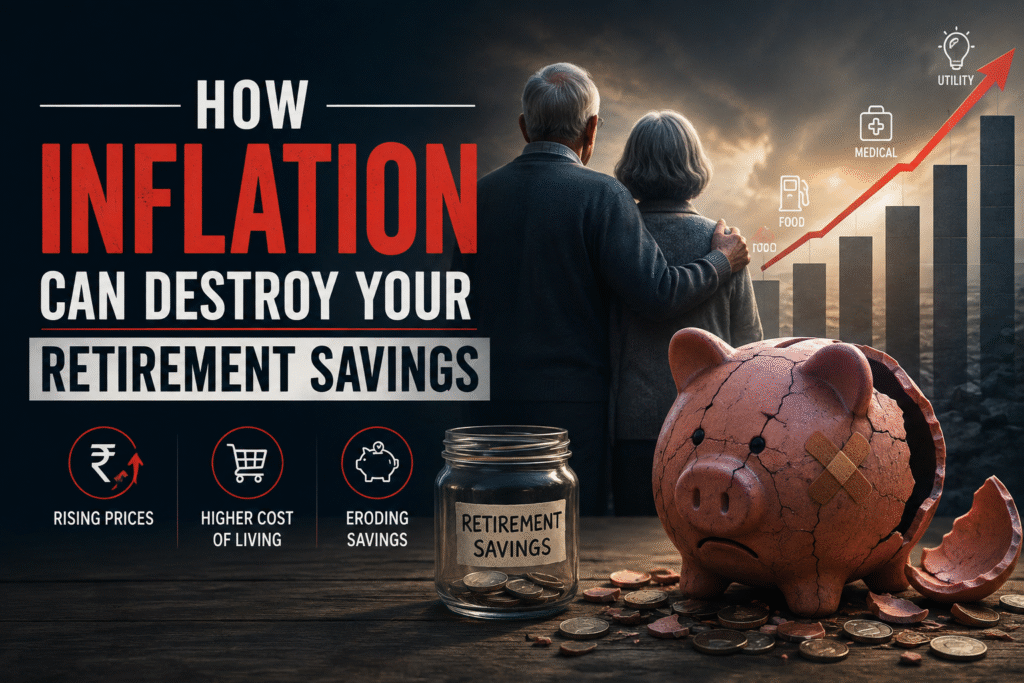
Most people plan for retirement the way they plan a road trip. They look at the distance, they look at the fuel in the tank, and they assume the road stays the same the whole way. Inflation is the pothole nobody budgets for. It does not announce itself with a crash. It works quietly, year after year, and by the time most retirees notice the damage, the corpus they built over three decades is already worth a fraction of what they thought it was.
This is not a scare story. It is simple arithmetic that far too many Indian investors skip.
What Inflation Actually Does to Your Money
Inflation is the rate at which prices rise and, in turn, the rate at which your money’s buying power falls. A retirement corpus is not measured by the number printed on your bank statement. It is measured by how much of your life it can pay for. If your money grows slower than prices rise, you are not saving. You are slowly losing ground while feeling like you are winning.
India’s headline retail inflation has been climbing through 2026, moving from around 3.9 percent in May to over 4.4 percent by July, driven largely by rising food and fuel costs. That is close to the Reserve Bank of India’s medium-term target of 4 percent, with a tolerance band of 2 to 6 percent. A number in that range sounds manageable. Stretched across a 25 or 30 year retirement, it is anything but.
The Math That Changes Everything
Here is the calculation that should be part of every retirement plan, yet is missing from most.
At a long-term average inflation rate of 6 percent, a retired couple spending ₹50,000 a month today will need close to ₹2,87,000 a month to maintain the exact same lifestyle in 30 years. Nothing has improved in that scenario. No new car, no bigger house, no extra holidays. That is simply the cost of standing still while prices keep moving.
Now widen the lens. India’s long-run inflation has averaged 6 to 7 percent a year over multiple decades, and healthcare costs alone have historically risen even faster, often in the range of 10 to 14 percent annually. Healthcare is precisely the expense category that grows heaviest in your sixties and seventies, right when your income has stopped and your corpus has to do all the work alone.
This is the part most people miss. It is not just that things cost more later. It is that the categories which matter most in old age, medical treatment, quality food, and home help, are the very categories rising fastest.
Why the “Safe” Approach Often Backfires
A large number of Indian savers keep the bulk of their retirement money in fixed deposits, recurring deposits, and traditional insurance-linked savings plans. These instruments feel safe because the number on the statement never goes down. But safety in nominal terms is not the same as safety in real terms.
If a fixed deposit pays 7 percent and inflation runs at 6 percent, your real return, the actual increase in purchasing power, is close to 1 percent. After adjusting for tax on the interest earned, that real return can turn negative. You can watch your balance grow every year and still be quietly getting poorer.
This is the central trap of inflation. It does not attack your account balance. It attacks what that balance can buy. A corpus that looks impressive on paper at age 60 can look thin by age 75 if it was parked entirely in low-yield instruments for those 15 years.
Why India Cannot Simply Copy Western Retirement Rules
Popular retirement guidance, including the well-known 4 percent withdrawal rule, was built using historical US market data where inflation averaged closer to 2 to 3 percent a year. India’s inflation profile does not match that. With general inflation running at 6 to 7 percent over the long term and medical inflation running considerably higher, financial planners in India generally suggest a more conservative safe withdrawal rate, closer to 3 to 3.5 percent, and a larger corpus multiple to compensate.
There is a second structural difference that makes this even more important. India does not have a universal social security system similar to the US Social Security program or the UK State Pension. For most private sector workers, EPF and NPS provide only a portion of what is actually needed. Your retirement corpus effectively has to function as your entire safety net. There is no government inflation-adjusted pension quietly filling the gap in the background.
How Much Corpus Do You Actually Need
A commonly used starting framework is the 25x rule. Multiply your expected annual expenses at retirement by 25, and that becomes your target corpus, assuming a real return of roughly 4 percent above inflation and a retirement span of about 25 years.
Given India’s higher inflation and healthcare cost trajectory, many planners now push this multiple higher, often into the 28x to 33x range for a more realistic safety margin, particularly for anyone who wants their corpus to comfortably last 30 years or more.
The formula in its simplest form looks like this:
Required Corpus = Annual Post-Retirement Expenses (adjusted for inflation) × 25 to 30
The inflation adjustment is the step people forget. Calculating this multiple against today’s expenses, without inflating them to what they will actually cost at the time you retire, is one of the most common and most costly retirement planning mistakes.
Five Ways Inflation Quietly Wrecks Retirement Plans
1. Underestimating the inflation number itself. Many people build their retirement plan assuming 3 to 4 percent inflation because that figure feels comfortable. Real, lived inflation for retirees, especially for healthcare, food, and services, has historically run closer to 6 to 8 percent.
2. Starting late. A delay of even 10 years in starting your retirement investing can double or triple the monthly SIP required to reach the same inflation-adjusted target.
3. Ignoring healthcare separately. Healthcare costs do not follow general inflation. They tend to rise faster and hit hardest exactly when your income has stopped. A retirement plan that does not budget for medical inflation as its own line item is incomplete.
4. Over-relying on EPF or NPS alone. These are useful pillars but were never designed to fund a full 25 to 30 year retirement on their own. Additional investing through equity mutual funds and other growth assets is what closes the gap.
5. Parking too much in fixed-rate instruments for too long. Cash and fixed deposits protect your nominal balance but rarely protect your purchasing power once tax and inflation are both accounted for.
How to Protect Your Retirement Savings from Inflation
The good news is that inflation, while relentless, is also predictable enough to plan around.
Let equity do the heavy lifting early. Over long time horizons, equity mutual funds and index funds have historically delivered returns well above inflation, which is exactly the kind of real growth a retirement corpus needs during the accumulation years.
Model healthcare inflation separately from general inflation. Build a distinct, larger bucket for medical expenses and keep it invested in a way that can outpace 10 to 14 percent annual healthcare cost growth, rather than lumping it into a single flat inflation assumption.
Shift gradually, not suddenly, as retirement nears. Moving entirely to fixed income the day you retire exposes the last 20 to 30 years of your life to inflation with no growth engine left. A bucket strategy, where a portion stays in equity even after retirement, tends to hold up better.
Revisit your corpus target every few years. Inflation is not static. The RBI’s own inflation readings have moved meaningfully within a single year in 2026, from below 3 percent early in the year to over 4.4 percent by July. A retirement number calculated five years ago on old assumptions is already outdated.
Increase your SIP contribution over time. Even a modest annual step-up of 10 percent in your SIP amount can add a substantial sum to your final corpus purely by keeping pace with rising income and rising costs, rather than freezing your contribution at today’s number forever.
The Bottom Line
Inflation does not need a crash, a scam, or a bad investment decision to damage your retirement. It works through patience and time, the same two things your retirement plan depends on. The only way to beat it is to plan for the India that will exist when you actually retire, not the India of today’s prices. That means inflating your expense assumptions honestly, treating healthcare as its own separate and faster-growing cost, and keeping enough of your corpus in growth assets to outrun rising prices rather than merely keeping up with them.
Frequently Asked Questions
How much will inflation reduce my retirement savings? At 6 percent average inflation, prices roughly double every 12 years. A monthly expense of ₹50,000 today can grow to nearly ₹2,87,000 in 30 years just to maintain the same standard of living, without any lifestyle upgrade.
What is a safe withdrawal rate for retirees in India? Given India’s higher long-term inflation compared to Western markets, many financial planners recommend a safe withdrawal rate of around 3 to 3.5 percent annually, rather than the 4 percent commonly used in US-based retirement guidance.
Does the EPF alone protect against inflation in retirement? EPF and NPS provide a valuable base but are generally not sufficient on their own to fund a full retirement once inflation, especially healthcare inflation, is factored in. Most planners recommend supplementing them with equity mutual funds or other growth-oriented investments.
Why is healthcare inflation more dangerous than general inflation? Healthcare costs in India have historically risen at 10 to 14 percent annually, well above general inflation, and this expense category tends to grow fastest exactly during the years when income has stopped after retirement.
What is the 25x rule in retirement planning? The 25x rule suggests your retirement corpus should be roughly 25 times your expected annual expenses at retirement, assuming a real return of about 4 percent above inflation over a 25-year retirement period. Many Indian planners recommend a higher multiple given the country’s inflation profile.
Disclaimer: This article is for educational purposes only and should not be treated as personalized investment or financial advice. Please consult a certified financial advisor before making retirement planning decisions.