
Loan Against Property vs Personal Loan: Which Should You Choose?
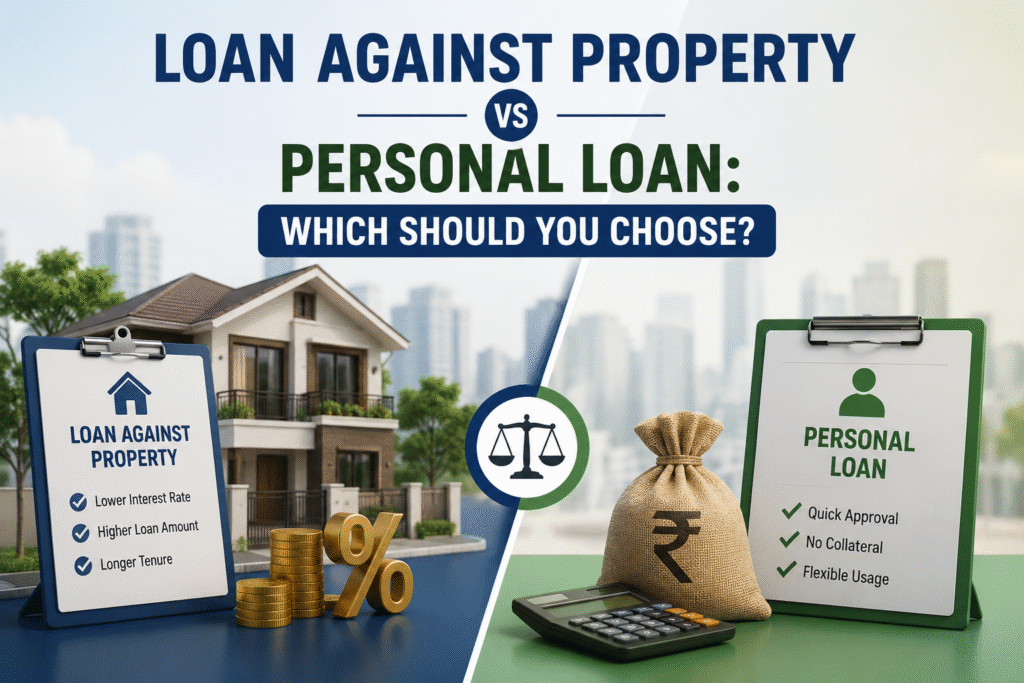
Money troubles rarely announce themselves in advance. A medical emergency, a child’s admission fee, a business that needs fresh capital, or a wedding that cannot wait, all of these push people toward borrowed money at some point. When the requirement is large and the source of funds is not clear, two options usually come up in conversation: a loan against property and a personal loan.
Both can put cash in your account within days. But they work on completely different principles, and choosing the wrong one can cost you lakhs of rupees over the loan tenure. This guide breaks down loan against property vs personal loan in plain terms, so you can pick the option that actually fits your situation.
What Is a Loan Against Property
A loan against property, commonly called LAP, is a secured loan where you pledge a residential or commercial property as collateral. The bank or housing finance company holds the property papers until the loan is repaid in full. Because the lender has something tangible to fall back on if you default, the risk to them is lower, and that gets passed on to you as a lower interest rate.
Most lenders in India sanction anywhere between 60 percent and 70 percent of the market value of the property. So if your house is valued at one crore rupees, you could be eligible for a loan of sixty to seventy lakh rupees, depending on the lender’s policy and your repayment capacity.
Loan against property interest rates in 2026 generally start from around 8 percent per annum and can go up to 15 percent or higher, based on your credit score, income stability, and the type of property offered as security. Tenure is also generous, often stretching up to fifteen or even twenty years, which keeps the monthly EMI comfortable even on a large loan amount.
What Is a Personal Loan
A personal loan is an unsecured loan. You do not need to pledge any asset, and the lender approves the loan purely on the strength of your income, credit score, and repayment history. Because there is no collateral protecting the lender, personal loans carry a higher interest rate compared to LAP.
As of 2026, personal loan interest rates in India typically start around 9.99 percent per annum for well qualified salaried borrowers with a strong credit score, and can go as high as 24 percent or more for applicants with a weaker profile. The loan amount is usually smaller than what a LAP can offer, and tenure is shorter too, commonly ranging from one to five years.
The biggest advantage of a personal loan is speed. Many banks disburse the amount within a few hours of approval, with minimal paperwork. There is no property valuation, no legal check on title documents, and no waiting for a mortgage to be registered.
Loan Against Property vs Personal Loan: Key Differences
| Factor | Loan Against Property | Personal Loan |
|---|---|---|
| Nature of loan | Secured against property | Unsecured |
| Interest rate | Roughly 8% to 15% per annum | Roughly 10% to 24% per annum or higher |
| Loan amount | Up to 60-70% of property value, can run into crores | Usually capped at a few lakh rupees, depends on income |
| Tenure | Up to 15-20 years | Usually 1 to 5 years |
| Processing time | 1 to 3 weeks, due to property valuation and legal checks | Same day to a few days |
| Risk to borrower | Property can be repossessed on default | No asset at risk, but credit score takes a heavy hit |
| Ideal for | Large expenses like business expansion, debt consolidation, higher education | Smaller, urgent expenses like medical bills, travel, wedding costs |
Interest Rate Comparison: Why the Gap Matters
The difference in interest rate between these two products is not minor. On a five lakh rupee loan taken for three years, even a three to four percentage point gap in interest rate can translate into a difference of well over a lakh rupees in total interest paid. This is the single biggest reason people with property to offer as collateral often choose LAP over a personal loan, even if it takes a couple of weeks longer to process.
That said, interest rate should never be the only factor. A LAP ties up your property for the entire loan tenure. If your income becomes unstable midway through a fifteen year loan, the property remains at risk until the last EMI is cleared. A personal loan, being shorter in tenure, gets you out of debt faster, even though you pay more in interest along the way.
When Should You Choose a Loan Against Property
A loan against property makes sense in these situations:
- You need a large sum, typically above ten lakh rupees, for a purpose like business expansion, buying commercial space, or funding a child’s education abroad.
- You own a residential or commercial property that is free of any existing loan, or has enough equity left in it.
- You want a lower EMI spread over a longer period, because your income, while steady, is not high enough to absorb a bigger monthly outflow.
- You are consolidating multiple high-cost debts, such as credit card dues or existing personal loans, into a single lower-interest loan.
- You are comfortable with the idea of your property being under mortgage for several years and are confident about steady repayment.
When Should You Choose a Personal Loan
A personal loan works better in these cases:
- You need funds quickly, within a day or two, for something urgent such as a medical emergency or an unexpected travel requirement.
- The amount required is relatively small, something you can repay within one to five years without much strain.
- You do not own property, or you are unwilling to pledge the one you have.
- You want to avoid the paperwork involved in property valuation, title verification, and mortgage registration.
- You have a strong credit score and a stable salaried income, which can get you a competitive rate close to the lower end of the personal loan range.
Eligibility and Documentation
For a loan against property, lenders check the market value of the property, its legal title, your income proof, and your credit score. Expect to submit property documents, income tax returns or salary slips, bank statements, and identity proof. The process includes a technical valuation of the property and a legal check of ownership documents, which is why LAP takes longer to process than a personal loan.
For a personal loan, the checklist is shorter. Salaried applicants typically need PAN, Aadhaar, salary slips for the last three months, and bank statements for six months. Self-employed applicants need PAN, Aadhaar, income tax returns for the last two years, and business bank statements. A credit score above 750 significantly improves your chances of getting the lowest advertised rate on both products.
Processing Fees and Other Charges
Both loan types come with charges beyond the interest rate. Loan against property usually attracts a processing fee of up to one to three percent of the loan amount, along with charges for property valuation and legal verification. There is also a government fee for registering the mortgage with the Central Registry of Securitisation Asset Reconstruction and Security Interest of India, known as CERSAI, which adds a small additional cost but strengthens the security of the transaction for the lender.
Personal loans typically charge a processing fee of one to two percent of the loan amount, sometimes capped at a fixed sum by certain banks. GST is applicable on processing fees for both loan types. It is worth asking your lender for a full breakup of charges before signing on the dotted line, since prepayment penalties, late payment fees, and bounce charges can add up if you are not careful.
Impact on Your Credit Score
Both loan types affect your credit score in similar ways. Timely EMI payments build a positive repayment history and improve your score over time. Missed payments or defaults hurt your score on both products, but the consequences differ sharply. Default on a personal loan usually leads to collection calls, legal notices, and a damaged credit score. Default on a loan against property can lead to the lender initiating recovery proceedings against the mortgaged asset, which is a far more serious outcome. This is worth weighing seriously before you pledge a property you cannot afford to lose.
Tax Benefits to Consider
A loan against property does not automatically qualify for the same tax deductions as a home loan. However, if the loan amount is used for business purposes, the interest paid can be claimed as a business expense, reducing your taxable income. If the LAP is used to purchase or construct another property, some tax benefits under the Income Tax Act may apply, subject to conditions. It is advisable to consult a tax professional to understand how the New Income Tax Act 2025 treats interest deductions on secured loans, since tax rules on this front can change with each budget cycle.
Personal loans generally do not offer any tax deduction, regardless of what the money is used for, unless it can be clearly demonstrated that the funds went into business use or into the construction or purchase of a house property.
Final Verdict: Which One Should You Pick
There is no single right answer, only the answer that fits your situation. If you own property, need a large amount, and can commit to a longer repayment horizon, a loan against property will almost always work out cheaper. If you need money quickly, the amount is modest, and you would rather not put an asset on the line, a personal loan is the more practical route, even at a higher interest cost.
A simple way to decide is to ask yourself three questions. How much money do you actually need? How quickly do you need it? And what are you willing to risk if repayment does not go as planned? The answers will usually point you toward the right loan without much difficulty.
Frequently Asked Questions
Is a loan against property cheaper than a personal loan? Yes, in most cases. Loan against property interest rates start lower because the loan is secured against an asset, while personal loans are unsecured and carry a higher rate to compensate the lender for the added risk.
Can I get a loan against property without an income proof? No. Even though the loan is secured, lenders still assess your ability to repay through income proof, bank statements, or income tax returns. The property only acts as security, not as a substitute for repayment capacity.
What happens if I fail to repay a loan against property? The lender has the legal right to initiate recovery proceedings against the mortgaged property, which can eventually lead to the property being auctioned to recover the outstanding dues. This is why LAP should only be taken when you are confident of steady repayment.
Which loan gets approved faster, LAP or personal loan? A personal loan is approved and disbursed much faster, often within a day, since there is no property valuation or legal verification involved. A loan against property can take one to three weeks due to the technical and legal checks required.
Can I prepay a loan against property or a personal loan early? Most lenders allow prepayment on both loan types, though some charge a prepayment penalty, particularly on fixed-rate personal loans. Always check the prepayment clause in your loan agreement before signing.
Does taking a loan against property affect my ability to sell the property later? Yes, until the loan is fully repaid and the mortgage is released, you cannot sell the property freely. The lender must issue a no-objection certificate and release the title documents before any sale can go through.
This article is for general informational purposes and does not constitute financial advice. Please consult a qualified financial advisor before making borrowing decisions.