
Commercial Property vs Residential Property: Which Investment Makes Sense for You in 2026?
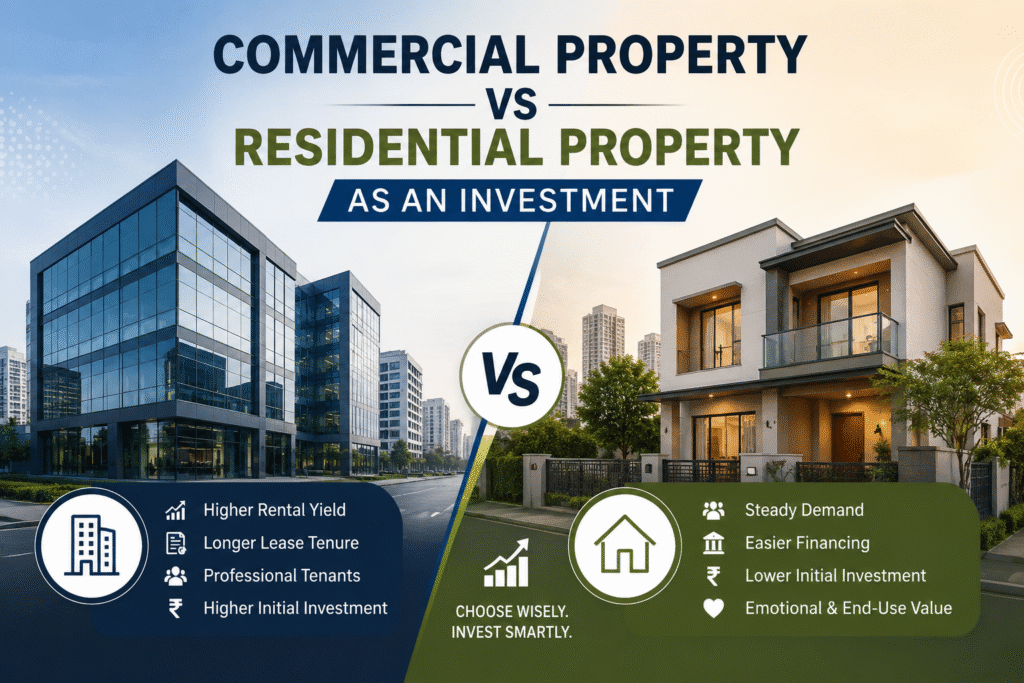
Every investor who has saved up a decent sum ends up asking the same question sooner or later. Should the money go into a shop or an office, or is a flat the safer bet? Real estate has always been the favourite asset class for Indian households, and the commercial versus residential debate has only grown louder as rental yields, home loan rates and capital gains rules keep shifting.
There is no single right answer here. The correct choice depends on how much capital you have, how much risk you can stomach, and whether you are chasing monthly rental income or long-term appreciation. This article breaks down both options across every parameter that actually matters, so you can decide with your eyes open instead of going by what a broker tells you over the phone.
Rental Yield: The Number Everyone Quotes First
Rental yield is the annual rent you earn expressed as a percentage of the property’s market value. It is the first thing any investor checks, and it is also where the gap between commercial and residential property is the widest.
Residential properties in India typically deliver a gross rental yield of about 3 to 5 percent of the property’s market value each year. A flat that costs 80 lakh might fetch you a rent of roughly 25,000 to 33,000 a month, and that is before you deduct maintenance, property tax and the odd month when the flat sits empty between tenants.
Commercial property behaves very differently. Gross yields for offices, retail shops and warehouses generally run between 7 and 12 percent, with 8 to 10 percent considered a good benchmark for well-located Grade-A assets in cities like Bangalore, Hyderabad, Gurgaon and Noida. Some pre-leased commercial assets with strong corporate tenants can push gross yields even higher, into the 8 to 15 percent range, particularly when the lease is long and the tenant is a bank, an MNC or an established retail chain.
Why does commercial property pay so much more? A big reason is lease structure. Commercial leases usually run five to fifteen years with a built-in rent escalation of 5 to 10 percent every three years, so the landlord is not renegotiating rent every eleven months the way a residential landlord often has to. Warehousing and logistics parks have become a particularly strong performer lately, with rental yields currently sitting around 7 to 10 percent, driven by the growth of e-commerce, manufacturing expansion and industrial corridor development.
Before you get too excited about that higher number, remember that yield is only half the story. A commercial unit that sits vacant for eight months a year because the location never attracted footfall will underperform a boring residential flat that stays rented without fuss.
Capital Appreciation: Where Residential Usually Wins
Rental income is one way to make money from property. The other is what the property is worth when you eventually sell it, and here the story flips.
Residential real estate in India tends to appreciate steadily because of population growth and ongoing housing demand, and this segment also happens to make up the bulk of the market, accounting for roughly 75 percent of all real estate transactions in India by volume. That scale brings liquidity. There is almost always a buyer or a tenant looking for a 2BHK in a decent locality, which makes residential property easier to exit when you need the cash.
Commercial property can appreciate faster, but only under the right conditions. Assets located in developing business districts can see rapid value increases, sometimes outpacing residential growth by a wide margin when an area transforms from a quiet suburb into a business hub. But this kind of appreciation is lumpy and location dependent. Get the corridor wrong and your commercial unit might barely move in value for a decade while nearby residential projects double.
Broadly speaking, commercial appreciation sits in a wider and less predictable band, while residential growth stays more moderate but consistent. The honest takeaway is this: commercial property is a cash flow play, residential property is a wealth building play, and the two rarely peak at the same time.
Entry Capital and Loan Terms
This is where a lot of first-time investors get filtered out of the commercial market without even realising it.
Home loans for residential property are the most generous credit product banks offer. Lenders will finance up to 90 percent of the property value for affordable housing under 30 lakh, and even on regular residential purchases the loan to value ratio stays comfortably high. Interest rates are also friendlier. As of mid-2026, a major private bank’s rate card showed residential loans priced around 8.95 to 9.95 percent for self-occupied property.
Commercial property loans are a different animal altogether. Loan to value ratios are capped much lower, typically 60 to 70 percent of market value for office or retail space, and 55 to 60 percent for warehouses, though a few lenders extend up to 75 percent loan to value for borrowers with a strong CIBIL score above 700. Interest rates run higher too, with the same bank quoting 9.25 to 10.25 percent per annum on commercial or non-self-occupied property loans. Industrial assets like warehouses and factories are treated as riskier still, and can see loan to value ratios as low as 40 to 50 percent along with the steepest interest rates in the mortgage category.
In plain terms, buying a commercial unit demands a much larger upfront cheque from your own pocket. If you have 20 lakh in savings, that amount might get you 80 percent financing on a residential flat but only 60 or 65 percent financing on a small office, meaning you would need a considerably more expensive commercial asset to make the numbers work, or you settle for a smaller unit.
Tax Treatment: Residential Has the Edge, Commercial Has Its Own Perks
Taxation rarely gets the attention it deserves in this debate, yet it can swing the real, after-tax return quite significantly.
On the sale side, both asset types are treated as capital assets under the Income Tax Act, and the holding period rule is identical. Sell within 24 months and the gain is short-term, taxed at your regular income slab rate. Hold beyond 24 months and it becomes long-term capital gains. For property acquired on or after 23 July 2024, long-term gains are taxed at 12.5 percent without indexation, while property bought before that date can still be taxed at 20 percent with indexation benefit under the earlier regime.
Residential property investors get an additional escape route that commercial property owners do not enjoy in the same way. If you sell a commercial property and reinvest the entire sale proceeds into a residential property, Section 54F of the Income Tax Act lets you claim a capital gains exemption, provided the new residential property is purchased within one year before or two years after the sale, or construction is completed within three years. This one-way exemption is a strong reason many long-term commercial investors eventually rotate profits into a home.
On the borrowing side, commercial property claws back some ground. If you take a loan against a commercial property for business use, the interest paid becomes a tax-deductible business expense under Section 37(1) of the Income Tax Act, which can meaningfully lower your effective cost of capital if you run a business that genuinely needs the funds.
Put together, residential property tends to offer better tax and financing advantages overall, while commercial property compensates investors with higher pre-tax rental yields. Neither side wins outright once you factor in the full picture.
Management Effort and Tenant Stability
A residential tenant needs a working tap, a functioning lift and a responsive landlord when the geyser breaks down. That is roughly the extent of it. A residential renter only requires limited infrastructure and utilities, which keeps operating costs for the landlord lower than for a commercial property.
Commercial tenants expect a lot more, and so does the property itself. Office spaces need central air conditioning, fire safety compliance, adequate power backup and often customised interiors before a corporate tenant will even sign a lease. The maintenance cost of a commercial property can end up eating into the higher rent you collect, which quietly lowers the actual return you take home. On the flip side, once a stable corporate tenant signs a long lease, you get years of predictable income without the tenant-hunting headache that residential landlords go through roughly every eleven to twenty-three months.
Investors who have spent years in the commercial segment tend to make the same point: rental yields on commercial property run higher than residential, but vacancy periods must be planned for, location determines tenant demand, and financial buffers are essential, since an empty office generates zero income while still costing you maintenance charges and property tax.
Risk and Liquidity
Residential property is the more forgiving asset if you ever need to exit in a hurry. Demand is broad based, buyers range from end users to investors, and a decent flat in a good locality rarely stays unsold for long once priced sensibly.
Commercial property carries concentrated risk. A single tenant leaving can wipe out your entire rental income overnight, and finding a replacement tenant for a large office floor or an oddly shaped retail unit can take months. Buyers for commercial assets are also a smaller pool, mostly other investors rather than end users, which can stretch the time it takes to sell when you need liquidity.
Who Should Choose What
If you are a first-time investor with a moderate budget, limited appetite for hands-on management and a preference for steady, low-drama appreciation, residential property remains the sensible starting point. It is easier to finance, easier to rent out, easier to sell and comes with tax exemptions that reward reinvestment.
If you already have a larger capital base, some tolerance for vacancy risk, and you are specifically hunting for monthly cash flow rather than long-term price growth, commercial property earns serious consideration. A well-located, pre-leased office or retail unit with a stable corporate tenant can deliver income that a residential flat simply cannot match.
Many experienced investors do not treat this as an either-or decision at all. A common approach seen among seasoned portfolios is holding two to three residential properties for appreciation alongside one commercial property for income, so growth and cash flow both get covered without over-concentrating in either segment. If direct commercial ownership feels too capital heavy, Real Estate Investment Trusts, or REITs, offer a way to get exposure to commercial-grade office assets through the stock market with a fraction of the entry capital and none of the tenant management headache.
Frequently Asked Questions
Which gives better rental income, commercial or residential property? Commercial property generally delivers higher rental yields, typically in the range of 6 to 10 percent or more, compared to 2 to 5 percent for residential property. The trade-off is longer vacancy periods and higher maintenance costs on the commercial side.
Is it harder to get a loan for commercial property than residential property? Yes. Commercial property loans usually come with lower loan-to-value ratios, often 60 to 75 percent compared to up to 90 percent for affordable residential housing, and interest rates tend to run higher as well.
Does residential property appreciate faster than commercial property? Not always, but residential property tends to appreciate more steadily due to consistent housing demand. Commercial property can appreciate faster in developing business corridors, though this growth is less predictable and more location dependent.
Are capital gains taxed differently for commercial and residential property in India? The holding period rules and tax rates are the same for both. However, residential property offers an additional exemption route under Section 54F when commercial property sale proceeds are reinvested into a residential home.
Can a beginner investor start with commercial property? It is possible but generally not advisable without adequate capital reserves, since commercial property demands a larger down payment, carries higher vacancy risk, and requires more active management. Most first-time investors are better served starting with residential property or exploring REITs for commercial exposure.
What is a good rental yield for commercial property in India in 2026? A gross rental yield of 8 to 10 percent is generally considered good for commercial property in India in 2026, with well-located Grade-A offices and warehousing assets in cities like Bangalore, Hyderabad and Delhi NCR often falling in this range.
This article is for general informational purposes and does not constitute investment advice. Property investment decisions should factor in individual financial goals, risk appetite and local market conditions. Readers are encouraged to consult a qualified financial advisor before making real estate investment decisions.