
Financial Planning Under Uncertainty: Scenario Analysis, Stress Testing and Contingency Planning
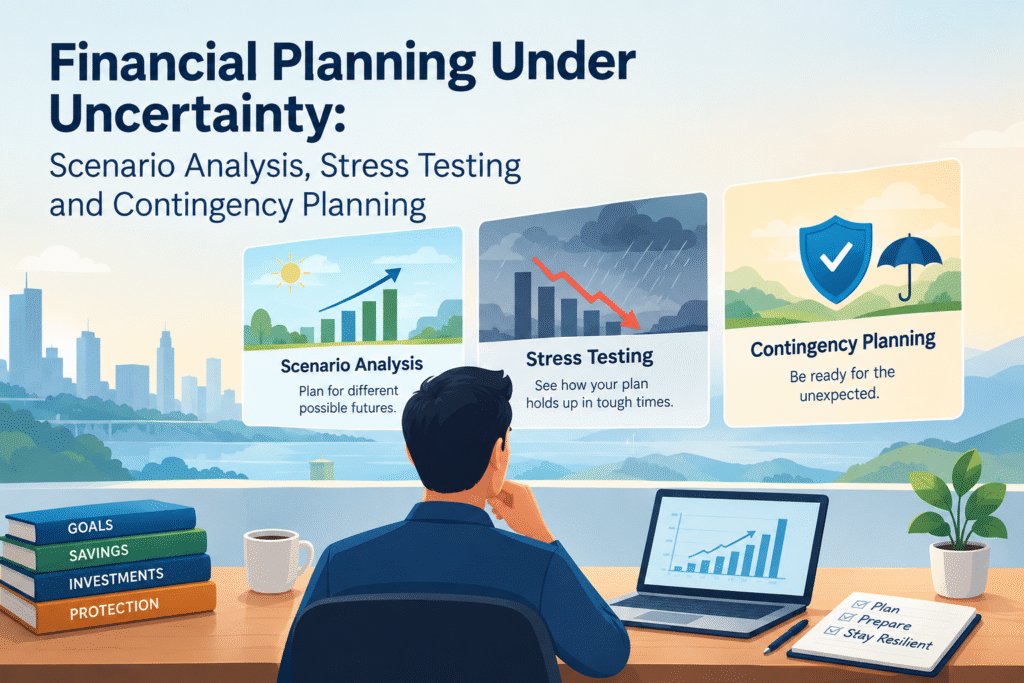
Most financial plans are built on a single, comfortable assumption: things will go roughly the way they went last year. Salaries will rise a little, markets will average out to their long-term return, and no unpleasant surprises will show up along the way. Then a job is lost, a market falls 20% in three months, a medical bill arrives out of nowhere, or interest rates climb faster than anyone expected, and the neat spreadsheet stops meaning much.
Financial planning under uncertainty is not about predicting the future correctly. Nobody does that reliably, not economists, not fund managers, not the person writing this article. It is about building a plan that still works reasonably well even when your guesses about the future turn out to be wrong. Three tools do most of the heavy lifting here: scenario analysis, stress testing and contingency planning. They sound like jargon borrowed from a bank’s risk department, and in a sense they are, but every one of them can be scaled down to fit a household budget and an ordinary investment portfolio.
This article walks through what each of these tools actually means for an Indian retail investor, how to use them without a finance degree, and how to put together a plan that bends instead of breaking when life does not cooperate.
Why Certainty Is the Wrong Thing to Plan For
A financial plan built around one expected outcome is really a bet dressed up as a plan. If you assume your equity mutual funds will return 12% a year, every number that follows, your retirement corpus, your child’s education fund, your target retirement age, is only correct if that one assumption holds. Markets do not cooperate on schedule. The Sensex has delivered years of over 30% returns and years of double digit losses, sometimes back to back.
The same is true off the stock market entirely. Jobs disappear during downturns exactly when markets fall, which is the worst possible timing for someone forced to sell investments to cover expenses. A SEBI 2025 household survey covering 90,000 households found that nearly 80% of Indian families still prioritise capital preservation over higher returns, which tells you something important: most people already sense, correctly, that their financial life carries more risk than a single confident projection admits.
Planning for uncertainty means replacing the question “what will happen” with a better question: “what could happen, and can I survive each version of it?” That shift in thinking is the whole point of scenario analysis and stress testing.
Scenario Analysis: Mapping the Range of Outcomes
Scenario analysis means building a small number of plausible futures and running your financial plan through each one, rather than relying on a single forecast. For a retail investor, three scenarios usually cover enough ground to be useful without turning the exercise into a research project.
The favourable scenario. Economic growth holds up, inflation stays close to the Reserve Bank of India’s target band, corporate earnings grow, and equity markets deliver returns close to their long-term historical average. Your SIPs compound the way the projection sheets promise. This scenario is useful mainly as a ceiling, so you do not build a plan that only works if everything goes right.
The base scenario. This is the realistic middle path: moderate growth, occasional volatility, a market correction or two along the way, interest rates moving within a normal range. Most financial plans are quietly built around some version of this scenario alone, which is the mistake this whole exercise tries to correct.
The adverse scenario. A recession, a sharp market fall, a spike in inflation that erodes real returns, a period of job insecurity or a health event that disrupts income. This is the scenario people avoid thinking about, and precisely the one that decides whether a financial plan actually holds up.
Running your own numbers through these three lenses does not require a Bloomberg terminal. Take your retirement corpus target, your SIP amount, and your investment horizon, then simply recalculate the outcome using three different return assumptions, say 12%, 9% and 5%, and three different saving disruptions, say no interruption, a six month gap in contributions, and a twelve month gap. Look at what each combination does to your final number and your timeline. If the adverse case pushes your retirement out by a decade, that is worth knowing now rather than at fifty five.
Financial advisors increasingly formalise this into a favourable, base and adverse framework for exactly this reason: it turns a vague worry about “the market going down” into a specific number you can plan around.
Stress Testing: Finding the Breaking Point
Where scenario analysis explores a range of plausible futures, stress testing asks a sharper question: how much shock can this specific plan or portfolio absorb before it actually breaks? It borrows directly from how banks test their balance sheets before a regulator asks them to, only here the balance sheet is your own.
A useful portfolio stress test links three layers of shock together, because in real life they tend to arrive as a package rather than one at a time.
Market shock. What happens to your portfolio’s value if equities fall 30%, debt fund NAVs dip on rate volatility, and gold moves unpredictably? A large-cap heavy Indian equity portfolio stressed with a 30% market decline and a moderate earnings contraction gives you a realistic worst-case value, not the theoretical floor but the kind of decline seen in real market cycles like 2008 or the early days of 2020.
Business or income shock. If you run a business or depend on variable income, model a 30 to 40% drop in revenue or a client loss. Salaried readers should model a layoff scenario: how many months can the household survive with zero income coming in?
Liquidity shock. This is the layer most people skip, and it is often the one that actually causes damage. Even a portfolio that is theoretically sound on paper can force an investor into a terrible decision if there is no accessible cash when a bill lands. This is precisely why the Franklin Templeton debt fund episode in 2020 became a cautionary tale for Indian debt investors: instruments that looked stable turned illiquid exactly when investors needed the money most.
Reverse stress testing flips the exercise around and is worth trying at least once: instead of picking a shock and measuring the damage, start from the outcome you cannot afford, running out of money before your child finishes college, being forced to sell your home, defaulting on an EMI, and work backwards to find exactly what combination of events would cause it. This tends to surface blind spots that forward-looking scenarios miss, because it forces you to name the failure mode explicitly instead of hoping it stays abstract.
For most households, stress testing does not need software. A simple spreadsheet with your monthly expenses, your EMIs, your liquid savings and your investment values is enough. Apply a shock, reduce income to zero or apply a 30% market fall, and count how many months the household stays solvent before forced selling or borrowing becomes necessary.
Contingency Planning: What You Actually Do When the Scenario Arrives
Scenario analysis tells you what could happen. Stress testing tells you where the plan would break. Contingency planning is the part that actually protects you: the pre-decided actions you take the moment a stress scenario starts turning real. Without this third piece, the first two are just an academic exercise that leaves you exactly as unprepared as before, only better informed about it.
Build a liquidity buffer sized to your income type, not a generic number. The blanket “six months of expenses” rule that gets repeated everywhere is a reasonable starting point, but it is not the whole answer. A salaried employee at a stable large company with a notice period can often manage with three to four months of essential expenses set aside. Someone in a startup, on commission-based income, or self-employed should target nine to twelve months, since income interruption risk is materially higher. The RBI’s Household Finance Survey, 2025, found that only 29% of Indian households had three or more months of liquid savings, while 52% did not even have a single month covered. That gap is not a minor statistic, it is the single biggest reason otherwise sound financial plans collapse under pressure.
Keep the buffer where it earns something without sacrificing access. Idle cash in a savings account earning 2.7 to 4% loses value to inflation every year. Splitting the emergency fund between a savings account for immediate access and liquid mutual funds or short-term fixed deposits for the larger portion, which typically yield closer to 7 to 8%, keeps the money working without compromising the one thing an emergency fund exists for: being there when you need it.
Insurance is a contingency plan you buy rather than save for. Adequate health cover and term life insurance exist specifically to absorb the two shocks most likely to derail a financial plan: a medical emergency and the loss of an income-earning family member. A household with a thin health cover and a thick equity portfolio has its priorities backwards; the equity portfolio is what gets liquidated at the worst possible moment if the health cover falls short.
Decide your response to a market fall before the market falls, not during it. Write down, today, what you will actually do if your equity portfolio drops 25%. Will you continue your SIPs. Will you avoid touching your long-term investments regardless of headlines. Will you draw from your emergency fund rather than your equity holdings if an expense comes up during the downturn. Behavioural research and plain experience both show that decisions made in the middle of a falling market are worse than decisions made calmly in advance, mainly because fear and loss aversion take over exactly when clear thinking matters most.
Rebalance on a schedule, not on impulse. Over time, a strong equity run can quietly push your allocation from a planned 60:30:10 equity, debt and gold split to something far more aggressive, simply because equity grew faster than the rest. Reviewing and rebalancing your portfolio once or twice a year, or whenever an asset class drifts a set percentage away from target, restores the risk level you originally chose rather than the risk level the market drifted you into.
Keep debt structured for resilience, not just affordability. An EMI that fits comfortably against your current income can become unmanageable the moment that income is disrupted. Before taking on a large loan, ask what your monthly obligations would look like if your income fell by a third for six months, and keep enough headroom that the answer is not frightening.
Putting the Three Together: A Working Template
The real value of scenario analysis, stress testing and contingency planning comes from using them together, not as three separate boxes to tick.
- List your major financial goals with target years: retirement, a child’s education, a home purchase.
- Build three scenarios for each goal, favourable, base and adverse, using different return and savings assumptions.
- Stress test your current liquidity position against a job loss or income disruption of six and twelve months.
- Stress test your portfolio against a 25 to 30% market fall and note the resulting corpus value against your near-term goals.
- Write your contingency responses in advance for each stress scenario: what gets cut first, what stays untouched, and where the money for an emergency actually comes from.
- Revisit the whole exercise once a year, or after any major life change such as a new job, a new loan, a marriage or a child.
None of this eliminates uncertainty. It cannot. What it does is remove the panic and improvisation that usually make a bad financial situation worse. A household that has already decided, on a calm day, exactly how it will respond to a falling market or a lost job tends to make far better decisions than one working it out for the first time under stress.
FAQ
What is the difference between scenario analysis and stress testing in financial planning? Scenario analysis builds several plausible future paths, favourable, base and adverse, and checks how a financial plan performs under each. Stress testing applies a specific, often severe shock, such as a 30% market fall or a total loss of income, to find the exact point at which a plan or portfolio would fail. Scenario analysis maps possibilities; stress testing finds the breaking point.
How much should an Indian household keep as an emergency fund? Most financial planners suggest three to six months of essential expenses for salaried individuals with stable jobs, rising to nine to twelve months for those with variable or self-employed income. The RBI’s 2025 Household Finance Survey found that just 29% of Indian households currently hold three or more months of liquid savings, which is well short of what most contingency plans recommend.
Why is contingency planning necessary if I already have insurance and investments? Insurance and investments address specific risks, but they do not tell you what to actually do in the moment a crisis unfolds. Contingency planning is the decision made in advance about which resource to draw on first, what to leave untouched, and how to respond to a market fall or income loss, so that decisions are not made under panic when they matter most.
How often should I stress test my portfolio? Once a year is a reasonable minimum, alongside your regular portfolio review, but it is worth repeating the exercise after any major change: a new loan, a job switch, a large one-time expense, or a period of unusually high market volatility.
Can scenario analysis actually predict a market crash? No, and that is not its purpose. Scenario analysis does not forecast when a downturn will happen. It prepares a plan to survive one whenever it does happen, by testing outcomes across a range of assumptions rather than relying on a single optimistic forecast.
This article is for educational purposes and does not constitute personalised investment, tax or legal advice. Please consult a SEBI-registered investment adviser before making financial decisions.