
Goal-Based Investing vs Benchmark-Based Investing: Rethinking Portfolio Success
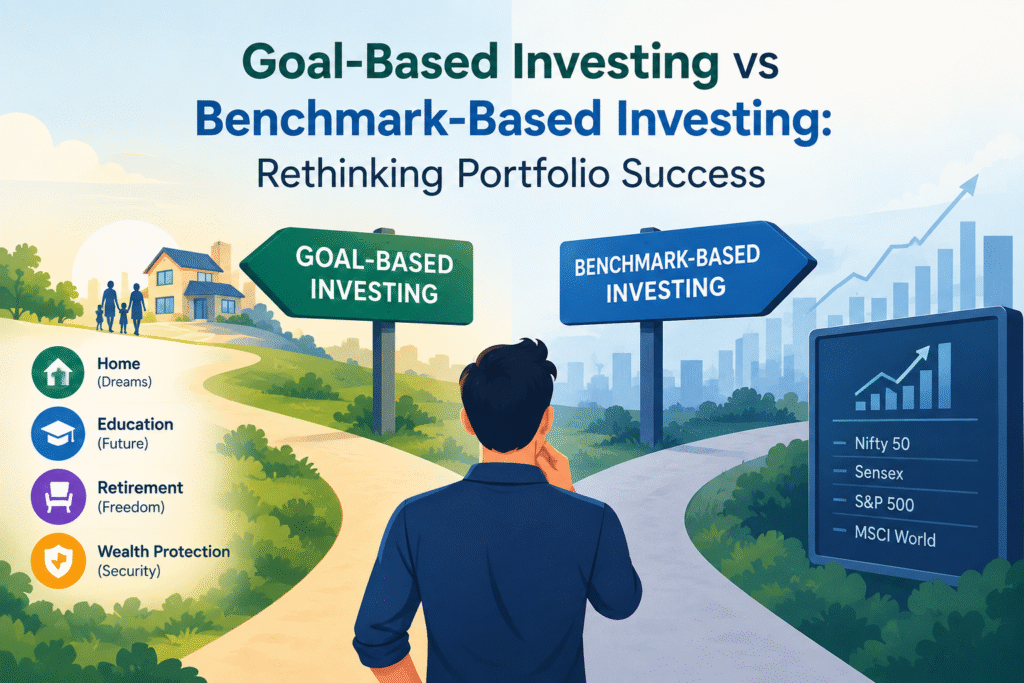
Every year, around the time annual portfolio statements land in the inbox, a familiar question shows up. Did my portfolio do well? Most investors answer this by opening a comparison chart. Nifty 50 returned so much, my mutual fund returned a little less or a little more, and that single gap decides whether the year felt like a win or a letdown.
This is benchmark-based investing in its purest, unspoken form. It is not a strategy anyone consciously chooses. It is a habit that creeps in because indices are easy to quote and comparisons are easy to make. But a portfolio judged only against an index can be technically successful and personally useless at the same time. It can beat the Nifty by four percentage points and still leave a child’s college fund short by two years, or fall short of the Nifty by two percentage points and still comfortably fund a retirement that begins on schedule.
Goal-based investing asks a different question altogether. Not “did I beat the market” but “will this money be there, in the right amount, when I actually need it.” That single shift in the question changes how a portfolio gets built, how risk gets measured, and how success gets defined. This piece lays out both approaches, where each one falls short, and how an investor in India can combine the discipline of one with the clarity of the other.
What Benchmark-Based Investing Actually Means
Benchmark-based investing treats a market index, usually the Nifty 50, Sensex, or a relevant category average, as the yardstick for everything. A large-cap fund is judged against the Nifty 100. A mid-cap fund is judged against the Nifty Midcap 150. Fund houses publish these comparisons because SEBI mandates benchmark disclosure for every scheme, and investors have grown used to reading returns in relative rather than absolute terms.
There is a real place for this. Benchmarks tell you whether a fund manager is adding value over a passive alternative, and they keep fund houses honest about fees and performance. A large-cap fund that consistently trails its benchmark after costs is not doing its job, and that comparison matters.
The trouble starts when the benchmark stops being a diagnostic tool and becomes the actual goal. An investor saving for a home down payment in four years has no business measuring success against a benchmark that has no concept of a four-year horizon, a specific rupee target, or the investor’s own tolerance for a bad year right before the money is needed. The index does not know when you plan to buy a house. It just moves.
What Goal-Based Investing Actually Means
Goal-based investing starts from the other end. Instead of asking which fund or asset class will produce the highest number, it asks what the money is for, when it is needed, and how much certainty the investor requires around that date. A retirement corpus being built over twenty-five years can absorb volatility that a wedding fund needed in eighteen months simply cannot.
Rather than balancing expected portfolio variance with return the way traditional portfolio construction does, goal-based investing works to minimise the probability of falling short of a minimum required amount within a set period. In practice, this means every goal gets its own mini-portfolio, sized and risk-calibrated to its own timeline, instead of one large pool of money judged by a single number.
A typical Indian household following this approach might end up with four or five separate buckets running in parallel: an emergency fund in a liquid fund or sweep-in fixed deposit, a child’s education fund in a mix of equity and debt weighted toward debt as the goal date approaches, a retirement fund that stays aggressive for decades and only de-risks in the final five to seven years, and a short-term goal like a car or a vacation parked almost entirely in debt instruments. Each bucket is judged only against its own target, not against what the Nifty did that year.
Where Benchmark Thinking Quietly Misleads Investors
The most common damage benchmark thinking does is behavioural, not mathematical. When an investor tracks a portfolio against the Nifty 50 every quarter, market noise becomes the main character in every financial decision. A portfolio that is on track for its actual goal can still feel like a failure in a year when the index runs ahead of it, and that feeling often triggers exactly the wrong response: chasing whatever asset class outperformed last year, or abandoning a well-suited debt allocation because “equity is doing better.”
The comparison also breaks down at the exact moment it matters most. An investor nearing retirement cannot afford a large drawdown right before withdrawal begins, and outperforming the general market by a wide margin offers little comfort if the broader market itself has dropped sharply and the portfolio has fallen along with it. A ten-point win over a falling benchmark is still a loss for someone who needed that money intact.
There is a second, quieter problem. Benchmarks push investors toward one-size-fits-all thinking. Treating every rupee the same, regardless of what it is meant to fund, is one of the two most common mistakes in Indian retail investing, alongside abandoning equity at the first sharp correction. A single portfolio managed against a single index tends to produce a single risk level applied uniformly across money that actually serves very different purposes and very different time horizons.
Where Goal-Based Investing Has Its Own Limits
Goal-based investing is not free of drawbacks, and a fair comparison has to say so plainly.
It demands more upfront work. Building separate portfolios for separate goals means more accounts, more SIPs, more tracking, and more decisions than simply picking a fund and comparing it to the Nifty once a year. For an investor with only one or two financial goals, this can feel like unnecessary complexity.
It can also produce a false sense of precision. Assigning a fixed rupee target and a fixed date to a goal fifteen years away involves guesswork about inflation, income growth, and life circumstances that nobody can predict with real accuracy. A goal-based plan built on a wrong assumption about school fees in 2040 is still a plan built on a guess, just a more organised one.
And goal-based investing can, if applied too rigidly, lead to under-investing in equity for long-horizon goals out of excessive caution, or over-segmenting money into so many small buckets that the portfolio loses the benefits of scale and simplicity. The fix for benchmark obsession should not be a new obsession with matching every number to a spreadsheet.
Random SIPs without a clear plan tend to build confusion rather than wealth, even when the amounts invested each month look disciplined on paper. The point is not that goal-based investing is flawless. It is that it fails in more forgiving ways, because the failure shows up as “I need to save a bit more” rather than “the market fell and my plan is gone.”
A Practical Way to Combine Both
The two approaches are not really rivals once the roles are separated correctly.
Use goals to decide the structure of a portfolio: how many buckets exist, how much goes into each, what asset mix suits each timeline, and when to start reducing equity exposure as a date approaches. This is the layer that should never be handed over to an index.
Use benchmarks to judge the quality of execution within each bucket. If the equity portion of the retirement bucket is invested through a flexi-cap fund, that fund’s performance against its category benchmark is a fair and useful check on whether the fund manager is earning the fees being paid. If a large-cap fund trails the Nifty 100 for three consecutive years after costs, that is a legitimate reason to review the choice of fund, separate from any question about the retirement goal itself.
This way, asset allocation ends up serving the goal, rather than the goal serving asset allocation, while the benchmark still does the narrower job it is actually good at: keeping individual fund choices honest.
Steps to Move From Benchmark Thinking to Goal-Based Thinking
List every financial goal with a number and a date attached. Not “save for retirement” but “build a corpus of a specific size by a specific year.” Vague goals cannot be measured, and what cannot be measured tends to drift back toward benchmark comparisons by default.
Sort goals by time horizon. Anything under three years belongs mostly in debt or fixed deposits. Anything beyond seven to ten years can carry meaningful equity exposure. The middle ground needs a blended, gradually de-risking allocation.
Open separate investment accounts or folios where practical. Mixing goals inside one pool makes it far too easy to raid a long-term bucket for a short-term need, or panic-sell a short-term bucket during ordinary equity volatility that was never a threat to a distant goal.
Review each goal against its own progress, not against the index. A quarterly or half-yearly check on whether the current SIP amount and allocation are still on pace for the target date matters far more than whether the portfolio beat the Nifty last quarter.
Keep one benchmark check for fund quality, separate from goal tracking. Once a year, compare each fund against its stated benchmark and category average purely to judge the fund manager, not the plan.
Passive options have made this easier to execute in recent years, with index fund folios in India growing roughly thirteen times between September 2021 and September 2025 and ETF folios growing more than sixfold in the same period, giving goal-based investors low-cost building blocks for the equity sleeve of long-horizon goals without needing to pick an actively managed fund at all.
The Real Measure of Portfolio Success
A portfolio that beats its benchmark by a wide margin but leaves a goal unfunded has not succeeded. A portfolio that trails its benchmark every single year but delivers the exact amount needed on the exact date needed has succeeded completely. Indices are useful for judging fund managers. They are the wrong tool for judging a life.
The shift from benchmark-based thinking to goal-based thinking is less about abandoning comparisons and more about putting them in their proper place: a check on execution, not a definition of success.
Frequently Asked Questions
Is goal-based investing only for wealthy investors with complex finances? No. Even an investor with a single SIP can practise goal-based investing by simply attaching a target amount and date to that SIP and reviewing progress against that target instead of against the Nifty.
Should benchmark comparison be dropped completely? Not entirely. Benchmarks remain useful for judging whether a specific fund manager is earning their fees, especially for actively managed equity funds. The mistake is using a benchmark to judge an entire financial plan rather than a single fund.
How many separate goal buckets should an average Indian household maintain? Most households manage comfortably with four to six: an emergency fund, one or two medium-term goals such as a home or vehicle, a child’s education fund if applicable, and a retirement fund. More than that tends to add tracking effort without adding real benefit.
Does goal-based investing mean avoiding the stock market for short-term goals? Largely, yes. Goals under three years are generally kept in debt instruments or fixed deposits, since equity volatility over such a short window can jeopardise the very outcome the money is meant to fund.
Can a single mutual fund serve more than one goal at the same time? It can, but it makes tracking harder and increases the temptation to withdraw for one goal in a way that damages another. Separate folios or at least separate SIP tags, where the platform allows it, keep the accounting honest.