
Dynamic Asset Allocation: When Should Investors Change Their Equity-Debt Mix?
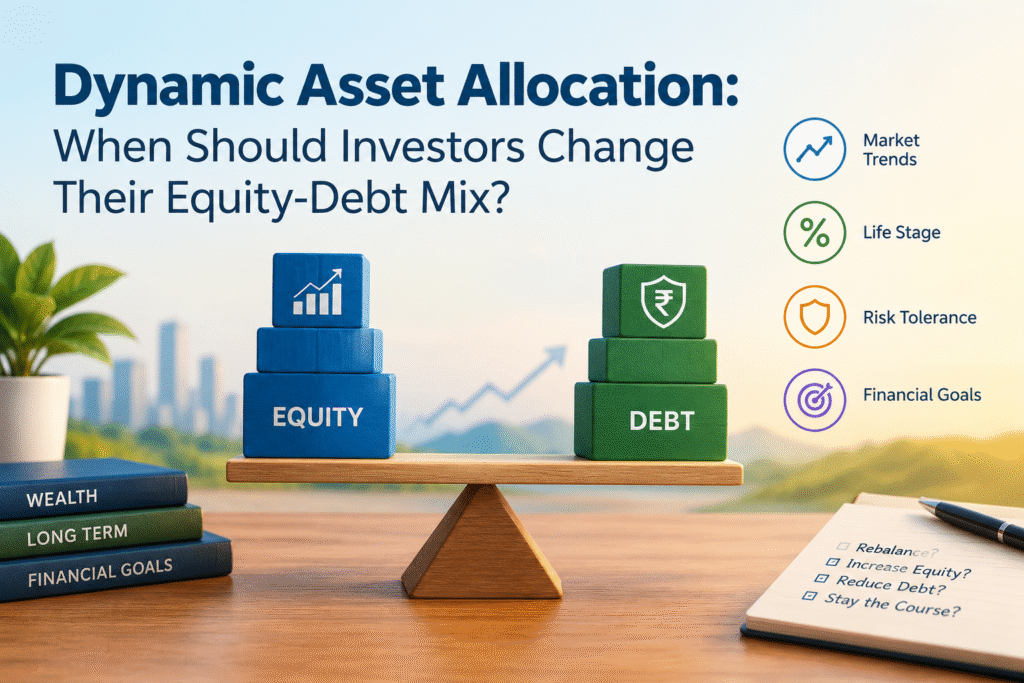
Most investors pick an equity-debt ratio once, usually when they open their first SIP, and then leave it untouched for years. A 70:30 split feels comfortable at twenty-five. Nobody revisits it until a market crash forces the question. That is precisely the gap dynamic asset allocation tries to close. It is not a single formula but a discipline: a way of deciding, on a recurring basis, whether your equity-debt mix still matches your goals, your risk appetite, and where the market currently stands.
This piece walks through what dynamic asset allocation actually means, the signals that genuinely justify a change in your mix, how balanced advantage funds do this job automatically, and where the whole idea tends to be misapplied.
What Dynamic Asset Allocation Really Means
A static allocation is fixed by rule: say, 60% equity and 40% debt, rebalanced back to that ratio every year regardless of anything else. Dynamic asset allocation goes a step further. The mix of equity and debt changes based on indicators specified in an investment approach, which can include equity valuations, earnings, market momentum, volatility, and interest rates. Exposure to equity may be trimmed when valuations look stretched, and raised when they look reasonably priced, though the exact method varies from one approach to another.
In simple terms, dynamic allocation asks a market-aware question instead of a calendar-aware one. A calendar-based rebalance asks, “has a year passed?” A dynamic one asks, “has anything changed that justifies a different mix right now?”
Dynamic asset allocation funds adjust the investment mix between debt and equity based on market conditions, with the goal of taking advantage of opportunities while managing risk more carefully. These funds, often called balanced advantage funds, may increase equity exposure during a bull run to capture gains, and shift toward debt during a volatile or falling market to protect capital. You can run the same logic in your own portfolio without buying a fund, but it takes more attention and more discipline than most people give it credit for.
Why a Fixed Mix Eventually Stops Working
A 70:30 equity-debt mix set up in your late twenties will not serve you the same way in your late forties, and it will not serve you the same way in a market trading at rich valuations versus one that has just corrected 20%. Three forces quietly work against a mix you never touch.
Drift. If equity rises faster than debt over a few years, your original 70:30 split can silently become 80:20 without you doing anything. You end up carrying more risk than you signed up for, purely because one asset class outperformed.
Life stage. Income, dependents, loan obligations, and how close you are to a goal all change your capacity to absorb a loss. A 30-year-old saving for retirement can ride out a 25% equity drawdown. A 58-year-old two years from retirement usually cannot.
Market cycle. Buying more equity when valuations are already expensive, simply because that is what the fixed ratio demands, works against the basic logic of buying low. A rigid ratio does not distinguish between a cheap market and an expensive one.
Dynamic allocation is the attempt to correct for all three without needing a crystal ball.
The Signals Worth Watching
1. Where valuations stand, not where prices have been
Price alone tells you very little. Price relative to earnings, and how that compares with history, tells you a great deal more. When broad market valuations run well above their long-term average, that is usually when investors should be trimming equity, not adding to it. When valuations compress after a correction, without a corresponding collapse in earnings, that tends to be the more attractive entry window, not the moment to retreat into debt out of fear.
One practical framework for 2026 suggests keeping equity exposure closer to the lower end of a strategic range while valuations stay stretched, with room to move that exposure higher only after a meaningful correction that does not fundamentally damage the underlying earnings trajectory. The specific numbers will vary by house view, but the underlying principle holds: valuation, not headlines, should drive the size of your equity sleeve.
2. How far you are from your goal
A goal ten years away can absorb a fair amount of equity volatility because there is time to recover from a bad year or two. A goal two years away cannot. This is why most well-run retirement or education-fund plans use a glide path: equity allocation is deliberately reduced as the goal date approaches, regardless of what the market is doing, simply because the cost of a bad sequence of returns rises sharply as the time horizon shrinks.
3. A genuine change in risk capacity
Risk appetite is often confused with risk capacity, and the two are not the same thing. Risk appetite is how much volatility you feel comfortable watching. Risk capacity is how much volatility your finances can actually absorb without derailing a goal. A job loss, a new home loan EMI, a medical event, or the birth of a child changes risk capacity even if your appetite for market swings has not changed at all. These are legitimate triggers to lower equity exposure, independent of what the market is doing.
4. Interest rate direction
Debt returns are sensitive to where interest rates are heading. When rates are expected to fall, longer-duration debt tends to benefit from price appreciation, which can make debt a more attractive counterweight to equity. When rates are rising or expected to stay elevated, shorter-duration debt instruments usually hold up better. This does not mean timing rate cycles perfectly, which almost nobody manages consistently, but it does mean the debt half of your portfolio also deserves a periodic look, not just the equity half.
5. Rebalancing bands, not rebalancing dates
A useful middle ground between doing nothing and constantly fiddling with your portfolio is the rebalancing band. Instead of rebalancing on a fixed date each year, you rebalance only when your actual allocation drifts beyond a set threshold from your target, commonly five to ten percentage points. Certain hybrid categories, including dynamic asset allocation funds, adjust the equity-debt mix internally based on a stated mandate, which suits investors who would rather not rebalance manually across separate equity and debt holdings. If you prefer to manage this yourself rather than delegate it to a fund manager, a band-based approach forces action only when it is actually warranted, and saves you from reacting to every small market wobble.
A Practical Reference: Equity-Debt Mix By Life Stage
These are starting points, not prescriptions, since income stability, dependents, and existing liabilities all shift the right number for any individual.
| Life stage | Typical equity range | Typical debt range | Why |
|---|---|---|---|
| 20s to early 30s, few dependents | 70-80% | 20-30% | Long horizon, high capacity to absorb drawdowns |
| Mid 30s to mid 40s, home loan, young children | 55-70% | 30-45% | Growth still needed, but liquidity needs rising |
| Late 40s to mid 50s, approaching major goals | 40-55% | 45-60% | Capital protection starts to matter more |
| Near or in retirement | 25-40% | 60-75% | Withdrawal phase; sequence-of-returns risk is now the primary threat |
Consider an investor putting Rs 10 lakh toward a 10-year goal with moderate risk tolerance and a stable income. A reasonable starting split for that profile might be 65% equity, 25% debt, and 10% gold. Assuming a blended long-term CAGR of roughly 11% for such a mix, based on pure equity indices in India historically compounding closer to 12-13% over rolling ten-year periods while debt has delivered around 6-7%, the corpus could grow to approximately Rs 28-29 lakh over ten years, before expense ratios and taxes on redemption are accounted for. That is an illustrative outcome, not a promise, since actual returns over any specific decade can land well outside historical averages.
Doing It Yourself vs Balanced Advantage Funds
There are two honest ways to practise dynamic asset allocation.
Manage it yourself. This means tracking valuation indicators, reviewing your allocation on a fixed schedule (quarterly is common), and rebalancing when you cross your chosen band. It gives you full control and no extra expense ratio, but it demands consistency most people struggle to maintain, especially in a falling market when the emotionally comfortable choice is to do nothing, or worse, to sell equity at the bottom.
Delegate it to a balanced advantage fund. These funds are open-ended schemes designed to provide long-term capital appreciation and income through a mix of equity and debt, with a fund manager actively adjusting the ratio. The advantages include diversification, professional management, and the ability to adjust asset allocation based on prevailing market conditions, along with exposure to both equity and debt that can help reduce overall risk while still aiming for reasonable returns. The trade-offs are real too: these funds still carry market risk, interest rate risk, and credit risk, and the debt portion can be exposed to default risk if an issuer fails to honour its obligations.
Newer entrants in this category have widened the scope beyond equity and debt alone. One recently launched fund of funds invests across equity, debt and commodity-oriented schemes, using an internal market framework that analyses valuations and historical trends to guide how allocations shift across cycles. The broader point holds regardless of which specific fund you pick: you are paying a manager, through a higher expense ratio than a plain index fund, to make the valuation and timing calls on your behalf.
Neither approach is inherently superior. The self-managed route suits investors who genuinely have the time, discipline, and interest to track their portfolio properly. The fund route suits those who would rather pay for that discipline than risk not exercising it themselves.
Taxation: A Detail That Changes The Calculus
Dynamic allocation decisions do not happen in a tax vacuum, and this is where a lot of DIY rebalancing plans quietly lose value. Where a scheme does not qualify as equity-oriented, its tax treatment depends on its debt allocation, the holding period, and the specific dates on which units were purchased and redeemed. From April 1, 2026, a specified mutual fund is defined as one investing more than 65% of its proceeds in debt and money market instruments, or one investing at least 65% in units of such a fund.
Practically, this means shifting money between separate equity and debt mutual funds every time you rebalance can trigger capital gains tax each time, while a balanced advantage fund making the same shift internally does not create a taxable event for you until you actually redeem your units. For frequent rebalancers, that difference compounds meaningfully over a decade.
Common Mistakes Investors Make With Dynamic Allocation
Reacting to headlines rather than to valuation data is the most frequent error. A market falling 10% in a week feels urgent, but a single week rarely changes the underlying case for your allocation. Chasing last year’s best-performing balanced advantage fund is another, since a strong one-year return often reflects a manager who happened to be positioned correctly for a specific cycle, not a repeatable edge. Treating dynamic allocation as a reason to time the market aggressively is the third, and probably the most damaging, since the entire point of the discipline is to reduce emotional decision-making, not to add another layer of it.
Closing Thought
Dynamic asset allocation is not about predicting the next market move. It is about building a repeatable process so that your equity-debt mix reflects where you actually are, both in life and in the market cycle, rather than where you happened to set it years ago and never looked again. Whether you manage that process yourself with valuation bands and a fixed review schedule, or hand it to a balanced advantage fund and let a manager do the recalibrating, the underlying discipline is the same: revisit the mix on purpose, not by accident.
Frequently Asked Questions
What is dynamic asset allocation in simple terms? It is an investment approach where the split between equity and debt in a portfolio changes based on market conditions such as valuations, interest rates, and volatility, rather than staying fixed at a predetermined ratio.
How is dynamic asset allocation different from a balanced advantage fund? Dynamic asset allocation is the underlying strategy. A balanced advantage fund is one type of mutual fund that implements this strategy on an investor’s behalf, with a fund manager actively shifting the equity-debt mix inside a single scheme.
How often should I review my equity-debt mix? A quarterly or half-yearly review is generally sufficient for most investors. Rebalancing itself should be triggered by your allocation drifting beyond a chosen band, commonly five to ten percentage points from your target, rather than by the calendar alone.
Should I change my equity-debt mix every time the market falls? No. A short-term fall does not automatically justify a change unless it reflects a genuine shift in valuations, your goal timeline, or your personal risk capacity. Reacting to every dip usually does more harm than good.
Are balanced advantage funds better than managing allocation myself? Neither option is universally better. Balanced advantage funds offer professional management and tax efficiency on internal rebalancing, at the cost of a higher expense ratio. Managing it yourself costs less but requires consistent discipline and periodic tracking of valuation indicators.
What equity-debt ratio is right for someone in their 30s? There is no single correct number, but investors in their mid-30s with typical obligations such as a home loan or young children often work with something in the range of 55% to 70% equity and the remainder in debt, adjusted for individual income stability and goals.