
Risk Parity vs Traditional Asset Allocation: Rethinking Portfolio Risk
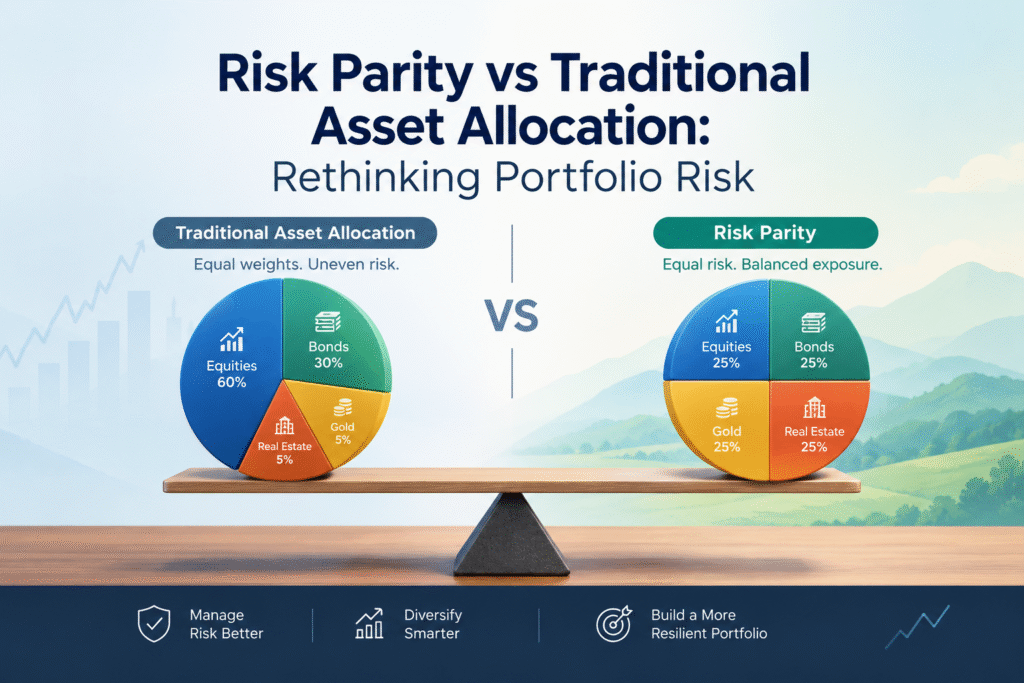
Most investors call a portfolio with 60% in stocks and 40% in bonds “balanced.” By rupees invested, it is. By risk, it is not even close. In a typical 60/40 portfolio, stocks produce roughly 85% to 90% of the ups and downs, and bonds add very little. When the stock market falls, the whole portfolio falls with it.
This gap between how money is split and how risk is split is the starting point of the risk parity vs traditional asset allocation debate. In this guide you will learn what each approach means, how they differ, what happened to risk parity in 2022, and whether an Indian retail investor can use the idea in a practical way.
Risk Parity vs Traditional Asset Allocation: The Short Answer
Traditional asset allocation divides your money between asset classes by a fixed percentage, such as 60% equity and 40% debt. Risk parity divides your portfolio so that each asset class adds about the same amount of risk, which usually means holding much more in lower-volatility assets like bonds and using leverage to lift returns.
Risk parity has historically delivered better risk-adjusted returns (a higher Sharpe ratio) and smaller drawdowns in most market conditions. It has also shown a clear weakness. When stocks and bonds fall together, as they did in 2022, the leverage in a risk parity portfolio can make losses worse than a plain 60/40.
What Is Traditional Asset Allocation?
Traditional asset allocation is the method most financial planners, mutual fund advisors and pension funds have used for decades. You pick a mix of asset classes based on your age, goals and comfort with loss. Then you rebalance once or twice a year to bring the portfolio back to the target.
Common examples:
- 60/40: 60% equity, 40% bonds. The classic balanced portfolio.
- Age-based rules: A common rule says your equity share should be about 100 minus your age. A 30-year-old would hold 70% in equity.
- Goal-based buckets: Short-term money in debt funds or fixed deposits, long-term money in equity.
The strength of this approach is simplicity. You can explain it in one sentence, build it with two or three index funds, and track it easily. Modern Portfolio Theory, the framework behind much of this thinking, supports the idea that mixing assets lowers risk without lowering return by the same amount.
The weakness is that the percentages describe capital, not risk. And that is where the trouble starts.
The Hidden Problem: Capital Weights Are Not Risk Weights
Stocks swing far more than bonds. Indian equities, measured by the Nifty 50, have often shown yearly volatility in the range of 15% to 20%. A good quality government bond or high-grade debt fund usually sits at a small fraction of that, often in the range of 3% to 6%. Gold sits somewhere in between.
Now look at a simple 60/40 split using round numbers. Suppose equity volatility is 16% and bond volatility is 4%.
- Equity risk contribution: 60% x 16% = 9.6
- Bond risk contribution: 40% x 4% = 1.6
Equity supplies about 86% of the combined risk, even though it is only 60% of the money. The bond slice barely changes how the portfolio behaves. Once you factor in the way stocks and bonds move together, many studies put the equity share of risk at 90% or higher.
So a 60/40 portfolio is really an equity portfolio with a smaller bond cushion. That is the central point behind risk parity, and it is the reason the idea got so much attention after the 2008 financial crisis.
What Is Risk Parity?
Risk parity is a portfolio construction method that gives each asset class an equal share of total portfolio risk, instead of an equal or fixed share of capital. The term is often credited to the investment industry in the late 1990s and early 2000s, and Bridgewater Associates, founded by Ray Dalio, made it famous through its All Weather strategy.
The core ideas are simple:
- Measure risk, not just returns. Each asset class is sized by its volatility.
- Hold more of the calmer assets. Bonds, being less volatile than stocks, get a much larger weight.
- Spread risk across different economic conditions. A well-built risk parity portfolio holds assets that do well in growth, in slowdowns, in rising inflation and in falling inflation. That usually means stocks, bonds, gold and commodities.
- Add leverage if you want equity-like returns. A portfolio with more bonds and less equity has a lower expected return. Institutions borrow against the portfolio to bring the return and risk back up to the level of a 60/40.
This is also why the strategy is sometimes called “volatility weighting” or “risk-based allocation.”
A Simple Worked Example for Indian Investors
Here is a simplified, illustrative example using three asset classes. The volatility numbers are round assumptions for explanation only, not forecasts.
| Asset class | Assumed volatility |
|---|---|
| Equity (Nifty 50 index fund) | 16% |
| Government bonds or high-grade debt | 4% |
| Gold | 14% |
The simplest risk parity method is inverse volatility weighting. You divide 1 by each volatility, then convert the results to percentages.
- Equity: 1 / 16 = 0.0625
- Bonds: 1 / 4 = 0.25
- Gold: 1 / 14 = 0.0714
- Total = 0.3839
Resulting weights:
- Equity: about 16%
- Bonds: about 65%
- Gold: about 19%
Compare this with a traditional 60/40 split. The risk parity mix holds far less in equity and far more in bonds. On its own, without borrowing, it would likely earn lower returns than a 60/40 over a long period, because equity is the main driver of long-term growth. It would also fall less in a bad year for stocks.
A real risk parity portfolio goes one step further and uses correlations between assets, not just volatility. This example skips that to keep the idea clear.
Risk Parity vs Traditional Asset Allocation: Side-by-Side Comparison
| Feature | Traditional (60/40) | Risk Parity |
|---|---|---|
| Allocation basis | Capital percentage | Risk contribution |
| Typical equity weight | 60% | 15% to 30% |
| Typical bond weight | 40% | 50% to 65% or more |
| Share of risk from equity | About 85% to 90% | Close to equal across assets |
| Use of leverage | No | Often yes (1.5x to 2x or more) |
| Complexity | Low | Medium to high |
| Rebalancing | Once or twice a year | Often quarterly or more, as volatility changes |
| Best conditions | Rising growth, stable inflation | Falling rates, stable stock-bond relationship |
| Main weakness | Equity concentration of risk | Leverage and rising stock-bond correlation |
What the Numbers Say
Backtests tend to favour risk parity on a risk-adjusted basis. One study of US data from 2003 to 2022 found a Sharpe ratio of about 0.92 for an unlevered risk parity portfolio against about 0.73 for a 60/40. The same study found a maximum drawdown near 20% for risk parity compared with about 35% for the 60/40. When the risk parity portfolio was scaled up to match the 60/40’s volatility, it earned a higher return.
Risk parity also held up well in 2008. Funds using the strategy fell roughly 20% while equity markets fell far more.
These results explain why many pension funds and institutional investors adopted the approach. A pension fund has fixed future payments to make, and a portfolio that depends 90% on the stock market is a poor match for that job.
What Happened to Risk Parity in 2022
2022 was the year that tested the theory. Stocks fell. Bonds also fell, because central banks raised interest rates quickly to fight inflation. The usual cushion from bonds disappeared.
According to figures published by industry sources, Bridgewater’s All Weather strategy lost something in the region of 20% to 22% in 2022, its worst year on record. A broad institutional risk parity index lost close to 20%, while a global 60/40 benchmark lost about 16% to 21% depending on how the index is built. Popular risk parity ETFs fell more than the plain 60/40 benchmark. Exact numbers differ across sources and indexes, but the pattern was the same. Risk parity as a group did worse than the simple portfolio it was meant to improve.
There were three reasons:
- Stock-bond correlation turned positive. For most of the period since 2000, stocks and bonds tended to move in opposite directions in a crisis. In 2022 they fell together. Risk parity depends on that relationship even more than a 60/40 does.
- Leverage made it worse. A large bond position, funded partly with borrowed money, loses a lot when interest rates rise.
- Inflation hurt both sides. Rising inflation is hard on both stocks and long-term bonds. Gold and commodities help, but often not enough to offset the damage.
The lesson is not that risk parity is broken. It is that no allocation method works in every economic regime, and leverage cuts both ways.
Where Traditional Asset Allocation Still Wins
A plain 60/40 or a similar split still has real advantages, especially for ordinary investors:
- No leverage. You cannot be forced to sell because of margin calls or borrowing costs.
- Higher expected growth. More equity usually means higher long-term returns, which matters when you are saving for retirement over 20 or 30 years.
- Low cost and low effort. Two index funds and a yearly rebalance is enough.
- Easy to understand. You are less likely to panic and sell if you know exactly what you own.
For a young investor with a long horizon and a steady income, the equity-heavy risk of a traditional allocation is often acceptable, even useful. The goal is to grow wealth, not to keep the ride smooth.
Can Indian Retail Investors Use Risk Parity?
Strict risk parity, with borrowing and futures contracts, is not practical for most retail investors in India. It needs derivatives, margin accounts and constant monitoring. But you can use the thinking behind it without any of that.
1. Check your real risk, not just your split. If you hold 70% in equity mutual funds and 30% in fixed deposits, your portfolio’s ups and downs come almost entirely from equity. That may be fine, but you should know it.
2. Add assets that behave differently. Gold has often moved differently from Indian equities, especially in global stress. Government bonds and high-quality debt funds have their own cycle. Holding all three gives you a spread of economic exposures, which is the best part of the risk parity idea.
3. Look at multi-asset allocation funds. In India, multi-asset allocation funds invest across equity, debt and gold (or other assets). SEBI rules require such funds to hold at least 10% in each of at least three asset classes. These funds are not risk parity funds, but they give you a mix of assets in one product, with the fund house handling rebalancing. Read the factsheet, check the asset mix and compare costs before investing. Also check how the fund is taxed, since the rules depend on the equity share of the fund.
4. Rebalance on a schedule. Pick a date once or twice a year, or rebalance when an asset drifts by more than 5 percentage points from its target.
5. Skip the leverage. If you want lower risk, hold more bonds and accept lower returns. If you want higher returns, hold more equity. Borrowing to chase returns is where most retail investors get hurt.
A simple middle path for a moderate investor could be a mix like 40% equity, 40% debt and 20% gold. That is an example of the idea, not advice. The right mix depends on your age, income, goals and how you handle losses.
Common Mistakes to Avoid
- Assuming 60/40 means “half the risk of stocks.” It is closer to 85% to 90% of the risk of stocks.
- Copying institutional risk parity without the tools. Pension funds have teams, cheap borrowing and risk systems. You do not.
- Judging a strategy on one year. Both 2020 and 2022 are poor guides on their own. Look at full cycles.
- Ignoring inflation. A bond-heavy portfolio can lose purchasing power in a high-inflation period.
- Over-trading. Rebalancing every month adds cost and tax with little benefit.
- Forgetting taxes and costs. Debt fund and gold taxation rules in India change from time to time, so check the current rules before you rebalance.
How to Decide Between the Two
Ask yourself four questions:
- How long until I need this money? The longer the horizon, the more a traditional equity-heavy mix makes sense.
- How would I react to a 30% fall? If you would sell in panic, you hold too much equity for your temperament.
- Do I understand what I own? Simple beats clever if clever means you will abandon it in a bad year.
- Do I need steadier returns? Retirees and people close to a goal may prefer a more risk-balanced mix with more debt and gold.
For most Indian retail investors, a diversified, low-cost, unlevered portfolio across equity, debt and gold, rebalanced on a schedule, captures most of the benefit of risk thinking without the complexity.
Frequently Asked Questions
What is risk parity in simple words?
Risk parity is a way of building a portfolio so that each asset class adds about the same amount of risk. Instead of putting 60% of your money in stocks, you put in less, and you hold more bonds and other assets, so no single asset class controls how the portfolio behaves.
Is risk parity better than a 60/40 portfolio?
On a risk-adjusted basis, risk parity has historically done better in many periods, with a higher Sharpe ratio and smaller drawdowns. But it did worse than a 60/40 in 2022, when stocks and bonds fell together. Neither is better in every market.
Why does a 60/40 portfolio have so much equity risk?
Stocks are about three to five times more volatile than bonds. Even though stocks are only 60% of the money, they produce close to 90% of the swings, because the bond portion moves so little by comparison.
Does risk parity use leverage?
Most institutional risk parity strategies do. A portfolio with more bonds earns less, so managers borrow to raise the return to a target level. Leverage can help in good years and hurt a lot in bad ones.
What is the All Weather portfolio?
The All Weather portfolio is a strategy associated with Ray Dalio and Bridgewater Associates. It spreads risk across assets meant to perform in different economic conditions, such as growth, slowdown, high inflation and low inflation. It is often described as a risk parity approach.
Why did risk parity fail in 2022?
Rising interest rates and high inflation hit stocks and bonds at the same time. The leverage that normally boosts returns made losses larger. Risk parity relies on stocks and bonds balancing each other, and in 2022 they did not.
Can I do risk parity in India?
Full risk parity with leverage is hard for retail investors. You can follow the same idea by holding equity, debt and gold, checking how much risk each one adds, and rebalancing regularly. Multi-asset allocation funds are one simple option.
How often should I rebalance a risk parity portfolio?
Institutional strategies often rebalance quarterly or more often, since volatility changes. An individual investor can rebalance once or twice a year, or when an asset drifts more than about 5 percentage points from its target.
What is the difference between asset allocation and risk allocation?
Asset allocation splits your money across asset classes by percentage. Risk allocation splits your portfolio by how much risk each asset class contributes. Two portfolios with the same money split can have very different risk profiles.
Conclusion
The risk parity vs traditional asset allocation question comes down to one idea: your portfolio should be balanced by risk, not only by money. A 60/40 portfolio looks balanced but behaves like an equity bet. Risk parity corrects that, and often delivers smoother returns, but it adds complexity, relies on leverage and stumbled badly in 2022.
For most Indian retail investors, the practical lesson is to know where your risk really comes from, spread it across equity, debt and gold, avoid borrowing to invest, and keep costs low. You do not need a hedge fund to think about risk the way a hedge fund does.
Disclaimer: This article is for general education only and is not investment advice. Past performance does not guarantee future results. Please consult a SEBI-registered investment advisor before making investment decisions.