
Factor Investing in India: Value, Quality, Momentum, Size and Low Volatility Explained
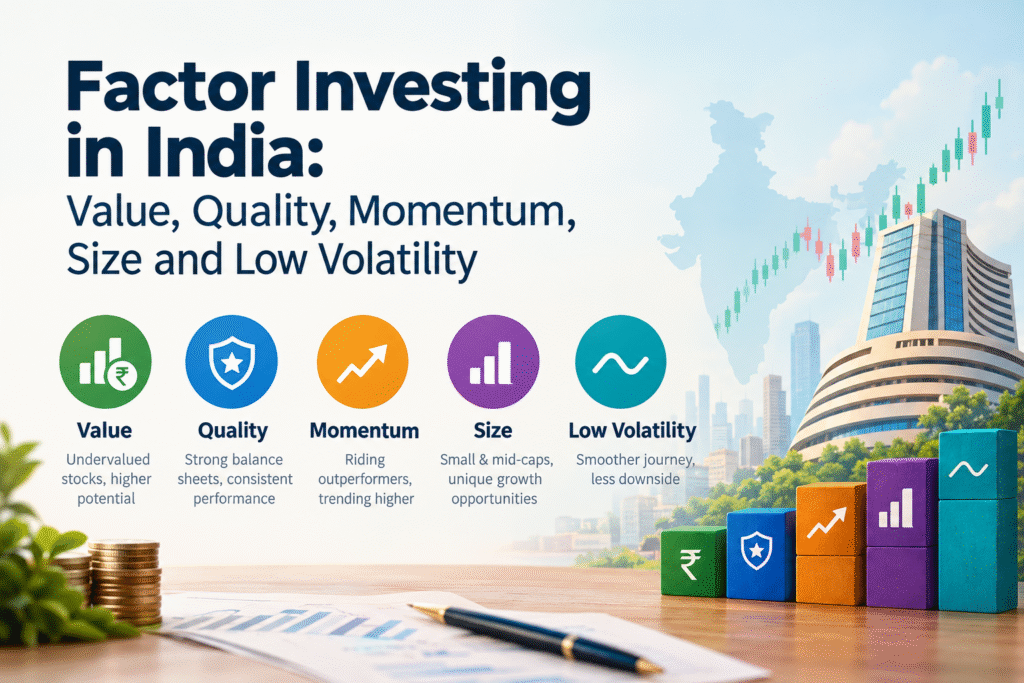
Factor investing is a rules-based way of picking stocks using traits that have historically earned higher returns or lower risk than the broad market. In India, the five factors most investors hear about are Value, Quality, Momentum, Size and Low Volatility. You can buy them through index funds and ETFs that track NSE factor indices, usually at a low cost.
Most of us choose mutual funds the same way. We open a list, sort by one-year returns, and pick whatever sits on top. It feels sensible, and it often goes wrong, because last year’s winner is usually a fund that happened to own the right kind of stock at the right time.
Factor investing asks a different question. Instead of asking which fund did well, it asks what kind of stocks tend to do well, and why. This guide explains how each of the five main factors works in Indian markets, what the numbers say, what can go wrong, and how a retail investor can use factor funds without the usual mistakes.
What Is Factor Investing?
A factor is a measurable trait that explains why some groups of stocks behave differently from others. Cheap stocks behave one way. Fast-rising stocks behave another way. Small companies behave differently from large ones.
The idea goes back to academic work in the 1990s. Eugene Fama and Kenneth French showed that company size and valuation explained returns better than the market alone, and Mark Carhart later added momentum. Researchers also found that profitable, stable companies and calmer stocks earned good returns for the risk they carried.
Factor investing is often called smart beta. A normal Nifty 50 index fund owns companies in proportion to their market value. A smart beta fund also follows an index, but the index picks and weights stocks by a rule, such as “own the 30 stocks with the strongest recent price trend.” So a factor fund sits between passive and active investing. You get low fees and clear rules, with a tilt toward one type of stock.
Why Factor Investing Has Grown in India
One industry estimate puts factor and smart beta fund assets at more than ₹70,000 crore by the end of FY26, up from under ₹15,000 crore in 2022. Momentum and quality funds drew most of the new money.
Many investors began to feel that a plain Nifty 50 fund was too narrow. Direct plans of factor index funds usually charge between about 0.2% and 0.45% a year. That is higher than a plain Nifty 50 fund, but far lower than most active equity funds.
The Five Main Factors at a Glance
| Factor | What it picks | Example NSE index | Tends to do well when | Tends to struggle when |
|---|---|---|---|---|
| Value | Cheap stocks (low P/E, low P/B, high dividend yield) | Nifty 50 Value 20, Nifty 500 Value 50 | Beaten-down sectors recover | Growth stocks lead |
| Quality | Profitable, low-debt companies with steady earnings | Nifty 200 Quality 30 | Markets turn nervous | Weak stocks rally hard |
| Momentum | Stocks with strong recent price trends | Nifty 200 Momentum 30, Nifty Midcap150 Momentum 50 | Trends last for months | Markets reverse sharply |
| Size | Smaller companies | Nifty Midcap 150, Nifty Smallcap 250 | Money is plentiful | Money runs to safety |
| Low Volatility | Stocks with the smallest price swings | Nifty 100 Low Volatility 30 | Markets fall or move sideways | A strong bull run |
Index names and rules can change, so check the latest factsheet from NSE Indices before you invest.
Value Factor: Buying What the Market Dislikes
Value investing picks stocks that look cheap compared with their earnings, book value or dividends. The Nifty 50 Value 20 index, for example, picks 20 Nifty 50 stocks using price-to-earnings, price-to-book and dividend yield.
It can work because investors often get too gloomy about unloved companies. When mood returns to normal, cheap stocks can recover quickly. In India, value had a long weak patch through much of the 2010s, then a strong run in 2021 and 2022 when public sector banks, energy and metal stocks rallied.
The main risk is the value trap. A stock can be cheap because the business is in real trouble, and a low P/E tells you nothing about whether it will survive. This factor suits patient investors who can sit through years of poor relative returns.
Quality Factor: Paying for Strong Businesses
Quality investing picks companies with a high return on equity, low debt and steady earnings. The Nifty 200 Quality 30 index is a popular Indian example.
Strong balance sheets survive bad times, and companies that earn good returns on capital can keep reinvesting at a good rate. One academic study of the quality factor in India found a significant monthly alpha even after adjusting for market, size, value and momentum. In practice, quality index funds have often kept pace with the Nifty 50 with smaller drawdowns, though they can trail when weaker companies lead a rally.
The risk is price. Everyone likes good companies, so they can get expensive, and returns can stay flat for a long time. Quality lagged value, size and momentum in 2023 for exactly that reason. It suits investors who want equity but want to sleep better when the market falls.
Momentum Factor: Following the Trend
Momentum investing buys stocks that have risen the most over the last six to twelve months. The Nifty 200 Momentum 30 index picks 30 stocks from the top 200 companies by market value, ranked by a momentum score. Most momentum indices rebalance every six months.
It can work because news spreads slowly and trends often run longer than expected. Estimates for India depend on the window. One fund house summary shows roughly 18% to 19% a year over ten years against 13% to 14% for the Nifty 50. An independent backtest from December 2006 to June 2025 shows a lower long-run figure of about 14% a year.
Momentum can also hurt. That same backtest found a drawdown of about 70% and a recovery that took over five years. A popular Nifty 200 Momentum 30 index fund showed a one-year return of about minus 17% on tracking sites in mid-2026, while a Nifty Midcap150 Momentum 50 fund was up about 9.5% for the year to August 2026, when the Nifty 50 total return index was slightly negative. Momentum suits investors who can handle sharp falls and will not sell near the bottom.
Size Factor: Small Companies, Big Swings
The size factor is the idea that smaller companies earn higher returns than large ones over long periods, as pay for extra risk. In India, investors get size exposure through midcap and smallcap indices such as the Nifty Midcap 150 and Nifty Smallcap 250.
Smaller companies have more room to grow and get less analyst attention, so prices can stay wrong for longer. Small and midcap stocks have delivered large gains in good years. They have also been through painful stretches. Small caps fell by more than half in 2008 and went through a long weak patch from early 2018 to March 2020.
The risks are liquidity and volatility. Small stocks are harder to sell in a hurry, and prices can drop fast when sentiment turns. This factor suits investors with a horizon of ten years or more.
Low Volatility Factor: The Smoother Ride
Low volatility investing picks stocks whose prices have moved the least. The Nifty 100 Low Volatility 30 index selects the 30 calmest stocks from the top 100.
Research across many countries found that calmer stocks earned returns close to the market with less pain. One industry summary found Indian low volatility indices tracked the broad market closely with drawdowns 15% to 20% shallower. The indices tend to hold plenty of FMCG, pharma, IT and private banks, so results often follow those sectors.
A good example of regime change came in August 2024. The Nifty 200 Quality 30 rose 2.40% and the Nifty Low Volatility 50 rose 1.73%, both ahead of the Nifty 50’s 1.14%. The Nifty Alpha 50 gained only 0.31% and the Nifty 500 Value 50 fell 1.19%. The risk is the other side of that coin. Low volatility can lag badly in a strong bull market and can get crowded and expensive. It suits cautious investors who get nervous when markets drop.
How the Factors Move Together and Apart
The main reason to hold more than one factor is that they do not all win at the same time.
NJ Mutual Fund published correlations for Nifty 500 factor indices. Quality and Value were at about minus 0.06, so they moved almost independently. Quality and Low Volatility were closer at about 0.61. Momentum and Low Volatility were only about 0.13. In plain words, when one factor is having a bad year, another may be having a good one.
This is also why chasing the best recent factor tends to disappoint. By the time a factor tops the performance table, the cycle may already be turning.
Single-Factor vs Multi-Factor Funds
Single-factor funds give you a clear bet, and you can mix them yourself. The downside is that each one can have a long bad run.
Multi-factor funds blend two or more factors in one index. NSE Indices has built indices such as the Nifty Alpha Low-Volatility 30, Nifty Quality Low-Volatility 30 and Nifty Alpha Quality Value Low-Volatility 30. NSE’s own research shows the Alpha Quality Low-Volatility 30 beating the Nifty 50 by about 5.22% a year since April 2005. That is a backtest, which means the index was calculated historically, not earned with real money. If you do not want to choose between factors, a multi-factor index fund is the simpler option.
How to Invest in Factor Funds in India
- Start with a core. A broad index fund, such as a Nifty 50 or Nifty 500 fund, should usually be the main holding. Factor funds work best as a smaller add-on.
- Match the factor to your temperament. Aggressive investors may lean toward momentum and value. Conservative investors may lean toward quality and low volatility.
- Check the index, not the fund name. Read the scheme information document to see which index the fund tracks. Some funds called factor funds mix in manager choice.
- Use a SIP and hold for years. A monthly SIP spreads your buying across time, and factor premiums show up over five to ten years, not one or two.
Here is one way a cautious investor could split a monthly SIP. It is an illustration, not advice: 60% in a Nifty 500 or Nifty 50 index fund, 15% in quality, 10% in momentum, 10% in low volatility and 5% in value.
Tax on Factor Funds
Most factor index funds are equity-oriented, so equity mutual fund tax rules apply. For FY 2026-27, gains on units sold within 12 months are taxed at 20%. Gains on units held longer are taxed at 12.5% on the amount above ₹1.25 lakh in a financial year. Budget 2026 did not change these rates.
Switching from one factor fund to another counts as a sale, so switching within 12 months means short-term tax. Do not hop between factors every few months. Tax rules can change, so confirm current rates before you act.
Common Mistakes to Avoid
- Chasing last year’s winner. Buying the top factor after a big run often means buying near the peak.
- Judging too early. One or two years tell you very little about a factor.
- Skipping the core. Putting everything into one factor is a bet, not a plan.
If you need the money within three years, or you will panic when a fund trails the Nifty 50 for long, a plain index fund is easier to live with.
Frequently Asked Questions About Factor Investing in India
What is factor investing in simple words?
Factor investing means picking stocks by a shared trait, such as being cheap, profitable, rising, small or stable, instead of by company name or market size. In India you can do this through index funds and ETFs that follow NSE factor indices.
What are the main factors in factor investing?
The five most talked-about factors are Value, Quality, Momentum, Size and Low Volatility. Value picks cheap stocks, Quality picks strong businesses, Momentum picks rising stocks, Size picks smaller companies and Low Volatility picks stocks with smaller price swings.
Which factor has performed best in India?
It depends on the period. Momentum has led over many long windows but has also had deep drawdowns. Quality and low volatility have held up better in nervous markets. Value had strong stretches in 2021 and 2022. No factor wins every year.
Are momentum index funds safe?
No equity fund is safe, and momentum funds carry very high risk. They can rise fast and fall fast. One long-run backtest of the Nifty 200 Momentum 30 strategy showed a drawdown of about 70%. Only invest money you can leave alone for years.
How much of my portfolio should go into factor funds?
There is no fixed answer. Many investors keep most of their money in a broad index fund and put a smaller share, often 20% to 40%, into factor funds. Your age, goals and risk tolerance should decide the split. A SEBI-registered investment adviser can help.
How are factor funds taxed in India?
Equity-oriented factor funds follow equity mutual fund rules. For FY 2026-27, short-term gains (12 months or less) are taxed at 20%. Long-term gains are taxed at 12.5% above ₹1.25 lakh a year.
Final Thoughts
Factor investing is not a shortcut to beating the market. It is a disciplined way to own certain kinds of stocks and accept the risks that come with them. Value asks for patience, quality asks you to pay for strength, momentum asks you to ride out sharp falls, size asks for a long horizon, and low volatility asks you to accept slower gains in a hot market.
The investors who do best with factor funds keep a broad core, pick a mix they can stay with, and hold it long enough for the cycles to play out. If you are new to this, start small with one or two factor funds and read the factsheets before you add more.
Disclaimer: This article is for education only and is not investment advice. Mutual fund investments are subject to market risks. Past performance and backtested index data do not guarantee future returns. Read all scheme documents carefully and consider speaking to a SEBI-registered investment adviser before investing.