
How to Stress Test Your Investment Portfolio Against Inflation, Recession and Market Crashes
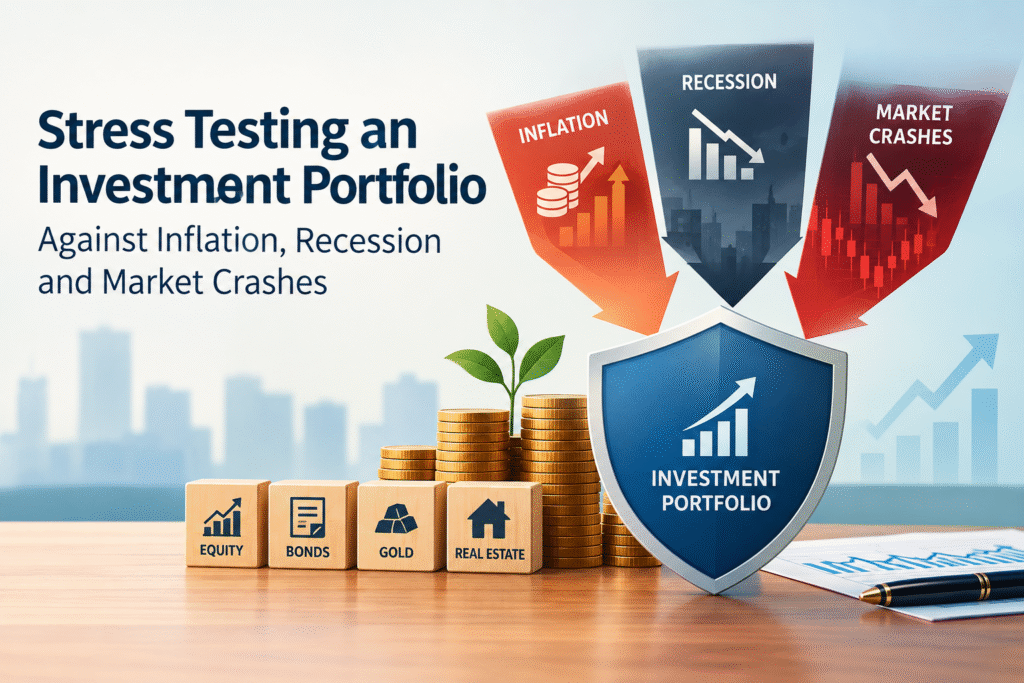
Most investors check their portfolio on the way up. Very few check it on the way down, and that is exactly when it matters. Stress testing an investment portfolio means asking one plain question: if a bad year arrives, how much will I lose, and can I live with it? You pick a few harsh but believable scenarios, apply them to your holdings, and see what the damage looks like in rupees.
This guide shows you how to do that in five steps, with a worked example for a ₹50 lakh portfolio. It covers the three threats Indian investors worry about most: rising prices, a slowing economy, and a sharp fall in the stock market.
What Is Portfolio Stress Testing?
A portfolio stress test is a what-if exercise. Banks run them on their loan books because the RBI expects them to. Individual investors can run a simpler version at home with a spreadsheet and an hour of free time.
It is different from a forecast. You are not trying to guess what will happen. You are measuring how your portfolio behaves if something bad does happen. Two numbers come out of it:
- Maximum drawdown: the largest fall from a peak to a bottom, in percentage and in rupees.
- Recovery time: how long the portfolio may take to get back to its old high.
If both numbers are within what you can handle, your portfolio passes. If not, you have found a weak spot before the market found it for you.
Why Indian Investors Should Stress Test Right Now
The case for doing this today is not theoretical. On 7 October 2026 the RBI raised the repo rate by 25 basis points to 5.50%, its first increase since February 2023. Retail inflation was 4.8% in August, and the RBI now projects 5.2% for FY27. The 2026 monsoon came in at about 87% of the long-period average, which adds pressure on food prices. The rupee has been trading near 96 to the dollar, and the Nifty 50 was around 22,400 at the start of October after a run of losing sessions.
None of this means a crash is coming. It means the easy conditions of the last few years have changed, and a portfolio built for falling rates and low inflation deserves a second look.
Step 1: Write Down What You Actually Own
You cannot test what you have not listed. Open a sheet and write down every holding with its current value and its category: large cap, mid cap, small cap, debt funds, fixed deposits, PPF, EPF, gold, silver, real estate, and cash.
Two things surprise people at this stage. First, overlap. Three different large cap funds often hold the same twenty stocks, so you own less diversification than you think. Second, the real equity share. Add the equity inside hybrid funds, your NPS equity portion, and any employee stock options. The total is usually higher than the number you carry in your head.
Step 2: Choose Your Stress Scenarios
Pick four scenarios. Use real history as your guide, because history is what you can check.
- A 2008 style crash. The Nifty fell roughly 60% from its January 2008 peak to the low in early 2009, and it took nearly three years to get back to the old high.
- A 2020 style shock. The Nifty lost close to 38% in about two months during COVID-19, then recovered within the same calendar year.
- A slow recession. Corporate earnings fall, hiring slows, equities drift down 20% to 30% over a year, and the RBI cuts rates.
- A high inflation spell. Consumer prices run at 7% or more, bond yields rise, and the real value of fixed returns shrinks.
You can add personal scenarios too, such as a job loss lasting six months or a big medical bill. Those often hurt more than any market event.
Step 3: Run the Numbers (A Worked Example)
Take an investor with ₹50 lakh in this mix:
- ₹30 lakh in a Nifty 50 index fund (60%)
- ₹5 lakh in a mid cap fund (10%)
- ₹10 lakh in debt funds and fixed deposits (20%)
- ₹5 lakh in gold (10%)
Now apply an assumed return for each asset class in each scenario. These are rough assumptions for practice, not predictions.
| Scenario | Large cap | Mid cap | Debt | Gold | Portfolio change | Value left |
|---|---|---|---|---|---|---|
| 2008 style crash | -50% | -60% | +5% | +20% | -₹16.5 lakh (-33%) | ₹33.5 lakh |
| 2020 style shock | -38% | -45% | +2% | +5% | -₹13.2 lakh (-26%) | ₹36.8 lakh |
| Slow recession | -25% | -35% | +6% | +10% | -₹8.15 lakh (-16%) | ₹41.85 lakh |
| High inflation (7% CPI) | -10% | -15% | -1% | +12% | -₹3.25 lakh (-6.5%) | ₹46.75 lakh |
Look at the last row closely. A loss of 6.5% looks mild. But with prices rising 7%, the real value of the portfolio falls by about 13%. Inflation damage hides behind small nominal numbers, which is why you must calculate real returns (return minus inflation) and not just the headline figure.
The first row is the one to sit with. A ₹16.5 lakh fall on a ₹50 lakh portfolio is a third of everything saved. The question is not whether the maths is correct. The question is whether you would stay invested while watching it happen.
Step 4: Test More Than the Percentages
A drawdown figure alone tells you little. Three further checks give it meaning.
Time horizon. A 28 year old with a 25 year goal can wait out a three year recovery. A 58 year old planning to retire in two years cannot. The same -33% means very different things for these two people.
Cash flow. Suppose your SIP is ₹30,000 a month and your salary stops for six months. Can you keep the SIP going? Can you pay the home loan EMI, school fees and insurance premiums without selling units at a loss? An emergency fund of six to twelve months of expenses is what stops a market crash from turning into a forced sale.
Sequence of returns risk. This matters most to retirees. If the crash comes in the first years of withdrawals, you sell units at low prices to fund living costs, and the portfolio may never recover even when the market does. A retiree with ₹1 crore withdrawing ₹5 lakh a year (a 5% rate) feels a crash far more than someone who has not started withdrawing. Many Indian planners use a withdrawal rate of 3% to 3.5% because inflation here runs higher than in the markets where the 4% rule was studied.
How to Stress Test Against Inflation
Inflation is slow and quiet, so it gets less attention than a crash. It still destroys wealth. At 6% inflation, ₹1 crore today buys what ₹56 lakh buys in ten years.
Check these points in your portfolio:
- Fixed deposits and PPF. If your FD pays 6.5% and inflation is 5.2%, your real return is about 1.3% before tax. After tax in the 30% slab, it can turn negative.
- Debt fund duration. When the RBI raises rates, long duration debt funds lose value in the short run because bond prices fall when yields rise. Short duration and floating rate funds hold up better.
- Real asset exposure. Equity in companies with pricing power, gold, and to some extent real estate tend to keep pace with rising prices over long periods.
- Your own expenses. Retirees feel a different inflation rate than the headline CPI, mostly through healthcare and education costs.
How to Stress Test Against a Recession
In a recession, earnings drop, jobs are lost, and credit gets tight. Equity prices usually fall before the bad news shows up in the economy, and they often recover before the good news does.
Ask these questions:
- Which of my holdings depend on a booming economy? Cyclical sectors such as autos, metals, real estate and capital goods fall hardest.
- Is my debt allocation made of good quality paper? In a slowdown, credit risk funds can lose money at the very time you need them to be safe. Government securities and high rated corporate bonds do better.
- Is my income tied to the same sector as my portfolio? A software engineer who holds a large IT sector fund carries the same risk twice.
How to Stress Test Against a Market Crash
A crash is fast, and it tests your nerves more than your spreadsheet. During the 2008 and 2020 falls, correlations went up. Assets that normally move in different directions all dropped together for a while, so diversification gave less protection than people expected.
Check these:
- Maximum drawdown of each fund. Look at the worst fall of your mid cap and small cap funds in 2008, 2018 and 2020. Small caps often fell more than the Nifty and took longer to recover.
- Concentration. If one stock or one sector is more than 10% to 15% of your portfolio, a crash there hurts disproportionately.
- Borrowed money. Margin funding and loans against shares can force a sale at the worst moment.
- Your reaction. Be honest. Many investors stopped their SIPs in March 2020, right before the best buying opportunity in years.
Step 5: Fix the Weak Spots You Found
The test is only useful if you act on it. Common fixes are small and simple.
Adjust the asset allocation. If the worst-case fall is bigger than you can stomach, lower the equity share by 5 to 10 percentage points and move it to short duration debt or gold. A portfolio you can hold through a storm beats a better portfolio you abandon halfway.
Build the cash buffer first. Before taking more equity risk, make sure six to twelve months of expenses sit in a liquid fund or savings account.
Spread across more than one kind of asset. Equity, debt, gold and, if you wish, a small share of international funds do not all fail for the same reason.
Rebalance on a rule. Pick either a calendar rule (once a year) or a threshold rule (when any asset drifts 5 percentage points from target) and follow it. Rebalancing sells some of what has risen and buys what has fallen, which is exactly the habit that fear stops people from keeping.
Keep the SIP running. If your income is stable, continuing SIPs through a fall buys more units at lower prices.
Tools That Make Stress Testing Easier
You do not need expensive software.
- A spreadsheet. The table in Step 3 takes about twenty minutes to build in Excel or Google Sheets.
- Fund fact sheets. They show the maximum drawdown, standard deviation and the fund’s behaviour in past falls.
- Monte Carlo simulation. Several free retirement calculators run thousands of random return paths and tell you the chance your money lasts. It is more advanced than a scenario test and good for retirement planning.
- A SEBI registered investment adviser. If your portfolio is large or your situation is complicated, a fee-only adviser can run a full risk assessment.
Common Mistakes to Avoid
- Testing only the equity part and ignoring debt and real estate.
- Using nominal returns and forgetting inflation.
- Assuming the next crash will look like the last one.
- Running the test once and never again.
- Passing the test on paper and then panic selling in real life.
How Often Should You Stress Test?
Once a year is enough for most people. Run it again after any big life change such as a new job, a marriage, a child, a home purchase or a retirement date coming close. Also run it when the economy changes direction, as it has with the recent rate increase.
Frequently Asked Questions
What is stress testing in investing?
Stress testing in investing is a method of applying harsh but realistic scenarios, such as a recession, high inflation or a market crash, to your portfolio to see how much it could lose and whether you can handle the loss.
How do I stress test my mutual fund portfolio?
List every fund with its value and category, assign an assumed fall or gain to each category under each scenario, add up the rupee change, and compare the result with your time horizon and your emergency fund.
How much can a portfolio fall in a market crash?
It depends on the mix. An all equity portfolio fell about 38% in the 2020 crash and about 60% in the 2008 crash. A portfolio with 40% in debt and gold fell much less.
Which assets protect against inflation in India?
Over long periods, equity, gold and real estate have tended to beat inflation. Fixed deposits and PPF often earn only a small real return after tax.
What is a recession proof portfolio?
No portfolio is fully recession proof. A well diversified mix of equity, good quality debt, gold and an emergency fund lowers the damage and gives you time to wait for recovery.
How often should I rebalance my portfolio?
Once a year, or whenever an asset class moves 5 percentage points away from its target share, whichever suits you better.
Is stress testing only for rich investors?
No. Anyone with a SIP and a financial goal can run a basic stress test in a spreadsheet.
The Bottom Line
You cannot control inflation, recessions or crashes. You can control how your portfolio is built before they arrive. A stress test takes an hour, costs nothing, and replaces vague worry with real numbers. Write down your holdings, run four scenarios, check your cash flow, and fix the one or two weak spots that show up.
Disclaimer: This article is for educational purposes only and is not investment advice. The scenario returns in the worked example are assumptions made for illustration. Past performance does not guarantee future results. Please consult a SEBI registered investment adviser before making investment decisions.