
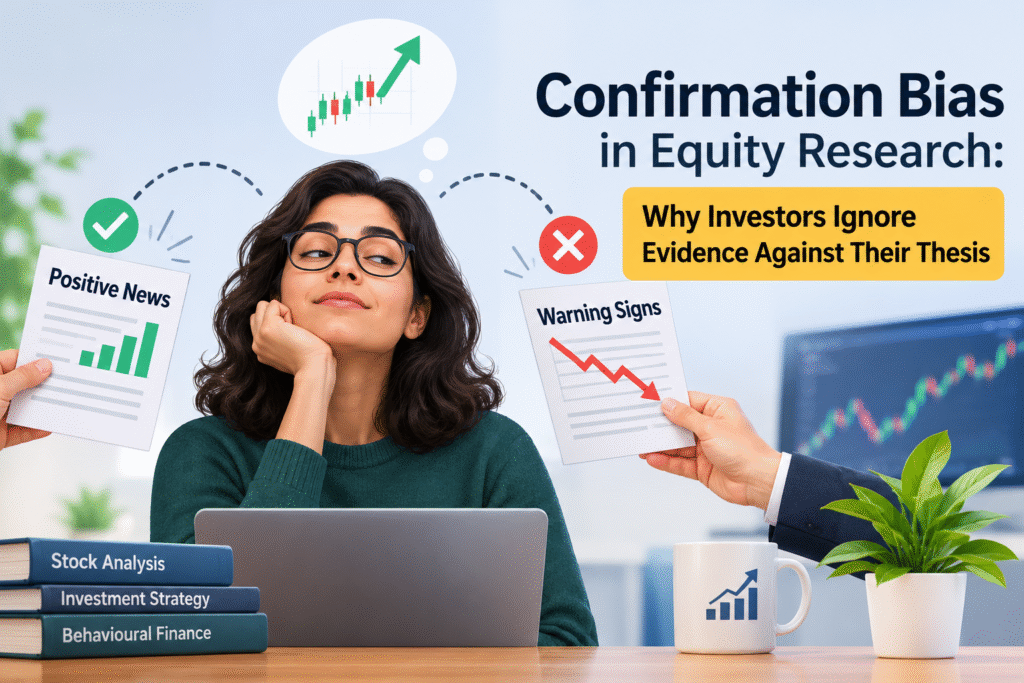
Confirmation Bias in Equity Research: Why Investors Ignore Evidence Against Their Thesis
This guide explains what confirmation bias in investing is, why smart people fall for it, how it shows up in stock analysis, and what you can do about it. There is a worked example, a checklist you can use before every buy, and an FAQ at the end.
What Is Confirmation Bias in Investing?
Confirmation bias is the tendency to favour information that agrees with what we already believe. The psychologist Peter Wason studied it in 1960, using a simple rule-discovery task where people tested their own guesses by looking for examples that fit, and almost never looked for examples that would prove them wrong. A well-known 1998 review by Raymond Nickerson described the bias as pervasive across many areas of human thinking. Behavioural finance, the field that studies how psychology affects money decisions, later applied the idea to markets.
In investing, confirmation bias works in three ways:
- Biased search. You read only the articles, videos and brokerage notes that are bullish on the stock you already own.
- Biased interpretation. Two investors read the same quarterly result. The bull sees ‘a one-off dip’. The bear sees ‘the start of a trend’. Each is sure the numbers back him up.
- Biased memory. You remember the three times your thesis worked and forget the two times it did not.
This is one of the most common cognitive biases in investing, and it sits quietly behind many stock analysis mistakes.
Why Smart Investors Still Ignore Evidence Against Their Thesis
Intelligence does not protect you from this bias. In some cases it makes things worse, because clever people are very good at building reasons for what they already want to believe. Several forces are at work.
Commitment. Once you have written a thesis, shared it with friends, or put real money behind it, changing your mind feels like admitting a mistake. Most people dislike that feeling and avoid it.
Cognitive dissonance. When new facts clash with a belief you hold, the mind feels discomfort. The easiest way to remove it is to doubt the new fact, not the old belief.
Sunk cost and loss aversion. If the stock is down 30 per cent, selling makes the loss real. Holding keeps hope alive, so every positive headline feels like proof and every negative one feels like noise. Behavioural finance researchers Hersh Shefrin and Meir Statman named a related habit the disposition effect, which is the tendency to sell winners early and hold losers too long.
Information overload. Annual reports, concall transcripts, exchange filings and social media posts add up to more than anyone can read. So we pick what to read, and we tend to pick what feels comfortable.
Echo chambers. Telegram groups, WhatsApp forwards, finance YouTube channels and X (formerly Twitter) feeds are built around attention. Recommendation systems show you more of what you already click on. If you follow ten people who like a stock, you will see ten reasons to like it.
How Confirmation Bias Shows Up in Equity Research
Here are the most common warning signs. If two or three of these sound familiar, your thesis may be running your analysis, and not the other way round.
1. Cherry-picked metrics. You quote revenue growth and skip operating cash flow. You quote the best quarter and skip the average of the last eight.
2. Bad news is always a one-off. A rise in debtor days is blamed on ‘timing’. A margin fall is blamed on ‘raw material prices’. When every negative has a special excuse, it is worth asking whether there is a pattern.
3. Moving goalposts. The target price is raised when the stock rises, but the assumptions behind it are also quietly loosened. The valuation multiple grows to justify the price.
4. Reading only one side. You have never read a bearish report on the company you own. You have not opened the auditor’s notes, the contingent liabilities, or the related-party section of the annual report.
5. Blaming the market. When the share price falls, the thesis is not questioned. The market is said to be ‘wrong’ or ‘not seeing the long-term picture’. Sometimes that is true. Often it is not.
6. Selective peer comparison. You compare your company only with peers that look worse, so it always appears cheap or high quality.
7. Ignoring base rates. Most small companies do not double their revenue in three years. If your thesis needs that to happen, the burden of proof is higher than it feels.
Analyst Bias and Conflicts of Interest in Equity Research
Confirmation bias is not only a retail investor problem. Professional research has its own version of it, made stronger by incentives.
The International Organization of Securities Commissions (IOSCO) describes three broad types of analysts: sell-side analysts at brokerages, buy-side analysts who work for fund houses, and independent analysts. Sell-side analysts face the greatest risk of conflict, because their employer may also earn money from investment banking, broking or corporate relationships with the companies they cover.
Research from other markets supports this concern. Studies of United States analysts found that those at firms with large investment banking business were slower to downgrade a stock from Buy to Hold. After the United States introduced Rule 2711 in the early 2000s to separate research from banking, later studies found the link between conflicts and recommendations became weaker, though it did not disappear.
A second, quieter problem is the rating scale itself. For example, in a 2021 research note, one Indian brokerage defined Buy as an expected return above 15 per cent over 12 months, Hold as anything from minus 6 per cent to plus 15 per cent, and Sell as below minus 6 per cent. A Hold band that wide means many weak stocks can stay in the ‘safe’ middle for a long time without a formal downgrade.
In India, the SEBI (Research Analysts) Regulations, 2014, which came into force on 29 November 2014, require registered research analysts to disclose financial interest in the companies they write about and any other material conflict of interest. They also set limits on trading by analysts. These rules help, but they cannot remove human bias. As a reader, always check the disclosure section at the end of a report, and ask what the analyst gains if you agree.
A Worked Example: When a Good Thesis Goes Wrong
This example is fictional, made up only to show how the bias works.
An investor buys Sunrise Polymers Ltd at ₹800 per share. The thesis is simple: a new plant will double capacity in three years, so revenue and profit will grow fast. The first two quarters go well.
Then the evidence begins to change:
- Receivable days rise from 60 to 95.
- Reported profit grows, but operating cash flow turns negative.
- Promoter pledging goes up from 5 per cent to 18 per cent.
- A competitor starts selling cheaper imports in the same product line.
The biased reading: Receivables are up because the company is giving credit to win new customers. Cash flow is weak because the plant is being built. The pledge is only for a short-term loan. Imports are a small threat. The investor buys more at ₹700, ‘because it is cheaper now’.
The honest reading: Each item may have an innocent explanation, but four warning signs pointing the same way are a pattern. The investor should go back to the original thesis, check which assumptions have failed, and decide whether to hold, cut or sell, as if he had no position at all.
The point is not that the stock must fall. The point is that the biased investor never asked the question.
How to Avoid Confirmation Bias in Investing: 8 Practical Steps
1. Write your thesis down. Put it in one short paragraph with the date. Include what you expect to happen, over what time, and why the market has it wrong. A written thesis is hard to quietly rewrite later.
2. Set kill criteria before you buy. Decide in advance what would prove you wrong. For example: receivable days above 90 for two quarters, promoter pledge above 15 per cent, a fall in market share, or a price fall of 25 per cent without a change in fundamentals. Kill criteria taken from a calm moment are better than decisions made during a drawdown.
3. Run a pre-mortem. Psychologist Gary Klein popularised this method. Imagine it is two years from now and the investment has failed. Write down the most likely reasons. This lets you list risks without feeling disloyal to your own idea.
4. Read the bear case first. Before you buy, find the strongest argument against the stock and try to answer it honestly. Search for the company name along with words like ‘concerns’, ‘auditor’, ‘pledge’, ‘related party’ and ‘short report’.
5. Use a checklist. A fixed list stops you from skipping the uncomfortable questions. Useful items for Indian stocks include operating cash flow against net profit, receivable and inventory days, promoter holding and pledge, related-party transactions, contingent liabilities, auditor changes and qualifications, and debt maturity.
6. Keep a decision journal. Record what you bought, why, what you expected and what actually happened. After a year, read it. You will see patterns in your own errors that no one else can point out to you.
7. Limit position size. Bias does less damage when no single stock can hurt you badly. Size positions by how sure you are that you might be wrong, not by how sure you feel.
8. Review on a schedule. Every quarter, ask: if I did not own this stock today, would I buy it at this price, for this reason? If the honest answer is no, you have your answer.
A Quick Checklist Before Every Buy or Review
- Can I state my thesis in three sentences?
- What three facts would prove me wrong?
- Have I read at least one serious bearish view?
- Does profit match cash flow over the last three to five years?
- Who gains if I believe this stock tip, and how?
- Would I buy this stock today if I did not own it?
Frequently Asked Questions
What is confirmation bias in equity research?
Confirmation bias in equity research is the tendency of an analyst or investor to seek out and favour information that supports an existing view on a stock, while giving less weight to information that goes against it. It can lead to over-optimistic forecasts, late downgrades and holding a falling stock for too long.
Why do investors ignore evidence against their investment thesis?
Investors ignore contrary evidence mainly because changing their view feels like admitting a mistake. Commitment to a public or written thesis, loss aversion, cognitive dissonance, and information sources that only repeat their opinion all make it easier to dismiss bad news.
What is an example of confirmation bias in investing?
An investor owns a stock because of a strong growth story. Profits are rising, but cash flow is turning negative and promoter pledging is going up. The investor reads only positive brokerage notes, calls the warning signs temporary, and buys more on every dip. That is confirmation bias in action.
How can I avoid confirmation bias when analysing stocks?
Write your thesis down, set kill criteria before buying, read the strongest bear case, use a fixed checklist, keep a decision journal, and review each holding every quarter by asking whether you would buy it today. A pre-mortem exercise also helps.
Are analyst buy ratings biased?
They can be. Analysts face pressure from their employers, from the companies they cover, and from their own earlier calls. Studies in the United States found that conflicts of interest slowed downgrades. In India, SEBI rules require disclosure of financial interests, so read the disclosure section of any research report before relying on a rating.
What is the difference between confirmation bias and anchoring?
Anchoring is relying too heavily on the first number or fact you see, such as your purchase price or an early target price. Confirmation bias is favouring facts that agree with what you already believe. The two often work together: you anchor on a price, and then collect evidence that supports it.
Final Thoughts
No investor is free of confirmation bias. The goal is not to remove it, because that is not possible, but to build habits that catch it before it costs you money. Write down what would change your mind, go looking for the evidence against your stock, and treat your thesis as a claim to be tested, not a belief to be defended. The investors who last in the Indian stock market are usually not the ones who are right most often. They are the ones who find out quickly when they are wrong.
Be Part of Something Bigger!
Whether you’re exploring new ideas, learning something new, or looking for opportunities, Enigma Community brings you closer to a world of possibilities.
Join Us: https://www.enigmacommunity.com/
Disclaimer: This article is for education only and is not investment advice. The company in the worked example is fictional. Please speak to a SEBI-registered investment adviser before making investment decisions.