
Capital Allocation: How Management Decisions Create or Destroy Shareholder Value
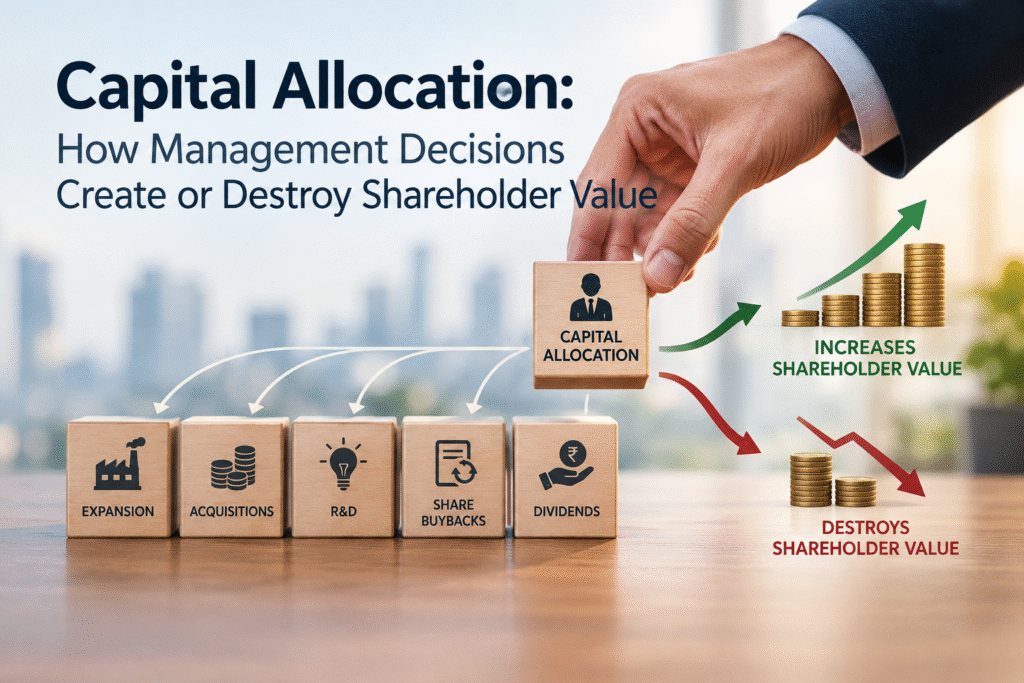
Two companies can sell similar products, serve the same customers and report similar profits this year. Ten years later, one has made its shareholders rich and the other has barely beaten a fixed deposit. In most cases, the gap does not come from the product. It comes from what management did with the money.
That is capital allocation. It is the least talked about driver of stock returns and, for a long-term investor, one of the most important. This guide explains what capital allocation means, the five choices every management team has to make, how to tell good decisions from bad ones, and what Indian investors should check before trusting a company with their savings.
What Is Capital Allocation?
Capital allocation is the way a company’s management decides where to put the cash it has. That cash comes from two places: profits earned from operations, and money raised from outside through debt or new shares.
Once the cash is in hand, management has only a handful of options. It can reinvest in the existing business, buy another company, pay down debt, pay a dividend, or buy back its own shares. Every rupee of cash goes to one of these five uses, or it sits idle in the bank.
The reason this matters for you as a shareholder is simple. You own a share of the business, and management decides how your share of the profits is used. A great operator who allocates capital badly can slowly wear down the value of an otherwise good business. An average business with a disciplined management can quietly compound wealth for decades.
Why Capital Allocation Decides Shareholder Value
Shareholder value is created when a company earns more on its capital than that capital costs. The two numbers to watch are ROCE and WACC.
ROCE (return on capital employed) shows how much operating profit a company earns for every rupee of capital used in the business, including both equity and debt.
WACC (weighted average cost of capital) is the blended cost of the money the company uses. Think of it as the return you could reasonably expect elsewhere for a similar level of risk. For most Indian companies, analysts estimate it in the range of 10 to 14 per cent, and higher for smaller or riskier firms.
The rule is easy to remember:
- If ROCE is above WACC, every extra rupee reinvested adds value.
- If ROCE is below WACC, every extra rupee reinvested destroys value, even if profits and revenue are growing.
That second point surprises many beginners. A company can grow sales by 20 per cent a year and still hurt its shareholders if the new capital earns less than it costs. Growth is only good when it is profitable growth.
A Simple Example
Take two companies, each with ₹100 crore of capital, and assume WACC is 12 per cent for both.
- Company A earns a ROCE of 22 per cent. It earns ₹10 crore more than the cost of its capital each year.
- Company B earns a ROCE of 9 per cent. It falls ₹3 crore short each year.
Now assume both reinvest all profits at the same return for ten years. Company A’s capital grows to roughly ₹730 crore. Company B’s grows to roughly ₹237 crore. Same starting point, same management hours, very different outcomes. The only variable is the return earned on each reinvested rupee.
Real businesses do not reinvest everything at a fixed rate, but the example shows why long-term investors watch the return on capital so closely.
The Five Capital Allocation Decisions
Here is how each of the five choices can add or remove value.
1. Reinvesting in the Existing Business
This is the best use of capital when the business earns a high return. Spending on new capacity, technology, brands or distribution makes sense when the extra profit clears the cost of capital with room to spare.
The trouble starts when a company keeps spending long after the best opportunities are gone. Many capital-heavy businesses, such as metals, power and infrastructure, keep adding capacity in good times, only to find the extra supply pulls down returns for everyone.
What to check: Compare capital expenditure with depreciation, and then look at whether sales and operating profit grew in proportion to the new spending.
2. Acquisitions (Mergers and Acquisitions)
Acquisitions are where a large amount of shareholder money gets destroyed. Managements often overpay to win a bidding contest, and the cost savings or “synergies” they promised rarely show up in full. Research on Indian companies has found that close to half of a sample of large firms suffered a major write-off, sold off a large business, or saw their value fall sharply over a five-year window, and acquisitions were a common cause.
Debt-funded overseas acquisitions in commodity and infrastructure sectors are a well-known example. They looked attractive when commodity prices were high, and they became a heavy burden when the cycle turned.
That does not mean every acquisition is bad. Small, focused purchases that add a product or a region to a business the management already understands tend to work better than large, transformative deals.
What to check: Look for repeated goodwill write-offs, a sharp rise in debt after a deal, and a fall in ROCE after the purchase.
3. Repaying Debt
Paying down debt is a safe and often sensible use of cash, especially when interest rates are high or the business is cyclical. It lowers risk, and it lowers interest costs.
There is a flip side. A company with almost no debt that keeps repaying more of it may be underusing cheap borrowed money. A moderate amount of debt, used well, can raise returns to shareholders.
What to check: Look at the interest coverage ratio and the debt to equity ratio, and compare both with peers in the same sector.
4. Paying Dividends
A dividend is a direct cash payout to shareholders. It tells you management is confident about future cash flows, and it limits the chance that spare cash gets spent on pet projects.
Markets punish companies that cut dividends, so once a company starts paying regularly, the payout becomes close to a promise. For that reason, a good dividend policy is steady and sized to what the business can afford in a weak year, not just in a strong one.
Dividends are taxed in your hands at your income tax slab rate, which is a point worth remembering if you are in a high bracket.
What to check: Look at the dividend payout ratio over five to ten years, and confirm that free cash flow covers the payout.
5. Buying Back Shares
A share buyback means the company uses cash to buy its own shares from the market or from shareholders. Done well, it lifts the value of each remaining share. Done badly, it wastes money.
The test is price. A buyback creates value for the shareholders who stay only if the company buys at a price below what the business is truly worth. If a stock with an intrinsic value of ₹1,000 is bought back at ₹800, remaining shareholders gain. If it is bought back at ₹1,300, they lose.
Buybacks are also sometimes used to cancel out the new shares issued under employee stock option plans, or to improve earnings per share when management bonuses are tied to that number. In such cases the buyback is not really a return of capital at all.
What to check: Look at whether the total share count has actually fallen over five years, and not just in the year of the buyback.
Dividends vs Buybacks: What Changed for Indian Investors
For years, buyback taxation in India kept changing, so it is worth being clear about where things stand.
| Period | How buybacks were taxed |
|---|---|
| Up to 30 September 2024 | Company paid the tax, shareholders received the money tax-free |
| 1 October 2024 to 31 March 2026 | Entire proceeds treated as dividend in the shareholder’s hands, taxed at slab rate |
| From 1 April 2026 | Taxed as capital gains, so only the profit over your purchase cost is taxed |
Under the current rule, a retail investor pays tax only on the gain. If you hold listed shares for more than 12 months, long-term capital gains above ₹1.25 lakh in a year are taxed at 12.5 per cent. Shorter holding periods attract 20 per cent. Promoters face an additional buyback tax, which brings their effective rate to about 22 per cent for a domestic company and about 30 per cent for individuals.
For ordinary investors this is better than the dividend treatment, because the old rule taxed the full amount received rather than the profit. Tax rules change often, so confirm the latest position with a tax advisor before you act.
How to Evaluate a Company’s Capital Allocation
You do not need to read every annual report line by line. A short checklist, repeated for each stock, goes a long way.
- Check the ROCE trend over 5 to 10 years. A single year tells you little. A ROCE above 15 per cent is generally seen as good for Indian companies, and it should stay above the cost of capital through the cycle.
- Compare ROCE with WACC. If returns are below the cost of capital for years, the company is destroying value as it grows.
- Look at free cash flow, not just profit. Profit is an accounting number. Free cash flow is the cash left after running and maintaining the business. Consistent free cash flow is what funds dividends and buybacks.
- Read the capital allocation policy. Some larger companies state a clear policy on how much surplus cash goes back to shareholders. Infosys, for example, has publicly committed to returning a large share of its free cash flow, around 85 per cent. A written policy gives you something to hold management to.
- Study the acquisition record. Look at what the company bought, what it paid, and what happened to returns afterward.
- Track the share count. If the number of shares keeps rising, your slice of the company is shrinking.
- Look at the history. How management allocated capital in the last two or three downturns tells you more than any press release.
Good and Bad Capital Allocation in Practice
Indian markets offer plenty of examples on both sides.
Companies such as Hindustan Unilever and Tata Consultancy Services are often cited for sustained high returns on capital, with little need for outside funding and regular cash returns to shareholders. Titan is another name that analysts frequently use to show what steady reinvestment at high returns can do over a long period. Infosys under its founder-led management in the 2000s was known for small acquisitions, regular dividends and no debt.
On the other side, many investors learned the cost of debt-funded expansion the hard way in sectors like infrastructure, power and commodities. These companies borrowed heavily to buy or build at the top of the cycle, and the debt outlived the demand.
Common Capital Allocation Mistakes
Two more patterns show up again and again.
- Empire building. Management expands to be bigger, not to be better. Size feeds pay, status and ego, but not always returns.
- Hoarding cash. A large cash pile earning a low return drags down the overall return on capital.
Key Takeaways for Retail Investors
- Capital allocation is how management uses cash, and it is one of the strongest long-term drivers of shareholder value.
- Value is created only when ROCE stays above the cost of capital.
- Acquisitions carry the highest risk, while steady reinvestment at high returns carries the highest reward.
- Dividends and buybacks make sense when the company cannot find better uses for the cash, and buybacks only add value when shares are bought below their worth.
Frequently Asked Questions
What is capital allocation in simple words?
Capital allocation is how a company’s management decides to use its money. The main choices are reinvesting in the business, buying other companies, repaying debt, paying dividends and buying back shares. Good decisions raise the value of your shares over time, and poor decisions lower it.
Why is capital allocation important for shareholders?
It decides how much of the company’s profit actually turns into wealth for you. A management team that reinvests at high returns, avoids overpriced deals and returns surplus cash sensibly will usually grow shareholder value faster than one that does not, even when both run similar businesses.
What is a good ROCE for Indian companies?
A ROCE above 15 per cent is generally considered good in India, though the right level depends on the sector. More important than the number itself is whether ROCE stays above the company’s cost of capital, and whether it holds steady over five to ten years.
Are dividends or buybacks better for investors?
It depends on price and tax. A buyback is better when the company buys below the true value of the business. A dividend is better when you want regular income. Since 1 April 2026, buybacks are taxed as capital gains, so you pay tax only on your profit.
How do acquisitions destroy shareholder value?
Companies often pay too much, then fail to achieve the cost savings or extra sales they promised. Debt used to fund the deal adds risk. When the return on the acquired business is below the cost of capital, shareholders end up worse off than before the deal.
How can I check if management allocates capital well?
Look at 5 to 10 years of ROCE, free cash flow, dividend history, acquisitions, debt levels and changes in share count. Then compare ROCE with the cost of capital. A company that earns more than its cost of capital year after year and returns spare cash sensibly is usually allocating well.
Disclaimer: This article is for general education and is not investment advice. Please speak to a SEBI-registered investment adviser before making financial decisions.