
Floating-Rate vs Fixed-Rate Bonds Across Different Interest-Rate Cycles
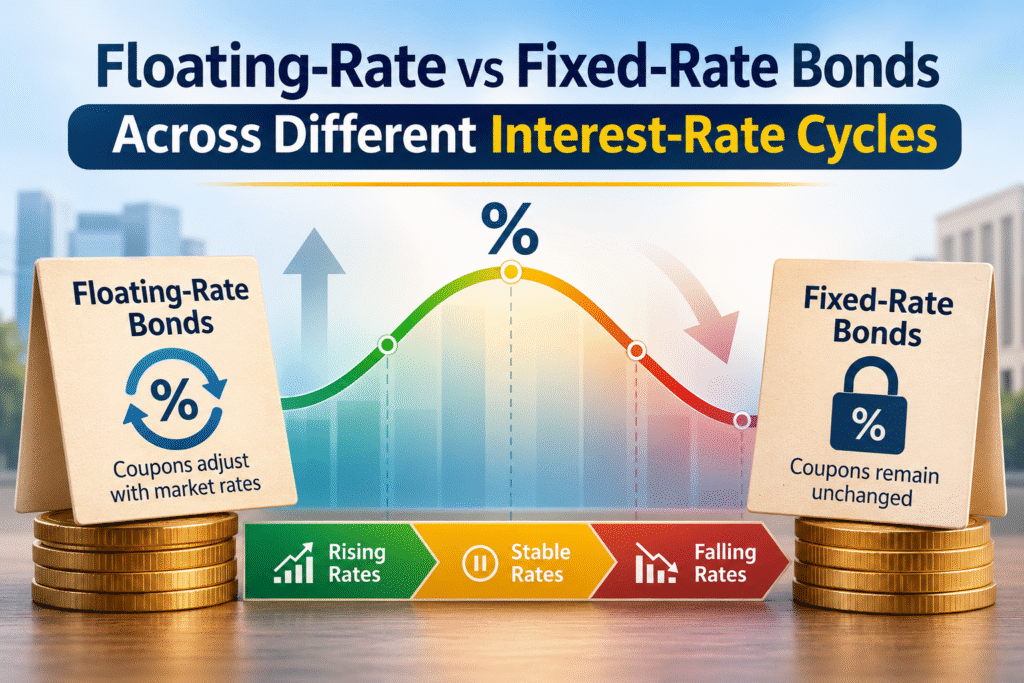
Floating-rate bonds usually do better when interest rates are rising. Fixed-rate bonds usually do better when interest rates are falling. When rates move sideways, the two end up closer than most investors expect. That is the short answer, and the rest of this article explains why, using Indian numbers and a few simple examples.
The question is timely. The RBI raised the repo rate by 25 basis points to 5.50% on 7 October 2026, after holding it at 5.25% from February to August. The yield on the 10-year government bond touched a three-year high above 7.37% on 12 October and was around 7.39% on 29 October. SBI Research has estimated that the repo rate could peak near 6% in this cycle. When rates start moving up, many investors ask whether their fixed-rate bonds and debt funds still make sense, and whether a floating-rate bond is the better choice.
What Is a Fixed-Rate Bond?
A fixed-rate bond pays the same coupon from the day you buy it until it matures. A government security (G-Sec) with a 7.2% coupon pays 7.2% of face value every year, no matter what the RBI does to the repo rate. At maturity, you get the face value back.
That certainty is the main attraction. You know your income in advance, which suits retirees, people saving for a known future expense, and anyone who values predictability. The catch is that the market price of the bond changes every day. If you hold to maturity, those price changes do not affect your final return. If you sell early, or if you own the bond through a debt mutual fund, they matter a great deal.
What Is a Floating-Rate Bond?
A floating-rate bond pays a coupon that resets at set intervals, often every six months. The new coupon is a benchmark rate plus a fixed spread. The benchmark can be a Treasury bill yield, a policy-linked rate, or a small savings rate.
Indian investors will come across a few versions:
- RBI Floating Rate Savings Bond 2020 (Taxable): the coupon equals the National Savings Certificate (NSC) rate plus 0.35%, reset every 1 January and 1 July. It carries a sovereign guarantee and has a seven-year tenure.
- Government floating-rate securities: issued in the past with coupons linked to Treasury bill auction yields.
- Floating rate mutual funds: a SEBI debt fund category that must hold at least 65% of its assets in floating-rate instruments.
- Corporate floating-rate bonds: available, but less common and harder to sell before maturity.
Floating-Rate vs Fixed-Rate Bonds: Quick Comparison
| Feature | Fixed-rate bond | Floating-rate bond |
|---|---|---|
| Coupon | Same until maturity | Resets, often every six months |
| Interest-rate risk | High, and grows with maturity | Low, close to the reset period |
| Best interest-rate cycle | Falling or near the peak | Rising |
| Income certainty | High | Low |
| Price behaviour | Moves with market yields | Stays close to face value |
| Main risk | Price loss when yields rise | Lower income when rates fall |
| Reinvestment risk | Appears at maturity | Appears at every reset |
Interest-Rate Risk and Bond Duration
Bond prices and yields move in opposite directions. When market yields rise, older bonds with lower coupons become less attractive, so their prices fall. How far a price falls depends on the bond’s duration, which measures sensitivity to a change in yields.
A rough rule: for every 1 percentage point change in yields, the price moves by about the bond’s modified duration, in percent. Take ₹10,00,000 invested in a 10-year fixed-rate bond with a modified duration of 7. If yields rise by 1 percentage point, the price falls by about 7%, a mark-to-market loss of roughly ₹70,000. A floating-rate bond that resets every six months has a duration close to 0.5, so the same move costs about 0.5%, or roughly ₹5,000. These figures are approximations and ignore convexity, but the gap between the two tells most of the story.
Because a floating coupon resets to the new market level, the bond price tends to stay near face value. That is why floating-rate bonds are seen as protection against interest-rate risk. The price of that protection is less upside when rates fall.
What Happens in a Rising Interest-Rate Cycle
Fixed-rate holders face two problems in a rising cycle. Their existing bonds lose value, and new bonds pay more than the ones they already own.
Floating-rate holders are in a better spot. Suppose a floating bond pays a benchmark of 7.0% plus a 1.0% spread, so the coupon is 8.0%. If the benchmark rises by 1 point before the next reset, the coupon moves to 9.0%. A fixed-rate holder stays at 8.0% and also sees a lower bond price.
There are limits to this advantage:
- Reset lag. Between resets, the bond keeps paying the old rate. A six-month reset means you can be behind the market for up to six months.
- Benchmark choice. Some benchmarks follow the repo rate quickly. Others, such as small savings rates, are set by the government and change slowly.
- Timing of the switch. Many investors prefer floating-rate bonds or short-duration funds early in a hiking cycle, then move toward fixed-rate bonds as yields get closer to a peak. Nobody can call the peak with certainty, so this is a plan, not a guarantee.
What Happens in a Falling Interest-Rate Cycle
Falling rates reverse the picture. A fixed-rate bond gains twice: its price rises, and its locked-in coupon looks generous next to new, lower-yielding bonds. Suppose you bought a 10-year bond at a 7.5% yield before rates came down. You keep that 7.5% for ten years while new buyers accept less.
A floating-rate bond does not share in that gain. The coupon resets lower at each review, so income shrinks, and the price stays near face value, so there is little capital gain to offset it.
One point is easy to miss. Long-term yields do not always follow the repo rate. While the RBI was cutting the repo rate by a cumulative 125 basis points, the 10-year G-Sec yield mostly stayed between about 6.5% and 6.9%, because heavy government borrowing, tight liquidity and oil prices pushed the other way. A fixed-rate investor in long bonds did not get the full benefit that a repo cut might suggest.
What Happens When Rates Peak or Move Sideways
When the RBI holds rates steady for a long stretch, both bond types behave quietly. The fixed-rate bond usually pays a higher starting yield because investors are paid extra for locking money in for longer. The floating-rate bond pays a little less but keeps its price steady.
The period close to the peak deserves attention. Yields are high, inflation pressure is easing, and the next big move in rates is more likely to be down than up. That is historically a good time to add fixed-rate bonds. The difficulty is that a peak is only clear in hindsight, which is why many investors build positions in stages instead of in one go.
The shape of the yield curve matters too. When long-term yields are well above short-term yields, fixed-rate bonds pay you for taking duration risk. When the curve is flat or inverted, a floating-rate bond gives up very little income, so the choice becomes easier.
What the RBI Floating Rate Savings Bond Teaches Us
The RBI Floating Rate Savings Bond (FRSB) is the most familiar floating-rate product for Indian retail investors, and its history is useful.
The coupon was 7.15% for all of 2021 and 2022, moved to 7.35% in January 2023, and rose to 8.05% from July 2023. It has stayed at 8.05% at every reset since, including the current period from 1 July to 31 December 2026, which the RBI confirmed as the NSC rate of 7.70% plus 0.35%.
The lesson is that a floating coupon follows its own benchmark, not the repo rate directly. The NSC rate is set by the government every quarter. While the RBI was cutting the repo rate, the NSC rate did not fall, so the FRSB coupon did not fall either. In practice, this floating bond behaved like a fixed-rate bond for more than three years. The next reset is on 1 January 2027, and it will depend on the NSC rate announced by the government.
Two more practical points. The FRSB interest is fully taxable at your slab rate, and premature redemption is generally allowed only for senior citizens, subject to lock-in rules. Non-resident Indians cannot buy it.
Where India Stands in the Rate Cycle Today
As of early November 2026, the signals point toward tighter policy. The RBI has raised the repo rate to 5.50% and moved to a calibrated tightening stance. Inflation has been rising, and several market participants expect the 10-year G-Sec yield to move toward 7.70% to 7.75% by December. SBI Research expects further hikes.
Forecasts like these can change quickly with oil prices, US interest rates and government borrowing. Treat them as context, not as instructions. What they do tell us is that the cost of being wrong on duration is higher now than it was a year ago, when the RBI was still holding rates steady.
Risks of Floating-Rate Bonds
Floating-rate bonds are not risk-free. Before buying, check these points:
- Falling-rate risk. Your income drops when the benchmark drops.
- Spread and benchmark. A low spread over a slow benchmark can lag the market for a long time.
- Liquidity. Lock-ins and thin trading can make early exit costly or impossible.
- Credit risk. A corporate floating-rate bond depends on the issuer’s ability to pay, so check the credit rating.
- Tax. Bond interest is taxed at your slab rate. Debt mutual fund gains are also taxed at slab rate under current rules, so check the latest rules before investing.
- Fund risk. A floating rate fund still has some credit exposure and some duration, and its returns are not guaranteed.
How to Choose Between Floating-Rate and Fixed-Rate Bonds
The right choice depends on your holding period, your need for predictable income, and your view on where rates are going. Use this as a starting point:
- You will hold to maturity and want fixed income: a fixed-rate bond fits. Price swings do not matter if you do not sell.
- You may need the money in one to three years and rates are rising: a floating-rate bond, floating rate fund or short-duration fund limits price losses.
- You are a retiree who needs steady monthly or half-yearly income: a ladder of fixed-rate bonds with different maturities, plus a smaller floating-rate holding, spreads the risk.
- You are unsure where rates are heading: a mix of both is a reasonable way to avoid a single bet.
This is general education, not personalised advice. Consider your tax slab, your time horizon and the credit quality of the issuer, and talk to a SEBI-registered advisor if you need help.
Common Mistakes to Avoid
- Assuming a floating rate always rises. It can fall, or stay flat if the benchmark does.
- Comparing coupon rates instead of yields, taxes and reset terms.
- Buying a long-duration bond fund at the start of a rate-hiking cycle.
- Ignoring the lock-in period when choosing a savings bond.
- Locking everything into fixed-rate bonds for the sake of certainty, then needing the money before maturity.
Frequently Asked Questions
Are floating-rate bonds better than fixed-rate bonds? Neither is better in every situation. Floating-rate bonds usually work better when interest rates are rising because the coupon resets higher and the price stays stable. Fixed-rate bonds usually work better when rates are falling because the locked-in coupon and the bond price both look better.
Which is better when interest rates are rising, floating or fixed? Floating-rate bonds are usually better. Their coupons reset upward and their prices stay close to face value, while fixed-rate bonds lose market value as yields climb. The benefit depends on how often the coupon resets and which benchmark it follows.
What happens to floating-rate bonds when interest rates fall? The coupon resets lower at the next review, so your income falls. The bond price stays near face value, so you do not get the price gain that a fixed-rate bond would show. If the benchmark is slow to move, the drop in income may be delayed.
What is the current interest rate on the RBI Floating Rate Savings Bond? The coupon is 8.05% a year for the period 1 July 2026 to 31 December 2026. It is calculated as the NSC rate of 7.70% plus 0.35%, and the interest is paid on 1 January 2027. The rate resets every 1 January and 1 July.
Is the RBI Floating Rate Savings Bond a good investment? It offers a sovereign guarantee, no upper investment limit and a rate above many small savings schemes. The drawbacks are fully taxable interest, a seven-year lock-in with limited early exit, and a rate tied to the NSC rather than directly to market yields. Whether it suits you depends on your tax slab and time horizon.
What is a floating rate fund? A floating rate fund is a SEBI-defined debt mutual fund category that invests mainly in floating-rate instruments. It aims to limit the impact of rising yields on the portfolio. It still carries credit risk and some interest-rate risk, and returns are not guaranteed.
How does duration affect a fixed-rate bond? Duration shows how much a bond price may change when yields move. A bond with a duration of 7 may lose about 7% in price if yields rise by 1 percentage point. Longer maturity and lower coupons generally mean higher duration and higher interest-rate risk.
Final Thoughts
Fixed-rate and floating-rate bonds are tools for different parts of the interest-rate cycle. Fixed-rate bonds reward investors who lock in high yields before rates fall. Floating-rate bonds protect investors who expect rates to keep rising. With the RBI now raising the repo rate and bond yields at three-year highs, the duration you hold matters more than it did a year ago.
Before buying, ask four questions. How long will I hold? How much price swing can I accept? Which benchmark does the coupon follow? What will I pay in tax? Honest answers to these will usually point you to the right mix.
Data sources: RBI press releases on the repo rate and the Floating Rate Savings Bond, Business Standard, Kotak Neo, Free Press Journal and Trading Economics. Rates and forecasts are as reported in October and early November 2026 and can change. This article is for education and is not investment advice.