
How to Read a Mutual Fund Fact Sheet Like a Pro
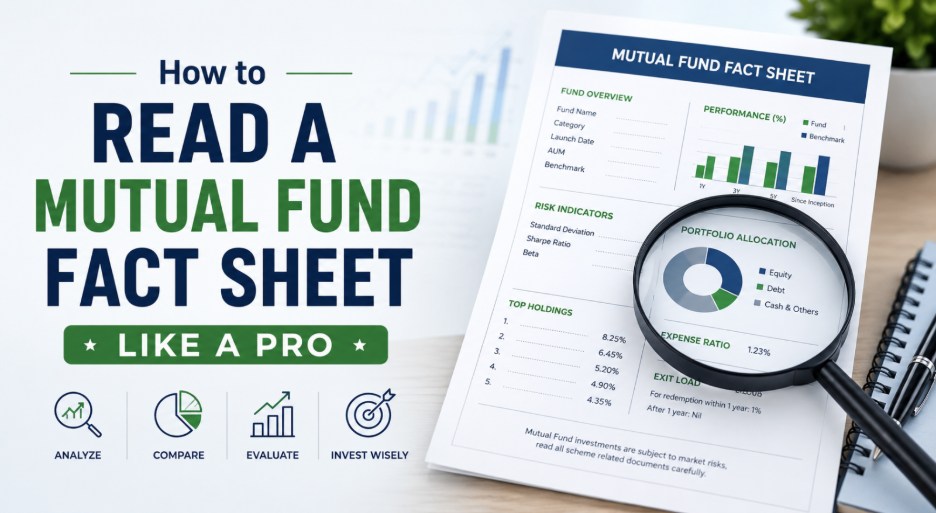
Mutual funds are one of the most popular investment vehicles for both beginners and seasoned investors. They offer diversification, professional management, and accessibility. Yet, before investing in a mutual fund, it is essential to understand what you are buying. The most important document that provides this information is the mutual fund fact sheet.
A fact sheet is a concise summary of a fund’s objectives, holdings, performance, and costs. It is usually updated monthly or quarterly and is designed to give investors a snapshot of the fund’s characteristics. Reading a fact sheet can feel overwhelming at first because it contains a lot of data and financial jargon. However, once you know how to interpret each section, you can quickly evaluate whether a fund aligns with your investment goals.
This article will guide you through the key components of a mutual fund fact sheet and explain how to analyze them like a professional investor.
1. Fund Overview
The first section of a fact sheet usually provides the fund’s name, category, and investment objective.
- Fund Name and Category: The name often indicates the type of investments the fund focuses on. For example, “ABC Large Cap Equity Fund” suggests that the fund invests primarily in large-cap stocks. The category helps you compare it with similar funds.
- Investment Objective: This is a short statement describing the fund’s goal. It might say “to provide long-term capital appreciation by investing in growth-oriented companies.” Understanding the objective is crucial because it tells you what the fund manager is trying to achieve.
Professional tip: Always check if the objective matches your personal financial goals. If you are seeking steady income, a growth-oriented equity fund may not be suitable.
2. Fund Manager and Management Team
The fact sheet usually lists the fund manager’s name and sometimes their track record.
- Experience: A manager with decades of experience in handling similar funds may inspire confidence.
- Philosophy: Some fact sheets briefly describe the manager’s investment style, such as value investing or growth investing.
Professional tip: While the manager’s reputation matters, remember that mutual funds are managed by teams. Do not rely solely on one individual’s credentials.
3. Portfolio Composition
This section shows where the fund’s money is invested.
- Asset Allocation: It breaks down the percentage of investments in equities, bonds, cash, or other instruments. For example, 70 percent equities, 25 percent bonds, and 5 percent cash.
- Sector Allocation: Equity funds often show how much is invested in different sectors such as technology, healthcare, or finance.
- Top Holdings: Fact sheets usually list the top 10 holdings, which can account for a significant portion of the portfolio.
Professional tip: Look at the concentration of holdings. If the top 10 stocks make up 60 percent of the portfolio, the fund may be less diversified than you think.
4. Performance Data
Performance is one of the most closely watched sections of a fact sheet.
- Historical Returns: Fact sheets present returns over different time horizons such as 1 year, 3 years, 5 years, and since inception.
- Benchmark Comparison: The fund’s performance is compared with a benchmark index like the S&P 500 or Nifty 50. This helps you see if the manager is adding value beyond what you could achieve by investing in the index directly.
- Annualized Returns: These show the average yearly return over a period, smoothing out short-term fluctuations.
Professional tip: Do not focus only on short-term performance. A fund that outperformed last year may not sustain that trend. Look at long-term consistency.
5. Risk Measures
Fact sheets often include risk metrics that help you understand the volatility of the fund.
- Standard Deviation: Measures how much the fund’s returns vary from the average. A higher number means more volatility.
- Beta: Indicates how sensitive the fund is to market movements. A beta of 1 means the fund moves in line with the market. A beta greater than 1 suggests higher volatility.
- Sharpe Ratio: Shows how much return the fund generates per unit of risk. A higher Sharpe ratio is better.
Professional tip: Compare these metrics with other funds in the same category. A fund with high returns but excessive volatility may not suit conservative investors.
6. Expense Ratio and Fees
Costs can significantly impact your returns over time.
- Expense Ratio: This is the annual fee expressed as a percentage of assets. For example, an expense ratio of 1.5 percent means you pay $15 annually for every $1,000 invested.
- Other Fees: Some funds may have entry loads or exit loads, which are charges when you buy or sell units.
Professional tip: Always compare expense ratios across similar funds. Lower costs often translate into better net returns, especially for long-term investors.
7. Fund Size and Liquidity
The fact sheet usually mentions the Assets Under Management (AUM).
- AUM: A larger fund may have more stability, but extremely large funds can struggle to remain nimble.
- Liquidity: This refers to how easily you can buy or sell units. Most mutual funds offer daily liquidity, but it is worth confirming.
Professional tip: A very small fund may face challenges in diversification, while a very large one may become less agile.
8. Dividend Policy
Some funds distribute dividends, while others reinvest them.
- Dividend Option: Investors receive payouts periodically.
- Growth Option: Dividends are reinvested, increasing the value of your units.
Professional tip: Choose the option that aligns with your financial needs. Growth options are better for long-term wealth creation, while dividend options suit those seeking regular income.
9. Fund Ratings and Analyst Opinions
Many fact sheets include ratings from agencies like Morningstar or CRISIL.
- Star Ratings: These are based on past performance and risk-adjusted returns.
- Analyst Notes: Sometimes, fact sheets provide commentary on the fund’s strategy or outlook.
Professional tip: Ratings are useful but should not be the sole basis for investment. They are backward-looking and may not predict future performance.
10. Key Disclosures
Fact sheets often include disclaimers stating that past performance does not guarantee future results. They may also highlight risks specific to the fund, such as exposure to foreign markets or derivatives.
Professional tip: Read these disclosures carefully. They remind you that investing always carries risk.
Putting It All Together
Reading a mutual fund fact sheet like a pro means going beyond surface-level numbers. Here is a step-by-step approach:
- Start with the investment objective to ensure alignment with your goals.
- Review the portfolio composition to understand diversification.
- Examine performance data in relation to benchmarks over multiple time horizons.
- Assess risk measures to gauge volatility.
- Compare expense ratios with peers.
- Consider fund size and liquidity.
- Decide between dividend and growth options.
- Look at ratings but treat them as supplementary information.
- Read disclosures to understand potential risks.
Final Thoughts
A mutual fund fact sheet is not just a marketing document. It is a powerful tool that helps you make informed investment decisions. By learning to interpret each section, you can evaluate whether a fund is suitable for your portfolio.
Professional investors know that success lies in discipline and thorough analysis. They do not chase short-term performance or rely solely on ratings. Instead, they study fact sheets carefully, compare funds within categories, and align choices with long-term objectives.
If you adopt the same approach, you will be able to read mutual fund fact sheets with confidence and make smarter investment decisions. Over time, this skill can significantly improve your ability to build wealth and achieve financial independence.