
Is Buy Now, Pay Later a Trap or a Smart Move?
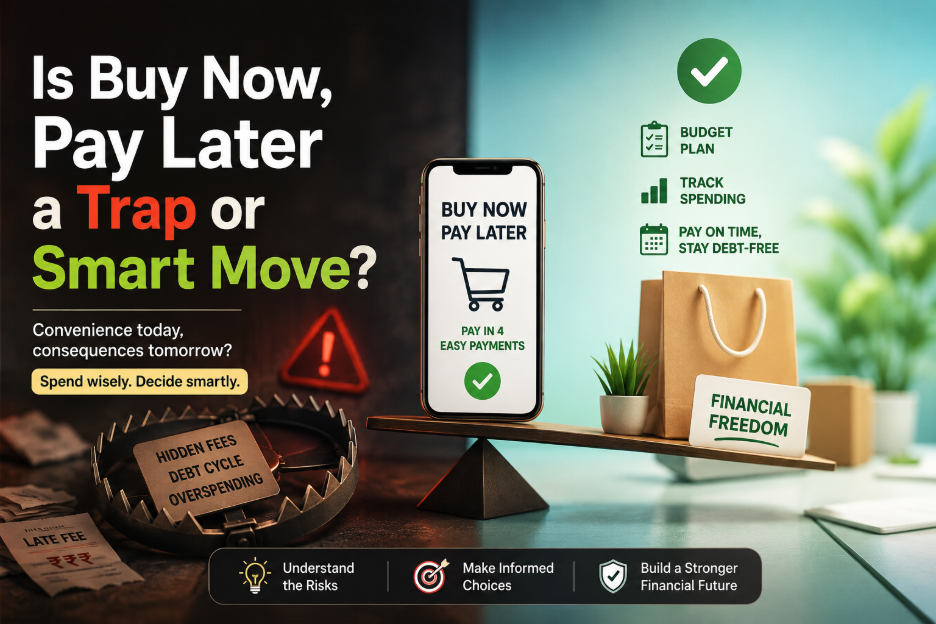
Buy Now, Pay Later in India: Is It a Trap or a Smart Financial Move?
Walk into any online checkout in India today and you will likely see it: a small button that reads “Pay Later” or “Buy Now, Pay Later.” What used to be a niche option tucked away in a handful of shopping apps has now become one of the most common ways Indians pay for things, from a new phone to a food delivery order to a weekend train ticket.
Buy Now Pay Later, commonly shortened to BNPL, has spread across e-commerce, travel, groceries, and even everyday UPI payments. The question most people ask, though, is a simple one. Is BNPL actually helping your finances, or is it a debt trap dressed up in a friendly checkout button?
This article breaks down how BNPL works in India, why it has grown so quickly, the regulatory changes shaping the industry in 2026, and how to decide if it belongs in your own wallet.
What Is Buy Now Pay Later (BNPL)?
BNPL is a short-term credit facility that lets a shopper buy something right away and pay for it later, either as a single deferred payment or spread out over a few installments. Most BNPL plans charge no interest if you clear the dues within the agreed window, though fees and interest can apply after that.
Some of the most recognised BNPL apps and services in India include:
- Amazon Pay Later, which lets shoppers buy now and settle the bill the following month or through EMIs
- Flipkart Pay Later, offering a monthly spending limit for purchases on the platform
- Paytm Postpaid, used for bill payments, recharges, and everyday shopping
- Bank and NBFC-backed Credit on UPI lines, a newer format that lets a BNPL-style credit limit sit directly inside a UPI app and be used to scan and pay at any store, online or offline
Unlike a personal loan or credit card, BNPL usually needs very little paperwork. Approval is based on your transaction history and basic KYC rather than a lengthy credit check, which is a big reason it appeals to first-time borrowers, students, and anyone without a credit card.
Why BNPL Has Taken Off in India
A few things explain why pay later apps have grown so fast among Indian shoppers:
No lengthy approval process. Most BNPL providers rely on alternative, data-driven underwriting instead of the traditional paperwork banks ask for, so a limit can be assigned within minutes.
Small ticket purchases feel manageable. Groceries, food delivery, and utility bills are a natural fit for BNPL, since the amounts are small enough that repayment feels painless compared to a full personal loan.
Interest-free windows. Many BNPL plans charge nothing extra as long as you repay within the set period, which makes them look like free short-term credit.
It shows up everywhere. BNPL is no longer limited to shopping apps. It is now built into travel bookings, food delivery, and, increasingly, UPI itself, so the option to defer a payment is always one tap away.
The Smart Side of BNPL
Used with discipline, BNPL can genuinely help rather than hurt your finances.
Smoother cash flow. For a salaried person paying bills a week or two before payday, BNPL can bridge that short gap without turning to a credit card cash advance or a payday loan, both of which usually carry far steeper costs.
A shot at building credit. Several BNPL and Credit-on-UPI providers now report repayment behaviour to credit bureaus. Paying on time, consistently, can work in your favour the way a small credit-builder loan would, and may help your CIBIL score over time.
Speed without a credit card. Not everyone owns or wants a credit card. BNPL gives that same instant-checkout convenience without the annual fees or the need to apply for a full card.
The Hidden Risks of BNPL
The same features that make BNPL convenient are exactly what make it risky if you are not careful.
It nudges you toward impulse buying. When payment is invisible at the moment of purchase, it is far easier to talk yourself into something you don’t really need.
Debt spreads across apps quietly. Using Amazon Pay Later, Flipkart Pay Later, Paytm Postpaid, and a UPI credit line all at once can leave you with several small dues that are easy to lose track of. Industry commentary has started calling this scattered, hard-to-track debt “phantom debt,” since it does not feel like a loan until the bills start arriving together.
Late fees can bite harder than they look. The interest-free period is often the headline, but miss the deadline and the penalty charges can end up costing more than a credit card would have.
The fine print gets skipped. Processing fees, the exact date interest kicks in, and penalty terms are frequently buried in the app’s terms and conditions, and most users never read them closely before tapping “confirm.”
Deleting the app does not delete the debt. If a BNPL bill goes unpaid, the provider can still report the default to credit bureaus and pursue recovery, regardless of whether the app is still on your phone.
Where BNPL Regulation Stands in 2026
The Reserve Bank of India has been steadily tightening the ground rules around digital lending and BNPL. Under the RBI’s Digital Lending Guidelines, loan disbursals and repayments must move directly between the borrower’s bank account and the account of the regulated lending entity, cutting out the practice of routing credit through third-party wallets. This has pushed many BNPL providers to restructure around licensed banks and NBFCs rather than operate through informal tie-ups.
The broader effect has been a shift toward bank-backed and NBFC-backed BNPL, often delivered through UPI credit lines, with fewer standalone fintech-only BNPL products than a few years ago. For the everyday user, this generally means more transparency around fees and clearer loan agreements, though it is still worth checking whether a given BNPL provider is genuinely tied to an RBI-regulated lender before signing up.
How to Use BNPL Without Getting Burned
If you do plan to use Buy Now Pay Later, a few habits go a long way:
- Keep a running list of every BNPL account you hold. Small dues across multiple apps add up faster than they seem to.
- Treat the due date like a loan EMI, not a suggestion. Set a reminder and pay in full before the interest-free window closes.
- Reserve it for planned expenses. A grocery bill or a booked flight is a reasonable use. An impulse purchase at midnight usually is not.
- Actually read the terms. Know the exact date interest starts, what the late fee looks like, and whether the provider reports to CIBIL.
- Stick to one or two providers you trust, rather than spreading small debts across five different apps.
So, Is BNPL a Trap or a Smart Move?
It depends entirely on the person using it. BNPL is not good or bad on its own; it is a financial tool, and tools behave the way their user directs them. For someone who pays on time and reserves BNPL for genuine, planned expenses, it can be a sensible way to manage short-term cash flow and even build a credit history. For someone who lets small dues pile up across five different apps and ignores the due dates, it can turn into exactly the debt trap critics warn about.
As India’s digital lending rules continue to evolve, financial literacy remains the real deciding factor. Before you tap “Pay Later” on your next order, it is worth asking a simple question: do you actually need this purchase, and will you be able to pay it back on time?
BNPL reflects how Indian consumers shop today, and it is not going anywhere. Used with a plan, it can work in your favour. Used without one, it can quietly become a debt you did not see coming.