
The Mathematics of Financial Independence: Savings Rate, Withdrawal Rate and Portfolio Risk
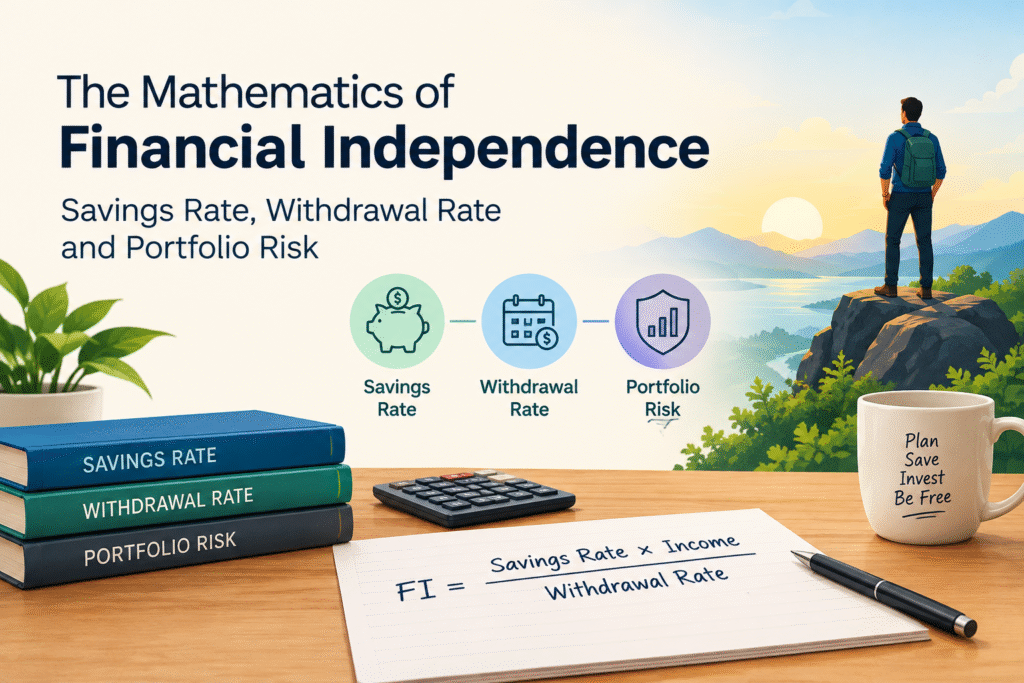
Financial independence means your investments can pay for your living expenses for the rest of your life, so working becomes a choice. Three numbers decide how soon you get there: your savings rate, your withdrawal rate and the risk in your portfolio. The savings rate sets how fast your corpus grows. The withdrawal rate sets how big the corpus must be. Portfolio risk decides whether the plan survives a bad market.
This guide explains each number with simple maths, rupee examples and current Indian data, so you can work out your own FIRE number and your own timeline.
What Financial Independence Means in Numbers
Financial independence, often shortened to FI or FIRE (Financial Independence, Retire Early), is reached when your corpus is large enough that a modest yearly withdrawal covers your expenses. The basic formula is:
FIRE number = Annual expenses ÷ Safe withdrawal rate
If you spend ₹6 lakh a year and plan to withdraw 3.5% of the corpus each year, your FIRE number is ₹6,00,000 ÷ 0.035, which is about ₹1.71 crore.
Notice that the formula uses expenses and not income. Every rupee you cut from spending does two jobs. It raises the amount you can save today, and it lowers the corpus you need later. That double effect is why the savings rate matters more than almost anything else in the plan.
Savings Rate: The Number You Control
Your savings rate is the share of your take-home income that you save and invest. If you take home ₹1,00,000 a month and invest ₹30,000, your savings rate is 30%.
The time you need to reach financial independence depends mostly on this one percentage, and not on the size of your salary. A person who earns ₹60,000 a month and saves half of it will reach FI before a person who earns ₹2,00,000 and saves 10%. The first person builds the corpus faster and also needs a smaller one.
The table below shows how many years it takes to reach FI when you start from zero. It assumes a 5% real return (return after inflation, tax and fund costs) and a 3.5% withdrawal rate, which means a corpus of about 28.6 times your yearly expenses.
| Savings rate | Years to financial independence |
|---|---|
| 10% | 54 |
| 20% | 39 |
| 30% | 30 |
| 40% | 23.5 |
| 50% | 18 |
| 60% | 14 |
| 70% | 10 |
Look at the jump from 10% to 30%. Tripling the savings rate cuts the wait by about 24 years. Above 50%, each extra 10 points saves fewer years, but the gain is still worth having.
The table assumes your expenses stay flat in real terms and that you start with no savings. If you already have some corpus, or your income grows faster than inflation, the timeline shortens. If your lifestyle grows with every raise, the timeline stretches.
A quick note on “real return”. It means the return left after inflation is removed. If your portfolio earns 11% in a year when inflation is 5.5%, your real return is about 5%. Planning in real terms keeps the maths simple, because you can work in today’s rupees and ignore future price levels.
Withdrawal Rate: How Big a Corpus Do You Need?
The safe withdrawal rate (SWR) is the percentage of your corpus that you take out in the first year of retirement. After that, you raise the amount every year to match inflation. The well-known 4% rule comes from US research by William Bengen in the 1990s. It says a portfolio can support a 4% first-year withdrawal for about 30 years, which works out to a corpus of 25 times your yearly expenses.
The 4% rule is a fair starting point, but it was built on US data. Three things make it risky for Indian investors:
- Inflation in India has often run higher than in the United States, so your withdrawals must grow faster each year.
- Early retirees may need the money for 40 or 50 years, while the original research looked at 30-year periods.
- Indian market history is shorter, and equity returns have been more uneven from one decade to the next.
Because of this, research by Raju Sarogi suggests that a safer withdrawal rate in India is usually between 3% and 3.5%. At 3%, the corpus needed is 33 times yearly expenses, and at 2.5% it is 40 times.
Here is what those rates mean for someone who spends ₹6 lakh a year:
| Withdrawal rate | Corpus multiple | FIRE number (today’s rupees) |
|---|---|---|
| 4% | 25x | ₹1.50 crore |
| 3.5% | 28.6x | ₹1.71 crore |
| 3% | 33.3x | ₹2.00 crore |
| 2.5% | 40x | ₹2.40 crore |
A general way to pick a rate is by your time horizon. If you plan to stop working at 60, a rate near 3.5% is a common choice. If you plan to stop at 40 or 45, a rate of 3% or lower gives you more room for error.
One more point on inflation. Your FIRE number should be based on the expenses you will have on the day you retire, and those will be higher than today’s. If you spend ₹6 lakh a year now and inflation averages 5% for 15 years, your yearly expenses will be about ₹12.47 lakh. At a 3.5% withdrawal rate, that needs a corpus of about ₹3.56 crore in future rupees. It buys the same lifestyle as ₹1.71 crore does today. Do your plan either in today’s rupees with real returns, or in future rupees with nominal returns. Do not mix the two.
Inflation and Returns: What the Latest Data Shows
India’s retail inflation, measured by CPI, rose to 4.82% in August 2026, up from 4.45% in July, with rural inflation at 5.23% and urban at 4.31%. That is the highest reading since December 2024, and it still sits inside the RBI’s tolerance band of 2 percentage points either side of 4%.
On the return side, the Nifty 50 Total Return Index delivered an annualised 12.44% over the 20 years ended February 2026, while the price index alone gave 11.09%. Returns depend heavily on the start and end dates you choose, and past numbers do not promise future ones. Safer instruments move at a slower pace: the PPF rate stayed at 7.1% for the July to September 2026 quarter. PPF interest is also tax-free.
Taking inflation of about 5% and blending equity with debt, a planning figure of 5% real return is reasonable and a little cautious. It is the figure used in the tables in this article.
Portfolio Risk: Why the Average Return Is Not Enough
An average return hides the path taken to reach it. Two portfolios can both average 10% a year over 25 years and still give a retiree very different outcomes, depending on the order in which the good and bad years arrive. This is called sequence of returns risk.
Here is a simple example. You retire with ₹1 crore and withdraw ₹4 lakh in the first year. The market then falls 20% during that same year. After the withdrawal you have ₹96 lakh, and after the fall you have ₹76.8 lakh. In year two, inflation of 5% lifts your withdrawal to ₹4.2 lakh. That is now about 5.5% of what is left, not 4%. You are selling units at low prices to fund your expenses, and those units cannot recover with the market.
The same 20% fall ten years into retirement hurts far less, because your corpus has had time to grow and you have sold fewer units at the bottom. The first five to ten years of retirement are the danger zone.
Falls of this size are normal in equity markets. The Nifty dropped roughly 15% between January and March 2026, and it lost more than half its value during the 2008 crisis. Your plan has to be built to sit through a fall like that without forcing you to sell.
Here are the common ways to manage portfolio risk:
- Asset allocation. Hold a mix of equity index funds, debt (PPF, EPF, government bonds, debt funds) and gold. There is no single correct split. As an example, someone using a 3.5% withdrawal rate might keep half the corpus in equity and half in debt and gold. Your split should depend on your horizon and on how much of a fall you can sit through.
- A cash bucket. Keep two to three years of expenses in fixed deposits, liquid funds or short-duration funds. In a bad year you draw from the bucket and leave the equity alone.
- Flexible spending. Cutting spending by 10% in a bad year lowers your effective withdrawal rate and gives the portfolio time to recover.
- Yearly rebalancing. Bring the mix back to your target once a year. It forces you to trim what has run up and add to what has fallen.
- Low costs. With a 3.5% withdrawal rate, an extra 1% a year in fund costs is a large share of what you take out. Low-cost index funds keep more of the return in your pocket.
Tax: The Part Many Plans Skip
Your FIRE number should work with after-tax returns. For FY 2026-27, long-term capital gains on listed equity shares and equity mutual funds held for more than 12 months are taxed at 12.5% on gains above ₹1.25 lakh in a financial year, while short-term gains are taxed at 20%. Interest from fixed deposits is taxed at your slab rate, while PPF interest is fully tax-free.
Two practical points follow. First, when you sell equity units to fund expenses, only the gain part is taxed, and the first ₹1.25 lakh of gains each year is exempt. Spreading sales across years can bring down your tax bill. Second, tax rules change with each Budget, so keep a small margin in your plan instead of counting on today’s rates staying the same for decades.
A Worked Example
Take a 32-year-old who brings home ₹1,00,000 a month and spends ₹60,000. The savings rate is 40%.
- Yearly expenses: ₹7.2 lakh
- FIRE number at a 3.5% withdrawal rate: ₹7,20,000 ÷ 0.035, about ₹2.06 crore in today’s rupees
- Yearly savings: ₹4.8 lakh
- Time to FI at a 5% real return: about 23.5 years, so around age 55
Now suppose the same person cuts spending by ₹10,000 a month, to ₹50,000. The savings rate becomes 50%. Yearly expenses fall to ₹6 lakh, so the FIRE number drops to about ₹1.71 crore. Yearly savings rise to ₹6 lakh. The timeline shortens to about 18 years, which means age 50. A ₹10,000 monthly cut brings FI closer by roughly five years, and the effect comes from both sides of the equation at once.
This example uses flat income for simplicity. In real life, salary raises that you save instead of spending will get you there sooner.
Common Mistakes to Avoid
- Applying the 4% rule without checking your own horizon and India’s inflation.
- Mixing real and nominal numbers in the same plan.
- Leaving out health insurance and medical costs, which often rise faster than general inflation.
- Counting the home you live in as part of the corpus. It does not pay your bills.
- Holding only equity and being forced to sell after a crash.
- Ignoring tax and fund costs when estimating returns.
Frequently Asked Questions
What is a good savings rate for financial independence?
A savings rate of 30% to 50% is a workable target for most salaried people. Under the assumptions in this article, 30% takes about 30 years and 50% takes about 18 years.
What is the 4% rule, and does it work in India?
The 4% rule says you can withdraw 4% of your corpus in the first year of retirement, then adjust for inflation each year, and expect the money to last about 30 years. It was built on US data. Because Indian inflation has often been higher and early retirees need longer horizons, many Indian planners prefer 3% to 3.5%.
How much money do I need for financial independence in India?
Multiply your yearly expenses by 28.6 for a 3.5% withdrawal rate, or by 33.3 for a 3% rate. For yearly expenses of ₹6 lakh, that is about ₹1.71 crore to ₹2 crore in today’s rupees.
How many years does it take to reach financial independence?
It depends on your savings rate. Starting from zero, with a 5% real return and a 3.5% withdrawal rate, a 20% savings rate takes about 39 years, 40% takes about 23.5 years and 60% takes about 14 years.
What is sequence of returns risk?
It is the risk that a market fall in the early years of retirement, while you are also withdrawing money, does lasting damage to your corpus. The order of returns matters as much as the average return.
What is a real return?
A real return is your investment return after removing inflation. If your portfolio earns 11% and inflation is 5.5%, your real return is about 5%.
This article is for education only and is not investment advice. Figures are based on the assumptions stated and on data available in September 2026. Speak to a SEBI-registered investment adviser before you decide your asset allocation or withdrawal plan.