
Multi-Asset Portfolio Construction: Combining Equity, Bonds, Gold and Real Estate
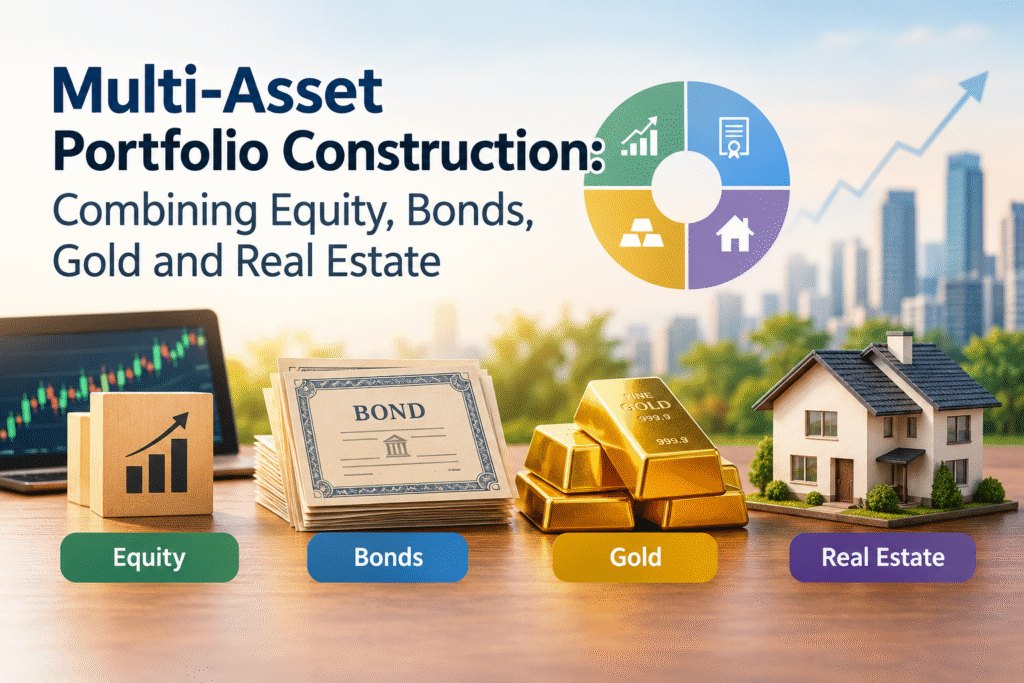
A multi-asset portfolio is an investment portfolio that spreads money across different asset classes, such as equity, bonds, gold and real estate, so that no single market decides your results. For an Indian investor, a common starting point is about 50% equity, 25% bonds, 15% gold and 10% real estate (usually through REITs), which is then adjusted for age, income, goals and risk tolerance.
The need for this mix is easy to see in the news this month. On 7 October 2026 the Reserve Bank of India raised the repo rate by 25 basis points to 5.50%, its first increase since February 2023, and changed its stance to calibrated tightening. The 10-year government bond yield has been hovering around 7.1% to 7.2%, a two-year high. The Nifty 50 has been trading near 22,500 to 22,650, and 24-carat gold is around ₹1.49 lakh to ₹1.50 lakh per 10 grams. Interest rates, shares and gold are each reacting to different forces, and a portfolio built on only one of them carries more risk than most people realise.
This article explains multi-asset portfolio construction in plain steps: what each asset class does, how to choose an asset allocation, how to rebalance, and how the taxes work in India.
What Is Multi-Asset Portfolio Construction?
Multi-asset portfolio construction is the process of deciding how much of your money goes into each asset class, and then choosing the investments that fill each slot. The first decision is called asset allocation. The second is called security selection. Research going back to the 1980s suggests that asset allocation explains most of the difference in how portfolios behave over time, which is why it deserves more attention than picking the best-performing fund.
The idea behind it is diversification. Each asset class earns money in a different way, so they rarely rise and fall together. When one part of the portfolio is weak, another part often holds steady or gains. The result is a smoother ride, and a smoother ride makes it easier to stay invested for ten or twenty years.
Why Combine Equity, Bonds, Gold and Real Estate?
Each of the four asset classes responds to a different driver:
- Equity follows company earnings and economic growth.
- Bonds follow interest rates and inflation expectations.
- Gold follows fear, inflation worries and the strength or weakness of the rupee.
- Real estate follows rental demand, local supply and the cost of borrowing.
Because the drivers differ, the correlation between these assets is lower than the correlation between two equity funds. Correlation is a number between -1 and +1 that shows how closely two investments move together. A lower number means better diversification.
There is one honest caveat. In a sharp market crisis, correlations can rise for a short time, and assets that normally move apart may fall together. Diversification reduces the size of your losses and shortens the recovery, but it does not remove losses.
The Role of Each Asset Class
Equity: The Growth Engine
Equity gives a portfolio its long-term growth. Over long periods, Indian equity has delivered returns in the range of roughly 11% to 13% a year, well above inflation, although the figure depends heavily on the start and end dates you choose. The price of that growth is volatility. Falls of 30% or more have happened more than once, and an investor who cannot sit through such a fall should hold less equity.
Most retail investors do well with a low-cost Nifty 50 index fund, a flexi cap fund, or a mix of both, bought through a monthly SIP. Direct stocks can be added in small amounts if you enjoy research, but they should not carry the whole equity allocation.
Bonds: Stability and Regular Income
Bonds lend money to the government or to companies in exchange for interest. They reduce the overall swings of the portfolio and provide income. In India, the main options are government securities (G-Secs), corporate bond funds, short duration funds, target maturity funds, PPF, EPF and bank fixed deposits.
One point matters a great deal right now. When interest rates rise, the price of existing bonds falls. With the RBI in a tightening stance and the 10-year yield near 7.2%, longer duration funds can show losses in the short run. Investors who want to avoid that risk usually choose shorter duration funds, or hold a target maturity fund or a G-Sec until it matures. G-Secs can be bought directly through the RBI Retail Direct platform.
Gold: The Hedge
Gold does not produce income, and its price can stay flat for years. Its value in a portfolio comes from how it behaves in bad times. It has often held up during inflation scares, geopolitical stress, equity sell-offs and periods of rupee weakness. The rupee has been trading close to ₹96.5 per US dollar in the futures market, and a weaker rupee tends to lift gold prices in rupee terms.
Most advisers suggest keeping gold between 5% and 15% of the portfolio. The convenient ways to hold it are gold ETFs, gold mutual funds and, for those who already own them, Sovereign Gold Bonds. Fresh SGB issues are no longer a regular option, so most new investors now use gold ETFs. Physical jewellery is not an efficient investment because of making charges and GST.
Real Estate: Rent and Inflation Protection
Real estate adds rental income and a long-term link to inflation. It also brings problems that the other three asset classes do not have: a large ticket size, high stamp duty and registration costs, slow sales and no easy way to sell a part of the property. Residential rental yields in Indian cities have usually been low, often around 2% to 3% of the property value a year, so most of the return comes from price appreciation.
For a portfolio, the practical choice for most people is a REIT (Real Estate Investment Trust). REITs are listed on the stock exchanges, can be bought in small amounts, and are required to distribute at least 90% of their net distributable cash flow to unit holders. Direct property can still make sense for investors with a large corpus and a long horizon, but the house you live in should not be counted as part of this allocation. It is a home, not an investment holding.
| Asset class | Common instruments in India | Main job in the portfolio |
|---|---|---|
| Equity | Index funds, flexi cap funds, direct stocks | Long-term growth |
| Bonds | G-Secs, short duration funds, target maturity funds, PPF, EPF | Stability and income |
| Gold | Gold ETFs, gold mutual funds, SGBs | Hedge against inflation and stress |
| Real estate | Listed REITs, direct property | Rental income, inflation link |
Where the Markets Stand Right Now
The current position, as of the first week of October 2026, shows why a single-asset approach is risky:
- The repo rate is 5.50% after the 7 October hike, and the RBI has said further action will be either another increase or a pause.
- The 10-year G-Sec yield is around 7.1% to 7.2%, its highest in nearly two years, with high crude oil prices and global bond yields adding to the pressure.
- Retail inflation was 4.82% in August 2026.
- The Nifty 50 is near 22,500 to 22,650.
- Gold is trading near ₹1.5 lakh per 10 grams for 24-carat.
Nobody can say which of these will do best over the next year. That uncertainty is the reason to hold all of them in sensible proportions instead of guessing.
How to Decide Your Asset Allocation
Four factors decide how much of each asset class suits you.
- Risk tolerance. How much of a fall can you accept without selling in panic?
- Time horizon. Money needed in three years should not sit in equity. Money needed in twenty years can.
- Income stability. A salaried person with a steady income can usually take more equity risk than a freelancer with irregular income.
- Goals. Retirement, a child’s education and a house purchase each have a different deadline and a different level of urgency.
A simple rule of thumb is to hold “100 minus your age” in equity. A 30-year-old would hold 70% in equity and a 50-year-old would hold 50%. Treat this only as a starting point, not as a final answer.
The table below shows sample allocations. These are examples for learning, not advice for any individual.
| Investor profile | Equity | Bonds | Gold | Real estate (REITs) |
|---|---|---|---|---|
| Conservative | 30% | 45% | 15% | 10% |
| Moderate | 50% | 25% | 15% | 10% |
| Aggressive | 70% | 10% | 10% | 10% |
Steps to Build a Multi-Asset Portfolio
- Build an emergency fund first. Keep six months of expenses in a savings account, a liquid fund or a fixed deposit. This money stays outside the portfolio.
- Write down your goals and their deadlines. The allocation should follow the goals.
- Choose a target allocation. Pick a mix from the table above, or adjust it to your situation.
- Select low-cost instruments. Index funds and ETFs with low expense ratios keep more of your return in your pocket.
- Invest through SIPs. Regular monthly investing removes the need to time the market.
- Set a rebalancing rule. Decide in advance when and how you will restore the original mix.
- Review once a year. Check your goals, income and risk tolerance, and change the target only if your life has changed.
Investors who prefer a single product can look at multi-asset allocation funds. Under SEBI rules, these funds must hold at least three asset classes with a minimum of 10% in each, and equity, debt and gold is the usual combination. They handle the rebalancing for you, although you give up control over the exact weights.
A Worked Example of Portfolio Rebalancing
Suppose you start with ₹10 lakh and a target of 50% equity, 25% bonds, 15% gold and 10% REITs.
- Equity: ₹5.00 lakh
- Bonds: ₹2.50 lakh
- Gold: ₹1.50 lakh
- REITs: ₹1.00 lakh
After one year, equity gains 30%, bonds gain 7%, gold gains 10% and REITs gain 7%. The values become ₹6.50 lakh, ₹2.675 lakh, ₹1.65 lakh and ₹1.07 lakh, for a total of about ₹11.9 lakh. The weights have drifted to roughly 55% equity, 22% bonds, 14% gold and 9% REITs. The portfolio now carries more equity risk than you chose.
To rebalance, you would sell about ₹55,000 of equity and add about ₹30,000 to bonds, ₹13,000 to gold and ₹12,000 to REITs. This brings the weights back to the original targets. The discipline forces you to sell some of what has risen and buy some of what has lagged.
There are two common methods. Calendar-based rebalancing is done at a fixed date, such as every April. Threshold-based rebalancing is done when any asset moves more than 5 percentage points away from its target. A good habit is to rebalance first with new SIP money, which avoids selling and keeps taxes low.
Taxation of Each Asset Class in India
Tax affects what you keep, so it should be part of the plan. The rules below apply for FY 2026-27, as the Union Budget 2026 made no changes to capital gains rates.
| Asset | Long-term if held more than | Long-term capital gains tax |
|---|---|---|
| Listed equity shares and equity mutual funds | 12 months | 12.5% on gains above ₹1.25 lakh in a year |
| Gold ETFs, listed REIT units, listed bonds | 12 months | 12.5%, no indexation |
| Physical gold, gold mutual funds | 24 months | 12.5%, no indexation |
| Real estate | 24 months | 12.5%, no indexation (property bought before 23 July 2024 may use the older 20% rate with indexation) |
| Debt mutual funds bought after 1 April 2023 | Not applicable | Taxed at your income tax slab rate |
Short-term gains on listed equity and equity mutual funds are taxed at 20%. Short-term gains on most other assets in the table are taxed at your slab rate. Sovereign Gold Bonds held to maturity are exempt from capital gains tax. Tax rules change often, so confirm the latest position with a qualified tax adviser before you sell.
Common Mistakes to Avoid
- Chasing last year’s winner. Moving money into whichever asset rose most recently usually means buying high.
- Overweighting gold after a rally. Gold is a hedge, not a growth asset. Keep it to the planned weight.
- Counting your own home as real estate allocation. A house you live in does not give you diversification or income.
- Taking a large home loan for a second property when rates are rising. With the RBI now in a tightening cycle, EMIs on floating rate loans can go up.
- Owning five funds that hold the same stocks. Overlap gives the look of diversification without the benefit.
- Ignoring costs. A difference of 1% a year in expense ratio adds up to a large sum over twenty years.
- Never rebalancing. Without it, the portfolio slowly turns into an equity-heavy one and the risk rises without notice.
Frequently Asked Questions
What is a multi-asset portfolio? A multi-asset portfolio holds several asset classes, such as equity, bonds, gold and real estate, in fixed proportions. The aim is to reduce risk by making sure that a fall in one market is partly offset by steadiness or gains in another.
What is a good asset allocation for equity, bonds, gold and real estate in India? A common moderate mix is 50% equity, 25% bonds, 15% gold and 10% real estate through REITs. A conservative investor may hold 30% equity and 45% bonds, while an aggressive investor may hold 70% equity. The right mix depends on age, goals and risk tolerance.
How much gold should I hold in my portfolio? Most advisers suggest 5% to 15% of the total portfolio. Gold does not earn interest or dividends, so a larger share can reduce long-term growth. Gold ETFs and gold mutual funds are more cost-effective than jewellery.
Is real estate a good part of a diversified portfolio? Yes, in a limited share. Real estate provides rent and some protection against inflation, but it is illiquid and costly to buy and sell. For most investors, listed REITs give exposure with smaller amounts and easier exit than buying property directly.
How often should I rebalance my portfolio? Once a year is enough for most investors. You can also rebalance whenever an asset class drifts more than 5 percentage points from its target. Using fresh SIP money to rebalance helps you avoid unnecessary tax.
Should I change my allocation after the RBI rate hike? A single rate hike is not a reason to overhaul a long-term plan. It may be a reason to review the duration of your bond holdings, because rising rates lower the prices of longer bonds. Your target allocation should change only when your goals or risk tolerance change.
Is a multi-asset allocation fund better than building my own portfolio? It is simpler, because the fund manager rebalances for you. The trade-off is less control over the weights and a fund-level expense ratio. Investors who want exact control over real estate or gold exposure usually build their own mix.
Final Thoughts
Multi-asset portfolio construction does not try to predict which market will win next year. It accepts that nobody can know this, and it spreads money across equity, bonds, gold and real estate so that the portfolio can survive different conditions. Choose an allocation that matches your goals and temperament, use low-cost instruments, invest regularly, and rebalance on a fixed schedule. Over a decade or two, that routine tends to matter more than any single investment choice.
Disclaimer: This article is for general education and is not personalised investment, tax or legal advice. Market figures are from early October 2026 and will change. Please consult a SEBI-registered investment adviser and a qualified tax professional before making decisions.