
Overconfidence and Excessive Trading: The Hidden Cost of Investor Conviction
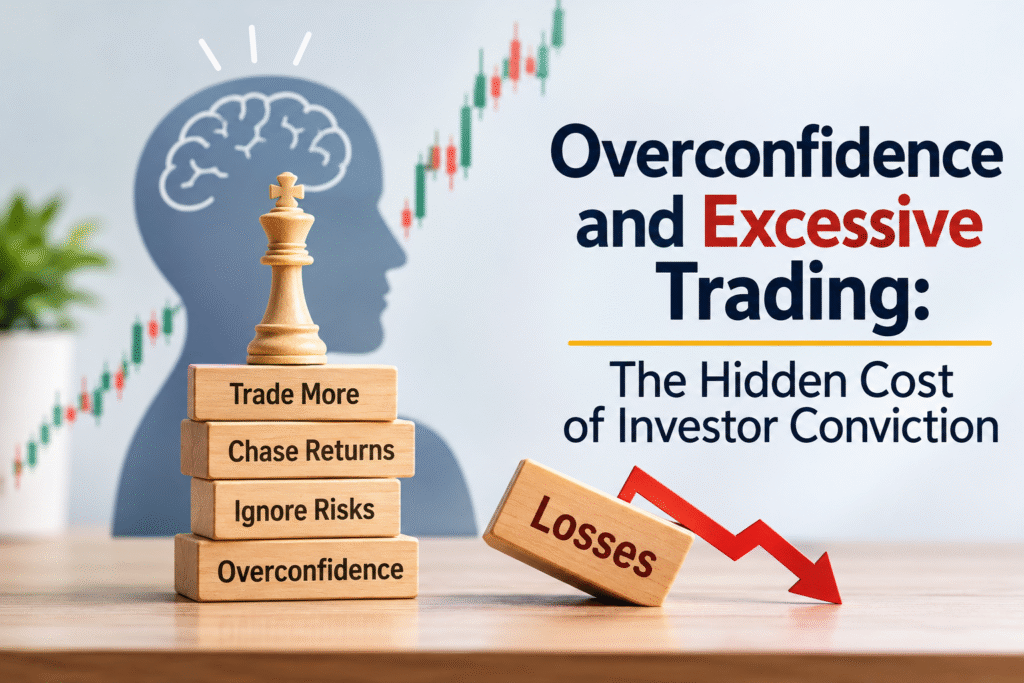
Most investors believe they are better than average. That sounds harmless, but it is one of the most expensive beliefs in the stock market. When you are sure you can pick the right stock, catch the right entry and exit before the crowd, you trade more. And the more you trade, the more you pay, in brokerage, taxes, and mistakes.
This article explains how overconfidence leads to excessive trading, what the research and the SEBI data actually show, and what you can do to protect your money.
Quick Answer: What Is Overconfidence and Excessive Trading?
Overconfidence bias in investing is the habit of overrating your own skill, knowledge and ability to predict the market. Excessive trading, also called overtrading, is buying and selling far more often than your plan or your results justify. The two go together. Studies of individual investors show that those who trade the most usually earn the least, because costs and poor timing eat into returns.
What Is Overconfidence Bias in Investing?
Overconfidence bias is a well-known idea in behavioral finance, the field that studies how emotions and mental shortcuts affect money decisions. In simple terms, it means you trust your own judgment more than the facts allow.
It shows up in a few common ways:
- Overestimating skill. You think a few good trades prove you have an edge.
- Illusion of control. You feel that watching the screen all day gives you some control over the outcome.
- Self-attribution bias. You credit wins to your skill and blame losses on bad luck, news, or the market.
- Overprecision. You feel certain about a price target or a date, when the honest answer is that nobody knows.
A rising market makes this worse. When almost every stock goes up, almost every investor feels like a genius. The feeling is real, but it is not proof of skill.
Why Overconfident Investors Trade Too Much
The link is simple. If you believe your information is better than everyone else’s, then every price move looks like a chance to act. Holding feels like doing nothing, and doing nothing feels like losing.
Several things feed this habit:
- Easy access. A trading app is on your phone. You can place an order in seconds, at any hour the market is open.
- Constant noise. Tips on social media, news alerts, and finance videos make every day feel urgent.
- Quick feedback. A trade that works in two days feels like proof. A trade that fails gets forgotten.
- Social proof. When friends, relatives, or online creators post profits, you want to join in. Losses are rarely posted.
None of this means active investing is always wrong. It means that conviction without evidence is not a strategy.
What the Research Says: Barber and Odean
The most quoted study on this subject comes from two finance professors, Brad Barber and Terrance Odean. In their paper “Trading Is Hazardous to Your Wealth,” they looked at the accounts of about 66,000 households at a large US discount broker between 1991 and 1996.
The result was clear. The households that traded the most earned about 11.4 percent a year, while the market returned about 17.9 percent. The gap came mostly from trading costs and from buying stocks that did worse than the ones they sold.
In a second paper, “Boys Will Be Boys,” the same authors found that men traded about 45 percent more than women, and that this extra trading cut their returns by more. Their explanation was overconfidence. The point is not about men and women. The point is that the more confident a person is, the more they trade, and the more their results suffer.
What SEBI Data Says About Indian Traders
Indian retail investors do not need to look abroad for proof. SEBI, the market regulator, has published several studies on individual traders in the equity futures and options (F&O) segment.
- In FY25, SEBI found that about 91 percent of individual F&O traders made net losses, and total net losses were around ₹1.06 lakh crore, up 41 percent from FY24. SEBI later revised the FY25 figure to about ₹1.12 lakh crore.
- In FY26, SEBI reported that about 87.7 percent of individual traders still lost money, with aggregate net losses of about ₹91,685 crore.
- Individual traders paid roughly ₹25,000 crore a year in transaction costs, which is money gone whether the trade wins or loses.
- SEBI’s behaviour study found that options made up the bulk of individual losses, and that the longer a person kept trading F&O, the more likely they were to lose. Only a tiny share of long-time traders stayed profitable year after year.
These numbers do not prove that every trader will lose. They do show that, for the average individual, frequent short-term trading has been a losing game. Fewer people are trading now than a year or two ago, which suggests many have learned the lesson the hard way.
The Real Cost of Excessive Trading
The cost of overtrading is bigger than the brokerage bill. Here is where the money goes.
1. Direct costs. Brokerage, securities transaction tax (STT), exchange charges, GST, stamp duty, and DP charges are small on one trade. On hundreds of trades they add up.
2. Taxes. Under the rules at the time of writing, short-term capital gains on listed shares are taxed at 20 percent, while long-term gains above ₹1.25 lakh a year are taxed at 12.5 percent. Frequent trading pushes more of your gains into the higher bracket. Please check the latest rates before you file.
3. Bid-ask spread and slippage. You rarely get the exact price you see on the screen, especially in less liquid stocks and in fast markets.
4. Missed compounding. Money taken out of the market to pay costs cannot grow. This is the quietest cost and often the largest.
5. Missing the best days. Long-term returns in any market depend on a handful of strong days. Investors who jump in and out often miss them.
A Simple Example in Rupees
Suppose you invest ₹10 lakh. Let us say each buy-and-sell round trip costs you 0.5 percent once you count charges, taxes, and the price gap. If you make 10 round trips in a year, you lose about 5 percent of your capital, or ₹50,000, before you earn anything.
Now look at the long run. If ₹10 lakh grows at 12 percent a year for 20 years, it becomes roughly ₹96 lakh. If costs and poor timing pull the return down to 7 percent, the same money becomes about ₹39 lakh. The difference is close to ₹58 lakh. These are example figures, not a promise of returns, but the pattern is real: small yearly drags become very large over time.
Signs You May Be an Overconfident Investor
Ask yourself honestly:
- Do you check your portfolio or charts many times a day?
- Do you change your mind about a stock within days of buying it?
- Do you explain wins as skill and losses as bad luck?
- Do you trade after a big loss to “make it back”?
- Do you act on tips without checking the company’s numbers?
- Have you never compared your returns with a simple Nifty 50 index fund?
- Do you size up your bets right after a winning streak?
If you said yes to three or more, it is worth slowing down.
Conviction vs. Overconfidence: What Is the Difference?
Conviction is not bad. Great long-term investors hold their views through noise. The difference is the base.
Conviction rests on research, a written reason for buying, a clear price or event that would prove you wrong, and a long holding period. Overconfidence rests on a feeling, a recent win, or a tip. One keeps you invested. The other keeps you clicking.
A useful test: can you write down why you own a stock, in two sentences, without using the words “I feel” or “I think it will go up”? If not, you probably have a hunch, not a conviction.
How to Stop Overtrading: 8 Practical Steps
- Write an investment plan. Set your goal, your time horizon, and your asset mix. Look at it before any trade.
- Keep a trade journal. Record why you bought, what you expected, and what happened. Review it every quarter. Your own records are the best cure for self-attribution bias.
- Use a waiting rule. Wait 24 to 48 hours before any non-emergency trade. Many urges fade in that time.
- Set a trade limit. Decide in advance how many trades you will make in a month.
- Compare with a benchmark. Measure your yearly return, after costs and taxes, against a Nifty 50 or Sensex index fund. If you cannot beat it, the index fund is the better choice.
- Automate the core. Use a monthly SIP in index funds or diversified mutual funds for most of your money. Automation takes emotion out of the process.
- Keep a small “play” bucket. If you must trade actively, limit it to a small share of your savings, say 5 percent, that you can afford to lose.
- Cut the noise. Mute trading tips, turn off price alerts, and check your long-term portfolio once a month instead of once an hour.
Frequently Asked Questions
What is overconfidence bias in investing? It is the tendency to overrate your own knowledge and skill, and to believe you can predict markets better than you really can. It leads to larger bets, less diversification, and more frequent trading.
Why does overconfidence lead to excessive trading? Because an overconfident investor believes each trade has a good chance of working. Every price move looks like an opening, so they act more often, and costs and errors pile up.
Does trading more often really reduce returns? For most individual investors, yes. The Barber and Odean study found that the most active traders earned much less than the market, and SEBI’s studies show that the large majority of individual F&O traders lose money.
How much do Indian F&O traders lose? SEBI reported that about 91 percent of individual F&O traders lost money in FY25 and about 87.7 percent in FY26, with aggregate yearly net losses of roughly ₹92,000 crore to ₹1.12 lakh crore.
How can I tell if I am overtrading? Warning signs include many trades with no written reason, trading to recover losses, checking prices constantly, and returns that trail a simple index fund after costs.
Is long-term investing safer than frequent trading? No investment is risk-free. But a diversified, long-term approach has lower costs and fewer chances for emotional mistakes, which is why it works better for most people.
What is the best way to avoid overconfidence as an investor? Keep a written plan, track your results honestly against a benchmark, wait before trading, and put most of your money in low-cost diversified funds.
Final Thoughts
Confidence is useful in life. In investing, it needs to be earned by evidence, not by a few lucky months. The data from India and from abroad points the same way: the more often the average investor trades, the more they pay, and the less they keep.
You do not have to give up on active investing entirely. You only need to be honest about your record, keep your costs low, and let time do most of the work. Often, the best trade is the one you decide not to make.
Disclaimer: This article is for education only and is not investment advice. Enigma Capital and the author are not offering personalized recommendations. Past results do not guarantee future returns. Please speak to a SEBI-registered investment adviser before you make financial decisions.
Be Part of Something Bigger!
Whether you’re exploring new ideas, learning something new, or looking for opportunities, Enigma Community brings you closer to a world of possibilities.
Join Us: https://www.enigmacommunity.com/