
Sum-of-the-Parts Valuation: When a Company’s Businesses Need to Be Valued Separately
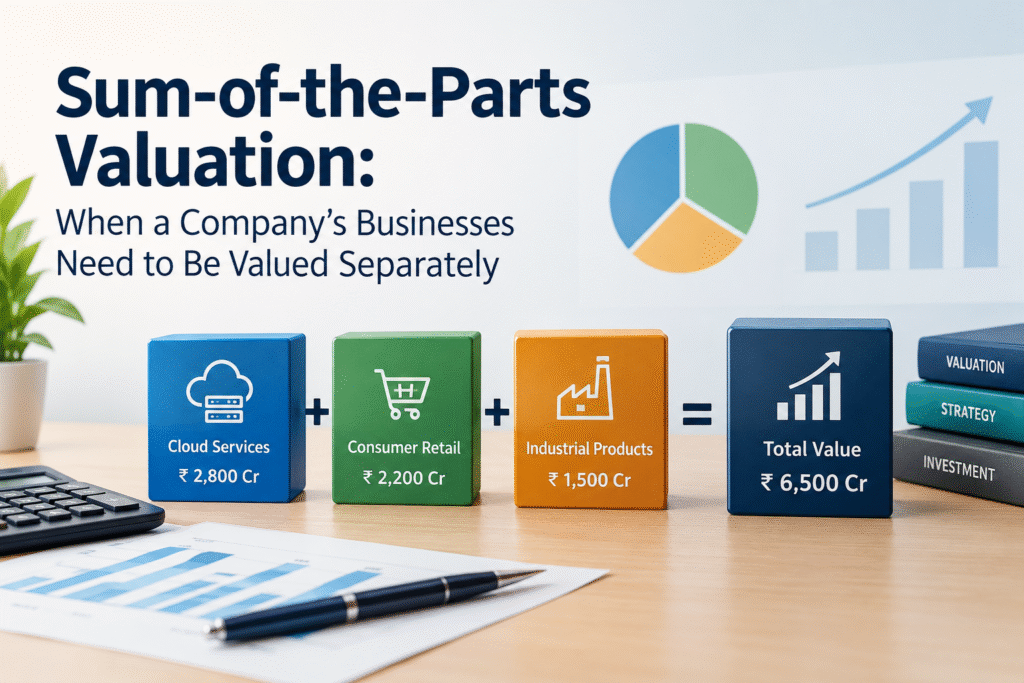
Sum-of-the-parts valuation, also called SOTP valuation, is a method of valuing a company by pricing each of its businesses separately and then adding the results together. It is used for conglomerates, holding companies and any diversified company whose divisions would earn very different multiples if they were listed on their own. In simple terms, you value every part at a fair price, add them up, subtract the debt, and compare the answer with the market price.
If you invest in Indian stocks, you have already seen SOTP in broker reports on Reliance Industries, Tata group companies, Vedanta, Grasim and Bajaj Holdings. This guide explains what SOTP valuation is, when it works, the SOTP formula, a step-by-step method, a worked example in rupees, and the mistakes that trip up retail investors.
What Is Sum-of-the-Parts (SOTP) Valuation?
Sum-of-the-parts valuation is a valuation method that values each business segment or subsidiary of a company on its own merits and then totals those values to arrive at the value of the whole company. Each segment is valued using the method and the peer multiples that suit that particular business.
Think of a company that makes branded biscuits, runs a chemicals plant and also owns a road construction arm. A biscuit business may deserve 20 times earnings. A chemicals business may deserve 12 times. A road builder may deserve 6 times. If you apply one blended multiple to the whole company, you get an answer that is wrong for all three. SOTP fixes this by treating them as three separate businesses.
Why One Multiple Fails for a Diversified Company
Most investors start with a simple tool such as the price-to-earnings ratio or EV/EBITDA. These work well when a company has one main business. They work badly when a company has several unrelated ones, for three reasons.
- Different growth rates. A fast-growing digital business and a slow-growing cement business should not share a multiple.
- Different risk and capital needs. A capital-heavy business such as steel or power is valued very differently from an asset-light software or consumer business.
- Different peer groups. Each division has its own listed competitors, and the market already prices those competitors in its own way.
When you blend these into a single number, strong divisions are dragged down and weak divisions are propped up. The market often does the same thing, which is why a diversified company can trade below what its parts are worth. That gap is the starting point for SOTP analysis.
When Should You Use SOTP Valuation?
SOTP valuation is the right tool when the company in front of you fits one of these cases.
- A conglomerate with unrelated businesses, such as a group with FMCG, chemicals and real estate under one roof.
- A holding company whose main assets are stakes in other listed or unlisted companies.
- A company planning a demerger, spin-off or IPO of a subsidiary, where the parts will soon be priced on their own.
- A company with one large hidden asset, such as a valuable land bank, a listed subsidiary or a fast-growing new business that is lost inside consolidated numbers.
- A company in a turnaround, where one division is loss-making and the rest are healthy.
SOTP is not the right tool for a focused single-business company. A pure-play bank, a pure-play software exporter or a single-product manufacturer is better valued with a discounted cash flow model or a peer comparison.
The SOTP Formula
The SOTP formula in its common form is:
SOTP Equity Value = Sum of Segment Enterprise Values + Value of Investments and Stakes − Net Debt − Minority Interest − Holding Company or Conglomerate Discount
To get the value per share, divide the SOTP equity value by the number of shares outstanding.
Here is what each term means.
- Segment enterprise value: the value of each operating business, usually its EBITDA multiplied by a fair EV/EBITDA multiple taken from listed peers.
- Investments and stakes: listed subsidiaries and associates, usually taken at market value, and unlisted holdings, taken at a conservative estimate.
- Net debt: total borrowings minus cash and liquid investments, at the group level.
- Minority interest: the share of a subsidiary that belongs to outside shareholders.
- Discount: the haircut that the market applies to a diversified structure, covered in detail below.
How to Do a Sum-of-the-Parts Valuation, Step by Step
Step 1: List every business segment. Open the annual report and read the segment reporting note. Indian companies disclose revenue, profit and capital employed by segment under accounting standards. List each segment and each major subsidiary or associate.
Step 2: Pick a valuation method for each segment. Use EV/EBITDA for most industrial and consumer businesses. Use price-to-earnings for stable profit-making units. Use price-to-book for banks, NBFCs and insurers. Use a discounted cash flow for businesses with uneven or long-dated cash flows. Use EV/sales only for early-stage businesses with no profit yet.
Step 3: Choose peer multiples. For each segment, find three to five listed competitors of a similar size, growth rate and return profile. Take the median multiple. Consider using a multiple averaged over a full market cycle, so that you do not lock in a peak or a trough.
Step 4: Value each segment. Multiply the segment’s earnings measure by the chosen multiple. This gives you the enterprise value of that segment.
Step 5: Add listed stakes and other assets. Value stakes in listed subsidiaries at their market capitalisation, multiplied by the holding percentage. Add surplus assets such as idle land or cash that is not needed in the business.
Step 6: Subtract net debt and minority interest. Use the group’s consolidated net debt. If a subsidiary is only partly owned, deduct the outside shareholders’ share so that you only count what belongs to your company’s shareholders.
Step 7: Apply a discount if it is justified. A diversified company rarely trades at its full SOTP value. Decide how large a discount is fair, and explain why.
Step 8: Divide by shares and compare with the market price. The result is your SOTP value per share. A market price well below it may point to a value opportunity. It may also point to a problem with the company, which is why the next steps in your analysis matter.
SOTP Valuation Example With Numbers
The example below is hypothetical. The company, the multiples and the figures are made up to show the method. All amounts are in rupees crore.
Meridian Industries has three operating businesses, a stake in a listed subsidiary, net debt of ₹6,300 crore and 100 crore shares. The market price is ₹260 per share.
| Component | Earnings measure | Multiple | Value (₹ crore) |
|---|---|---|---|
| Consumer goods | EBITDA ₹1,200 | 18x EV/EBITDA | 21,600 |
| Specialty chemicals | EBITDA ₹900 | 12x EV/EBITDA | 10,800 |
| Infrastructure and EPC | EBITDA ₹700 | 7x EV/EBITDA | 4,900 |
| Stake in listed subsidiary | Market value of holding | None | 4,000 |
| Gross value | 41,300 | ||
| Less: net debt | (6,300) | ||
| Equity value before discount | 35,000 | ||
| Less: 20 percent discount | (7,000) | ||
| Equity value after discount | 28,000 |
Divide ₹35,000 crore by 100 crore shares and you get ₹350 per share before the discount. Divide ₹28,000 crore by 100 crore shares and you get ₹280 per share after the discount.
At a market price of ₹260, Meridian trades about 7 percent below the discounted SOTP value and about 26 percent below the undiscounted value. The second number is the discount the market is actually applying today. The useful question for an investor is whether 26 percent is too harsh or too fair for this particular company, given its governance, its capital allocation and its debt.
Notice also how much the answer depends on the multiples. If the consumer business deserves 16 times instead of 18, the gross value falls by ₹2,400 crore, or ₹24 per share. This sensitivity is the main reason to run a low, base and high case rather than trust a single number.
Which Valuation Method Suits Which Business?
| Business type | Common method | Why |
|---|---|---|
| FMCG, auto, pharma, chemicals | EV/EBITDA or P/E | Stable earnings and many listed peers |
| Banks, NBFCs, insurance | Price-to-book, embedded value | Balance sheet is the business |
| Real estate and land bank | Net asset value | Value sits in the assets |
| Infrastructure and power | DCF or EV/EBITDA | Long contracts and heavy capital |
| Listed subsidiary | Market capitalisation | A live market price already exists |
| Early-stage or new business | EV/sales or recent funding round | Profits are not yet visible |
The Holding Company Discount and the Conglomerate Discount
The two discounts are related but not identical.
The conglomerate discount is the gap between what a diversified company trades at and the combined value of its divisions valued as standalone businesses. It applies to companies that run operating businesses under one roof.
The holding company discount is the gap between a holding company’s market value and the market value of the stakes it owns. It applies to investment holding companies such as Bajaj Holdings, Tata Investment Corporation or a promoter holding entity.
Reasons the market applies these discounts include:
- Tax leakage. Dividends can be taxed more than once as money moves up a group structure.
- Poor liquidity. Holding company shares often trade in thin volumes.
- Capital allocation worries. Investors fear cash will be spent on weak ideas instead of being returned.
- Governance concerns. Related-party transactions and promoter control make some investors cautious.
- Complexity. Investors dislike what they cannot easily understand, so they pay less for it.
- No control. A minority shareholder cannot force the company to sell a stake and distribute the cash.
So how big is the discount in India? Market commentary commonly puts the typical holding company discount in a range of 20 to 40 percent. Analyst estimates for some well-known holding companies, such as Bajaj Holdings, have sat in the 25 to 35 percent range. A recent media report on the possible Tata Sons listing noted that India’s 15 largest listed holding companies trade at an average discount of about 54.5 percent to the value of their listed stakes. Treat these numbers as indications that change with market conditions, not as fixed rules.
SOTP in the Indian Market: Three Live Examples
Indian markets offer plenty of current examples of why SOTP matters.
Reliance Industries and Jio Platforms. Brokerages have long valued Reliance using SOTP, with separate values for oil to chemicals, retail and digital services. The planned listing of Jio Platforms, announced at the 2026 annual general meeting, puts a market price on one of the largest parts. Analysts are now debating how the listing will change the valuation of Reliance itself, and whether a holding company discount will apply to the stake that Reliance continues to hold. Some broker SOTP models, such as one from Nomura, were built without applying a holding company discount to Jio, which shows how much the choice of discount can move the answer.
Vedanta demerger. Vedanta’s plan to split into separate listed companies is a textbook case of the market trying to close a conglomerate discount. Analysts have pointed to aluminium as the largest single contributor to the SOTP value, and some commentary expects up to about 20 percent of shareholder value to be created if sector-specific businesses are re-rated on their own. Whether that happens depends on execution, commodity prices and debt.
Tata Sons. An anticipated Tata Sons listing has started a debate about how a large holding structure, with many loss-making and unlisted ventures, will be priced. Here the SOTP approach would need to handle listed stakes at market value, private companies at estimated value and a discount for the holding structure.
These cases are changing, so check the latest company announcements and exchange filings before you form a view.
Why Demergers and Spin-Offs Often Follow SOTP Gaps
When the SOTP value is far above the market value for a long time, management has a choice. It can explain the businesses better, sell a stake, list a subsidiary, or split the company through a demerger. All of these aim at the same thing, which is to let the market price each business on its own and shrink the discount.
The discount tends to narrow when a holding company sells stakes and returns cash to shareholders, when a demerger is announced, when governance improves, or when a subsidiary is listed and gets a clear market price. A discount that keeps getting wider is often a signal that investors do not trust how the group uses its cash.
Common Mistakes in Sum-of-the-Parts Analysis
- Double counting. If a company owns a listed subsidiary and also consolidates its profits in a segment, counting both overstates the value.
- Using the wrong peers. A small regional chemicals unit does not deserve the multiple of a global specialty chemicals leader.
- Ignoring minority interest. If outsiders own part of a subsidiary, their share is not yours.
- Forgetting central costs. Head office costs belong to someone. Capitalise them and subtract them, or the total will be too high.
- Using peak multiples. A multiple taken at the top of a market cycle makes every segment look cheap.
- Skipping the debt. Net debt sits at the group level and must come off the total.
- Choosing the discount to fit a story. The discount should be justified by tax, governance, liquidity and capital allocation, not chosen to reach a target price.
- Treating SOTP as a guarantee. A gap between SOTP value and market price does not mean the gap will close.
Limitations of SOTP Valuation
SOTP is a useful lens, but it has real weaknesses.
- It is very sensitive to the multiples and the discount you choose. Small changes produce large swings.
- Segment data may not show the true economics of each division, because shared costs and inter-segment sales are often allocated by management.
- Unlisted businesses have no market price, so their value is an estimate.
- The parts may be worth more together than apart if there are real synergies, such as shared distribution or cheaper funding.
- Management may have no plan to unlock the value, in which case the discount can last for years.
For these reasons, SOTP is best used alongside a discounted cash flow model and a peer comparison rather than on its own.
A Quick SOTP Checklist for Retail Investors
- Read the segment note in the annual report before you open any broker report.
- Ask whether each segment has clear listed peers.
- Value listed stakes at market value and unlisted ones conservatively.
- Subtract net debt and minority interest.
- Run a low, base and high case.
- Ask why the discount exists and whether anything is likely to shrink it.
- Look for a trigger such as a demerger, a listing, a buyback or a stake sale.
- Compare the SOTP result with a DCF to see whether the two roughly agree.
Frequently Asked Questions
What is sum-of-the-parts valuation in simple words? It is a way of valuing a company by valuing each of its businesses separately and adding the values together. After that, you subtract the debt and compare the total with the market price.
What is the SOTP formula? SOTP equity value equals the sum of segment enterprise values, plus the value of investments and stakes, minus net debt, minus minority interest, minus any holding company or conglomerate discount. Divide by the number of shares to get the value per share.
When should you use SOTP valuation? Use it for conglomerates, holding companies, companies planning a demerger or listing of a subsidiary, and any company whose divisions would get very different multiples if they were valued as separate businesses.
What is the difference between a conglomerate discount and a holding company discount? A conglomerate discount applies to a company that runs several operating businesses and trades below the sum of their standalone values. A holding company discount applies to a company that mainly owns stakes in other companies and trades below the market value of those stakes.
How big is the holding company discount in India? Common market estimates fall between 20 and 40 percent, though the discount differs from one company to another and changes over time. Some recent reports have shown much larger average discounts across the largest listed holding companies.
Is SOTP better than DCF? Neither is better in every case. SOTP is built for companies with several different businesses. DCF is built to value the cash flows of a single business or a whole company. Many analysts use both and compare the results.
Why do conglomerates trade at a discount? Investors worry about tax leakage, poor liquidity, weak capital allocation, governance, complexity and the lack of control a minority shareholder has over the group.
Does a demerger always increase shareholder value? No. A demerger can help the market price each business correctly, but it does not guarantee gains. The result depends on how each new company performs, how much debt it carries and how the market values it afterwards.
Conclusion
Sum-of-the-parts valuation gives investors a fair way to value a company that is really several companies in one. It asks you to look at each business on its own terms, use the right peers, add listed stakes, subtract debt and then judge honestly how much of a discount the structure deserves.
For Indian investors, SOTP is not just a classroom idea. It sits behind many broker target prices, and it shapes how the market thinks about demergers, listings and group restructuring. Use it with care, run more than one case, and treat the final number as a range. When the SOTP value sits far above the market price, the useful question is not only “is it cheap” but “what will make the gap close”.
Disclaimer: This article is for education only and is not investment advice. Figures in the worked example are hypothetical. Market data and company plans change often, so check current filings and speak to a SEBI-registered adviser before you invest.