
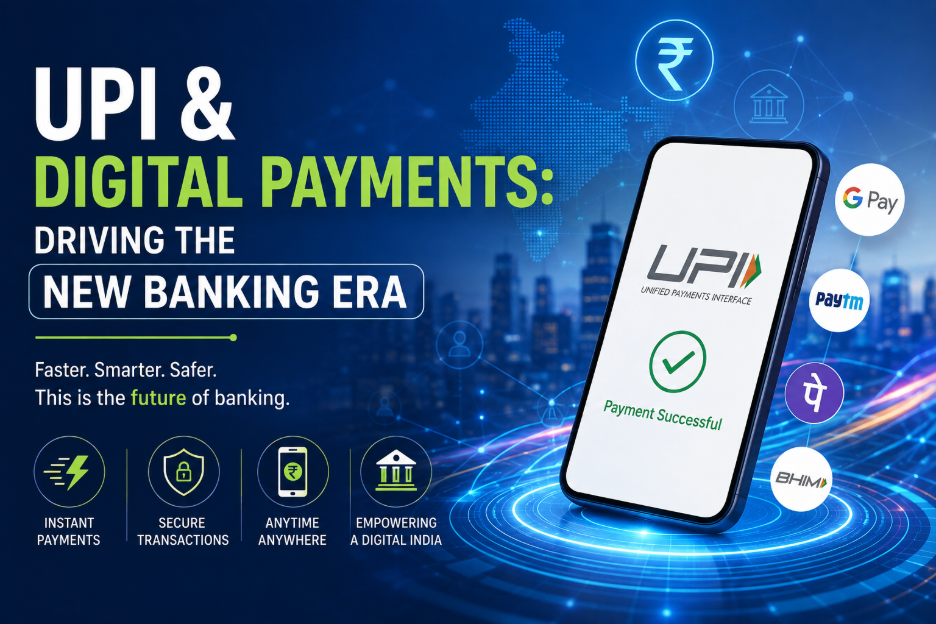
UPI & Digital Payments: Driving the New Banking Era
Introduction
The banking industry is undergoing a radical transformation, and at the heart of this change are digital payments and Unified Payments Interface (UPI). Together, they have revolutionized how money moves: making transactions faster, safer, and more inclusive. From urban professionals to rural entrepreneurs, digital payments have become a cornerstone of India’s financial ecosystem.
This blog explores how UPI and digital payments are shaping the new banking era, their benefits, challenges, and what the future holds.
What Are Digital Payments?
Digital payments refer to any transaction where money is transferred electronically without physical cash. This includes:
- UPI transactions
- Debit/Credit card payments
- Mobile wallets (Paytm, PhonePe)
- Net banking
- QR code-based payments
The goal is simple: convenience, speed, and security.
The Rise of UPI in Digital Payments
Introduced by NPCI in 2016, UPI has become the backbone of India’s digital payment ecosystem. It enables instant, real-time bank-to-bank transfers using a mobile app, eliminating the need for traditional banking hassles.
Key Stats
- UPI accounts for over 80% of retail digital transactions in India.
- In October 2025 alone, UPI processed 20.7 billion transactions worth ₹27.3 lakh crore.
- India contributes 48.5% of global real-time payments, thanks to UPI.
Benefits of Digital Payments
- Convenience: Pay anytime, anywhere, no need for cash or cheques.
- Speed: Instant transfers compared to traditional NEFT or RTGS.
- Security: Multi-layer authentication and encryption.
- Transparency: Digital records help track spending and prevent fraud.
- Financial Inclusion: Even small vendors can accept payments via QR codes.
Example: A tea vendor in a rural town can accept payments via UPI without owning a POS machine, something unimaginable a decade ago.
Impact on Banking & Economy
- Reduced Cash Dependency: Digital payments have lowered cash circulation.
- Boost to Financial Inclusion: Millions of new users now access banking services.
- Rise of Fintech: Apps like PhonePe and Google Pay dominate UPI transactions.
- Global Recognition: UPI is now accepted in countries like Singapore and UAE.
Future of Digital Payments
- Biometric Authentication: Fingerprint and facial recognition for seamless payments.
- Conversational Payments: “Chat and Pay” integrated into messaging apps.
- Credit on UPI: Micro-credit and EMI options embedded in UPI platforms.
- Cross-Border Expansion: UPI aims to be accepted in 20+ countries by 2029.
Challenges
- Cybersecurity Risks: Digital fraud is rising; stronger security is essential.
- Revenue Model: Zero MDR policy strains fintech profitability.
- Digital Literacy: Rural areas need education on safe digital practices.
Actionable Tips for Users
- Enable Security Features: Use UPI PIN, app locks, and transaction limits.
- Diversify Payment Methods: Combine UPI with cards and wallets for flexibility.
- Stay Updated: Explore UPI Lite and Autopay for recurring payments.
- Avoid Overspending: Track expenses using budgeting apps.
Conclusion
Digital payments and UPI have done more than make transactions convenient. they’ve changed the way India thinks about money. What was once a cash-heavy economy is now embracing speed, transparency, and inclusivity. From a street vendor scanning a QR code to a global traveler paying with UPI abroad, this shift is real and visible. The journey isn’t without challenges: security, sustainability, and education remain critical but the direction is clear. India is building a financial ecosystem that’s not just digital, but accessible, affordable, and future-ready. For individuals and businesses alike, adopting these tools isn’t optional anymore, it’s the key to staying relevant in the new banking era.