
Recency Bias in Investing: How Recent Market Returns Distort Long-Term Decisions
What Is Recency Bias in Investing?
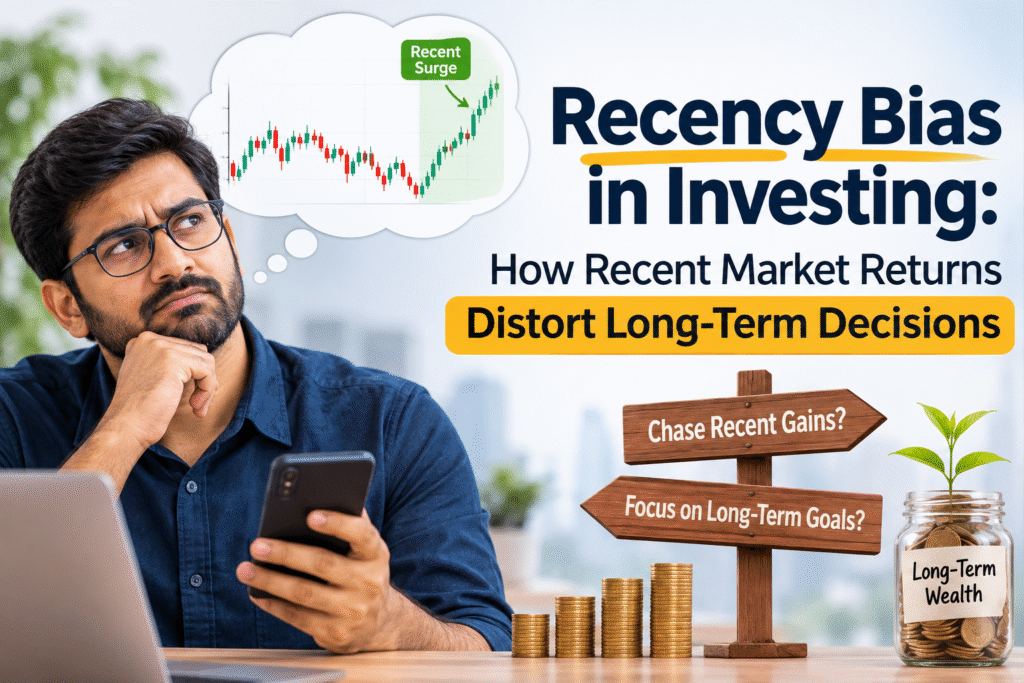
Recency bias in investing is the habit of giving too much weight to recent market events and too little weight to long-term history when making money decisions. If the stock market has gone up for the last twelve months, the investor starts to believe it will keep going up. If it has fallen for the last three months, the investor starts to believe it will keep falling.
In simple words, recency bias means the last thing you saw feels like the most important thing you know.
Recency bias is a well-known concept in behavioural finance, the field that studies how human psychology affects money decisions. It is closely related to the availability heuristic, an idea first described by psychologists Daniel Kahneman and Amos Tversky. People judge how likely something is by how easily examples come to mind. Recent events come to mind very easily, so they feel more likely to repeat.
For Indian retail investors, this shows up every time the Sensex or Nifty 50 makes a big move in either direction.
Why Does Recency Bias Happen?
Our brains are built to learn from what happened lately. In daily life, this works well. If a road was flooded yesterday, it is wise to avoid it today. The stock market does not work that way.
There are a few reasons recency bias is so strong in investing:
- News and social media repeat the latest story. Business channels, YouTube videos and WhatsApp forwards focus on what happened this week, not what happened over twenty years.
- Recent returns are easy to see. Every mutual fund app shows 1-year and 3-year returns on the first screen. Twenty-year returns are harder to find.
- Emotions are stronger than numbers. A fresh loss hurts more than an old gain feels good, so recent losses carry extra weight.
- Friends and family talk about recent winners. Nobody at a family function brings up the fund that quietly did well for fifteen years.
How Recent Market Returns Distort Long-Term Decisions
Long-term investing needs a long-term view. Recency bias pulls investors in the opposite direction. Here are the most common ways it damages returns.
1. Chasing Returns and Buying at the Top
This is the classic example of recency bias. A sector or fund category does very well for a year or two. Money flows in. New investors see the high past returns and buy, usually close to the peak.
India has seen this several times. Small-cap and mid-cap funds attracted huge inflows after strong rallies, and many investors who entered late saw sharp corrections soon after. The same pattern appeared with IT stocks in 2000, infrastructure and real estate funds around 2007 and 2008, and many thematic funds in later years.
Past performance does not guarantee future returns. Mutual fund advertisements say this in small print because it is true. A fund that gave 40% last year is not more likely to give 40% next year. Very often, the reverse happens, because the assets in that fund are now priced higher.
2. Selling in Panic After a Fall
Recency bias works in both directions. When markets fall sharply, the recent pain feels permanent.
In early 2020, the Nifty 50 fell by close to 40% in a matter of weeks during the COVID-19 crash. Many investors stopped their SIPs or sold their holdings at the bottom, sure that things would get worse. The market then recovered quickly and went on to reach new highs. Those who sold locked in their losses and missed the recovery.
The same thing happened after 2008. Investors who left equity mutual funds during the global financial crisis and stayed away for years missed a long and strong bull market.
3. Stopping or Pausing SIPs at the Wrong Time
A Systematic Investment Plan (SIP) is designed to remove emotion from investing. You invest a fixed amount every month, and you buy more units when prices are low and fewer units when prices are high. This is called rupee cost averaging.
Recency bias breaks this system. When the market is falling, many investors stop their SIPs because “the market is going down.” But falling markets are exactly when a SIP buys more units at lower prices. Stopping a SIP in a downturn takes away the biggest benefit of the plan.
4. Assuming the Current Trend Will Last Forever
When markets rise for a long time, investors start to feel that equity returns of 20% or more per year are normal. They raise their expectations, take more risk, and put in more money than they planned.
When markets fall for a long time, the opposite thinking takes over. Investors decide that equity is too risky and move everything to fixed deposits or gold, even when their goal is fifteen years away.
Both views are wrong. Markets move in cycles. Long-term equity returns come from many good years, some average years and a few bad years, all together.
5. Ignoring Asset Allocation
Good asset allocation means holding a mix of equity, debt, gold and other assets based on your goals and risk tolerance. Recency bias pushes people to abandon this plan. After a strong equity year, they put almost everything in equity. After a weak year, they run to debt or gold.
The result is a portfolio that is always built for the last cycle, not the next one.
The Investor Behaviour Gap
Studies of investor behaviour in several countries have found that the average investor often earns less than the funds they invest in. This difference is called the behaviour gap.
The reason is simple. Investors tend to put more money in after a rise and take money out after a fall. So even if a fund gives a good return over ten years, the investor who jumped in and out at the wrong times may earn much less from the same fund.
Recency bias is one of the main causes of this gap.
Recency Bias Examples in the Indian Market
Here are a few real-life situations where Indian investors commonly show recency bias:
- Buying a small-cap fund only after it appears at the top of a “best funds of the year” list.
- Moving money from a flexi-cap fund to a sectoral fund because the sector gave strong returns in the last six months.
- Stopping a monthly SIP because the portfolio value is lower than it was three months ago.
- Investing a large lump sum in the stock market right after a big rally because “everyone is making money.”
- Selling good stocks in a correction because of scary news headlines.
- Expecting the next three years to look like the last three years when setting a retirement or child education goal.
If any of these sound familiar, you are not alone. Almost every investor has done at least one of these.
How to Avoid Recency Bias in Investing
You cannot remove human psychology, but you can build habits that reduce its effect on your money.
Look at Long-Term Returns, Not Just 1-Year Returns
When you compare mutual funds, check 5-year, 7-year and 10-year returns, and look at how the fund performed in both rising and falling markets. A fund with steady results over many years is usually a better choice than one with a single great year.
Write Down an Investment Plan Before You Start
Write down your goals, your time horizon, your asset allocation and the rules you will follow. For example: “I will invest Rs 15,000 every month through SIP for the next 15 years, and I will not stop it because of a market fall.” A written plan is harder to break during a panic.
Keep Your SIPs Running
Automate your investments and do not touch them during market falls. Over long periods, SIPs that continue through downturns have often given better results than SIPs that were stopped and restarted.
Rebalance Your Portfolio Once a Year
Rebalancing means bringing your portfolio back to your original asset allocation. If equity has grown from 60% to 75% of your portfolio, you sell some equity and add to debt or gold. This forces you to book some profit when markets are high and add to equity when markets are low, which is the opposite of what recency bias tells you to do.
Study Market History
Read about the 1992 market crash, the dot-com bubble of 2000, the global financial crisis of 2008, and the COVID-19 crash of 2020. Each time, the fear felt real and permanent. Each time, markets eventually recovered. Knowing this does not make a downturn painless, but it makes it easier to stay calm.
Check Your Portfolio Less Often
Checking your portfolio every day makes every small move feel important. Reviewing it once every three or six months is enough for most long-term investors.
Limit Financial News and Social Media Tips
News is built to grab attention, not to help you build wealth. Be careful with tips about “the next multibagger” or “the best fund to buy this month.” These are almost always based on recent performance.
Talk to a SEBI-Registered Investment Adviser
A qualified adviser can help you stay on your plan when emotions run high. If you need personal advice, choose a SEBI-registered investment adviser and ask how they are paid.
Recency Bias vs Other Common Investing Biases
Recency bias often works together with other biases:
- Herd mentality: following what everyone else is doing.
- Loss aversion: feeling the pain of a loss more strongly than the joy of an equal gain.
- Confirmation bias: looking only for information that supports what you already believe.
- Overconfidence: believing a few good results prove you have special skill.
- FOMO (fear of missing out): buying because others are making money.
When several of these combine with recency bias, the chance of a poor decision goes up sharply.
Frequently Asked Questions About Recency Bias in Investing
What is recency bias in simple words?
Recency bias is the tendency to believe that what happened recently will keep happening. In investing, it means judging a fund, stock or the whole market by its latest returns and ignoring its long-term record.
What is an example of recency bias in the stock market?
A common example is buying a mutual fund only because it gave the highest return in the last year. Another example is selling all your equity investments after a sharp fall because you expect the fall to continue.
How does recency bias affect long-term investors?
Recency bias makes long-term investors buy high, sell low, pause SIPs at the wrong time and keep changing their asset allocation. All of these reduce long-term returns.
How can I avoid recency bias when investing?
Use a written investment plan, keep your SIPs running, look at long-term fund returns, rebalance once a year, check your portfolio less often and avoid decisions based on news or social media tips.
Should I stop my SIP when the market is falling?
For most long-term goals, no. A falling market lets your SIP buy more units at lower prices. If your financial situation has changed, or you need the money soon, speak with a SEBI-registered investment adviser before making a decision.
Is recency bias the same as herd mentality?
No. Recency bias is about giving too much weight to recent events. Herd mentality is about copying what other people do. They often appear together, but they are different biases.
Do past returns predict future returns?
No. Past performance is not a reliable guide to future returns. Markets, sectors and fund managers go through good and bad phases.
Key Takeaways
- Recency bias in investing means giving too much importance to recent market returns.
- It leads to chasing returns, panic selling, stopped SIPs and poor asset allocation.
- Recent returns are a weak guide to future returns.
- A written plan, regular SIPs, yearly rebalancing and a long-term view are the best defence.
- The aim is not to predict the market. The aim is to stay invested in a sensible plan for long enough for compounding to work.
Final Thoughts
The market will always give you a fresh reason to feel excited or scared. Good investors are not the ones who feel nothing. They are the ones who have a plan and follow it when feelings are strong.
The next time a fund app shows you a big 1-year return, or a headline says the market is crashing, stop and ask one question: “Does this change my goal, my time horizon or my risk capacity?” If the answer is no, your plan should not change either.
Disclaimer: This article is for education only and is not investment advice. Mutual fund investments are subject to market risks. Please read all scheme-related documents carefully, and consult a SEBI-registered investment adviser before making investment decisions.
Be Part of Something Bigger!
Whether you’re exploring new ideas, learning something new, or looking for opportunities, Enigma Community brings you closer to a world of possibilities.
Join Us: https://www.enigmacommunity.com/